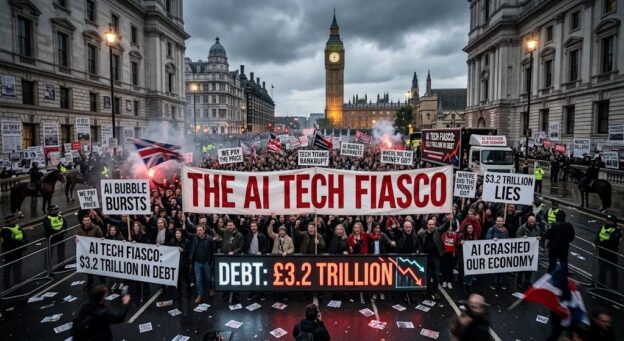
Every bubble has a number that makes people nervous. For the AI boom, that number is $3 trillion. That’s roughly how much the biggest tech companies have signed up to pay for AI data centers, chips and computing power, and almost none of it shows up as debt on their balance sheets. Here are the official warning signs, in plain English: what the money is, who owes it to whom, when it comes due and who might end up paying.
What KBRA found
On August 26, 2026, the credit rating agency KBRA published a report called “AI Credit: Off to the Races.” It looked at what it calls the AI-7: Meta, Amazon, Alphabet (Google), Microsoft, NVIDIA, Broadcom and Oracle.
- Their AI capital spending more than doubled, from about $243 billion at the end of 2024 to $574 billion through June 2026.
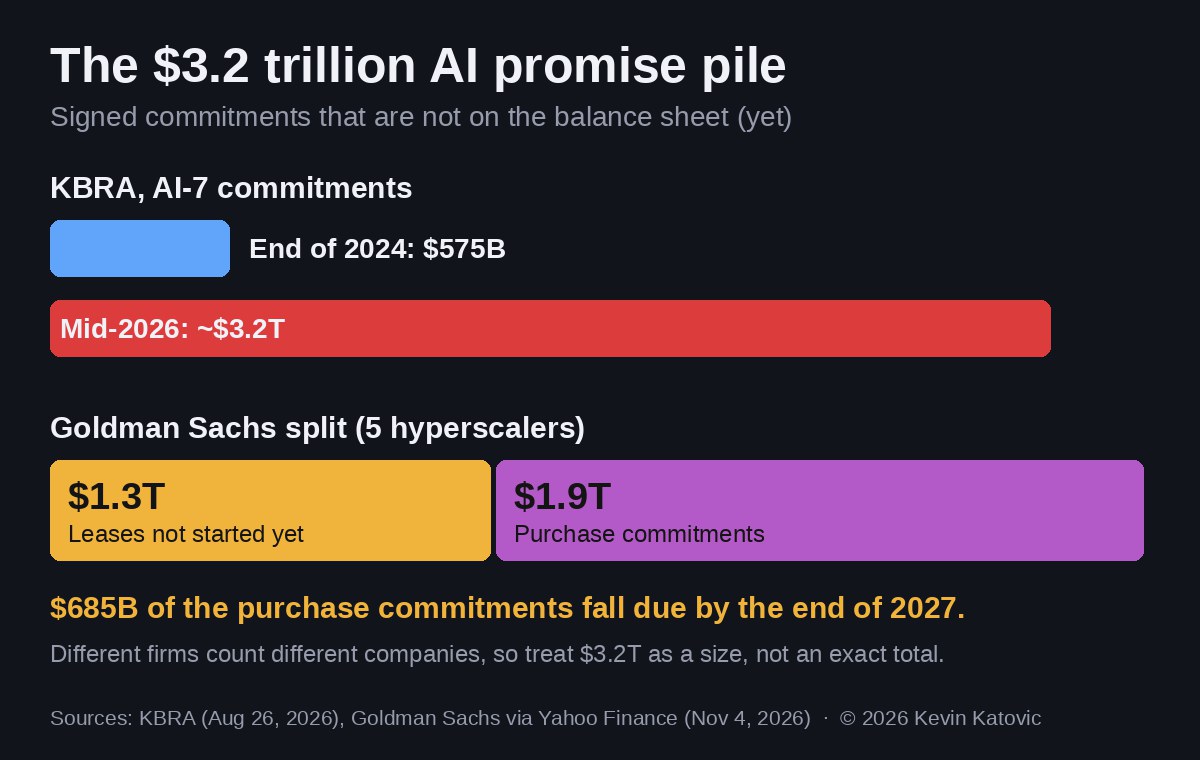
- Their contractual commitments and maximum contingent support jumped from $575 billion to about $3.2 trillion over the same stretch.
- Six of the seven still have low leverage on the traditional measure (below 1.5 times), but KBRA warned that the commitments are “reducing future financial flexibility.”
In November, two more teams landed on the same rough number. A Goldman Sachs credit note (reported by Yahoo Finance on November 4) counted about $3.2 trillion of off-balance-sheet commitments at Alphabet, Amazon, Meta, Microsoft and Oracle, and Nikkei Asia reported a similar total for the same five companies. They count different companies in different ways, so treat $3.2 trillion as a size, not an exact figure.
Commitments, not debt: how it works
This is the part most people miss. When Microsoft borrows money, the loan shows up as debt right away. But when it signs a 20-year lease on a data center that hasn’t been built yet, nothing goes on the balance sheet until the lease starts, usually when the building is handed over. A purchase order for chips works the same way: it’s recorded when the chips arrive, not when the contract is signed.
So these are promises in writing. They’re legally binding, and they’re disclosed in the footnotes of company filings, but they haven’t turned into debt yet. Goldman’s breakdown:
- About $1.3 trillion in leases that have been signed but haven’t started: data centers, computing infrastructure and other facilities.
- About $1.9 trillion in other purchase commitments: third-party cloud capacity, servers and networking gear, power supply and construction.
- Backstops on top of that: guarantees that only have to be paid if something goes wrong, such as a partner failing to pay.
Who is involved, and where the money goes
The commitments run in a chain. The cloud giants sign leases with data center developers, often financed by private credit. They sign purchase orders with NVIDIA, AMD, Broadcom and the memory makers for chips, and with server makers like Dell and Super Micro, which is why I keep an eye on what the server makers report each quarter. They sign power deals with utilities, and they rent extra capacity from neoclouds like CoreWeave, Nebius and former bitcoin miners such as IREN. Here’s how one of those miners turned itself into an AI landlord.
Some deals are pushed into separate companies so they stay off the books altogether. Meta’s Hyperion data center in Louisiana is the best-known example: according to Nikkei, investment firm Blue Owl owns 80% of the venture and Meta 20%, and the project grew to about $50 billion and 5 gigawatts.
Kalkine’s tally (relayed by others, so take it with salt) puts Alphabet’s commitments at about $1.06 trillion, Meta’s at $866 billion, Microsoft’s at $593 billion, Amazon’s at $453 billion and Oracle’s at $322 billion. Oracle’s figure is close to five times its yearly revenue.
When does it get paid, and with what?
Not all at once. Goldman says $685 billion of the purchase commitments fall due by the end of 2027. The leases run much longer, often 15 to 30 years, so some payments stretch past 2050. As Goldman’s Amanda Lynam put it, the total “will come due over various timelines spanning the next several years, with no weight on their balance sheet in the interim.”
For now, most of it is paid from cash flow. The biggest tech companies still make huge profits. But borrowing is growing fast. In the past few weeks, Microsoft sold $25 billion of bonds (its first US bond sale since 2017), Alphabet sold €6 billion, Oracle sold $10 billion of bonds and $9.9 billion of stock, and Meta is reportedly weighing at least $20 billion more. Oracle’s stock sale is the one to watch: it means share dilution, and existing shareholders own a smaller slice so the company can keep its promises.
Warning sign: circular financing
Here’s where it gets uncomfortable. A lot of AI money goes around in a circle. A chipmaker invests in an AI lab, and the lab uses the money to buy the chipmaker’s chips. A cloud company invests in the same lab, and the lab signs a contract to rent that company’s cloud. Bloomberg has mapped how Microsoft, OpenAI and NVIDIA “keep paying each other.” NVIDIA’s much-hyped $100 billion OpenAI plan was only a letter of intent; it ended up putting about $30 billion into an OpenAI funding round instead.
Defenders, including NVIDIA CEO Jensen Huang, call the “circular” label unfair. They say these deals are back-to-back business, and the demand at the end of the chain is real. Critics compare it to the telecom vendor financing of the late 1990s, which ended badly. Both can be partly right. The risk is that the same dollars get counted as revenue at several companies before any end customer pays for them.
Why the Anthropic IPO is the centre of it
Anthropic, the company behind Claude, set its IPO price range today at $70 to $78 a share, with trading on Nasdaq under ANT reported for November 19. It’s one of the biggest customers on the other end of all those commitments. It burned through a $104 billion net loss in the first nine months of 2026, mostly on computing power.
Look at who’s buying in. Alongside the IPO, AMD, Broadcom, Google, Micron, Microsoft, NVIDIA and TSMC agreed to buy $26 billion of Anthropic shares at the IPO price. Those are mostly the same companies that sell Anthropic its chips, memory and cloud. That’s circular financing, done in public. If the IPO goes well, public investors are effectively helping pay for the compute bills that keep the suppliers’ order books full. If it stumbles, the whole chain feels it. I’ve put all the numbers in this Anthropic IPO guide covering the price, ticker and date.
And the NVIDIA headlines
NVIDIA sits at the top of the chain: almost every commitment ends with an order for its chips. That’s why the latest news matters. On November 8, NVIDIA’s board opened an independent investigation, led by independent directors and outside counsel, into reports that Jensen Huang was targeted by a foreign intelligence effort. The board says it has no reason to believe NVIDIA secrets were compromised and that it has confidence in Huang. Huang has apologised to staff for personal conduct and says he’ll cooperate. Nothing has been proven. Three House committee chairs have asked him to brief them, with November 18 requested, the same day Anthropic is expected to price its shares. Markets hate uncertainty, and that’s a lot of it in one week.
Who actually benefits?
If the boom keeps going, the winners are the suppliers that get paid first: chipmakers, power companies and the builders pouring concrete. If it cracks, the losers are whoever is holding the long-dated promises when demand slows: lessors, private credit funds, and shareholders who get diluted to cover the bills. My rule is simple: follow the cash, not the commitments.
Personally, I’d rather own things where the rules are written into code and anyone can check the books. That’s part of why I like small, transparent projects on public blockchains like Polygon, where every transaction is on-chain. If you’re curious how that network is changing, here’s a plain-English explainer on Polygon 2.0 and the AggLayer. And if you’re planning real AI hardware rather than betting on it, price out a GPU build against real power rates before you sign anything with a 20-year tail.
FAQ
What is the $3.2 trillion in AI commitments?
It is the total of signed contracts that big tech companies have agreed to pay for AI infrastructure but haven’t paid for yet: data center leases that haven’t started, purchase orders for chips, servers, power and construction, cloud capacity deals and guarantees. KBRA put the figure for Meta, Amazon, Alphabet, Microsoft, NVIDIA, Broadcom and Oracle at about $3.2 trillion, up from $575 billion at the end of 2024.
Why aren’t AI commitments counted as debt?
Under the accounting rules, a lease only goes on the balance sheet as a liability when it starts, usually when the building is handed over. Purchase orders are recorded when the goods are delivered. Until then, signed commitments are disclosed only in the footnotes of company filings, even though they are binding.
When will the $3.2 trillion be paid?
Over many years. Goldman Sachs says $685 billion of the purchase commitments fall due by the end of 2027. Data center leases can run 15 to 30 years, so some payments stretch into the 2050s.
How will big tech pay for its AI commitments?
Mostly from cash flow, plus a growing amount of borrowing. Microsoft, Alphabet, Oracle and Meta have all sold or planned large bond deals in 2026, Oracle also sold $9.9 billion of stock, and some projects are funded through outside partners and private credit, such as the Blue Owl and Meta Hyperion data center venture.
Is the AI boom a bubble?
Nobody knows yet. Demand for AI is real and revenue is growing fast, but the commitments are growing faster, some of the money moves in circles between suppliers and customers, and a lot of it depends on a few AI labs raising more money. Those are warning signs, not proof of a crash.
Sources: KBRA, “AI Credit: Off to the Races” (August 26, 2026); Yahoo Finance on Goldman Sachs’ AI commitments note (November 4, 2026); Nikkei Asia and Kalkine figures as relayed by Dev.to (November 2026); Bloomberg, “AI Circular Deals” (2026); NVIDIA Board of Directors statement (November 8, 2026); Anthropic S-1/A Amendment No. 2 and CNBC (November 10, 2026). This is opinion and education, not financial advice.
© 2026 Kevin Katovic, all rights reserved. The featured image is an illustration of an imagined protest, not a real event, and the commitments it refers to are in US dollars and are not debt. To license an image, email support@kevinkatovic.com.