
The Democratic Party has won the 2026 midterm elections. On Tuesday, November 3, 2026, American voters handed Democrats control of the House of Representatives and, by the morning of November 4, enough seats to take back the Senate as well. NBC News, CBS News, CNN and the Associated Press all describe it the same way: a decisive win for Democrats and a clear rebuke of President Donald Trump two years into his second term.
I watched the results come in all night, flipping between NBC, MS NOW and Decision Desk HQ, so this post pulls everything into one place: the US election results so far, the Senate map, which states flipped blue, how Trump reacted, and the plain-English answers to the questions everyone is typing into Google this morning. All numbers are projections as of the morning of November 4, 2026, and I will say so wherever a race is still being counted.

Who won the midterms in 2026? The short answer
- House of Representatives: Democrats passed the 218 seats needed for a majority on election night. MS NOW projects at least 250 Democratic seats and NBC’s Decision Desk projects up to 258, which would be the party’s biggest House majority since 1993.
- Senate: Democrats are projected to flip seven Republican seats and hold about 54 of 100, with Alaska and Mississippi still too close to call. They needed a net gain of four to reach 51.
- Who becomes Speaker: House Democratic Leader Hakeem Jeffries is expected to become Speaker of the House in January. Speaker Mike Johnson has said he will not stay on as the Republican leader, NBC News reports.
- Trump’s reaction: he told The New York Times he would accept the results, but said he was not on the ballot and blamed other Republicans and Fox News coverage.
- When it takes effect: the new Congress is sworn in on January 3, 2027.
So if you are asking “did the Democrats win the midterms?”, “did the Democrats win the House and Senate?” or “who won the election in the USA?”, the answer this morning is yes, Democrats won both chambers of Congress. The presidency was not on the ballot; Donald Trump remains president until January 2029.
2026 US Senate election results
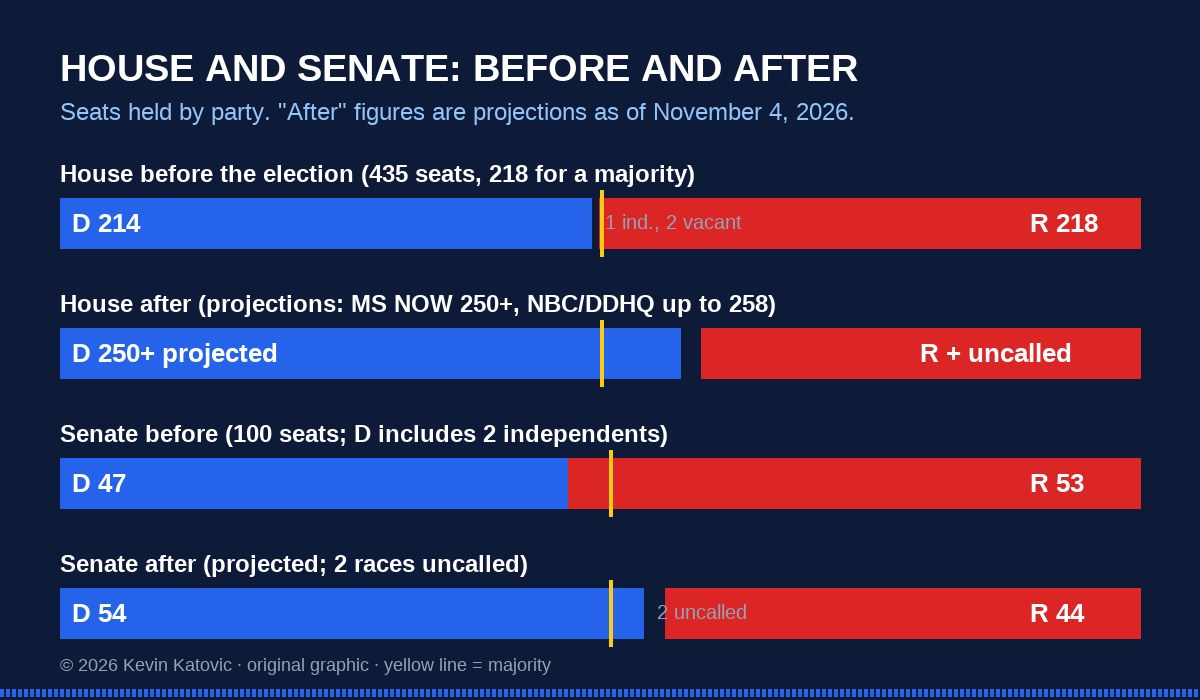
The Senate was the harder climb. Republicans went into election day with a 53–47 majority (the 47 includes two independents, Angus King and Bernie Sanders, who caucus with Democrats). Because Vice President JD Vance breaks ties, Democrats needed 51 seats, a net gain of four. They are projected to have gained seven.
| State | Projected winner | Result |
|---|---|---|
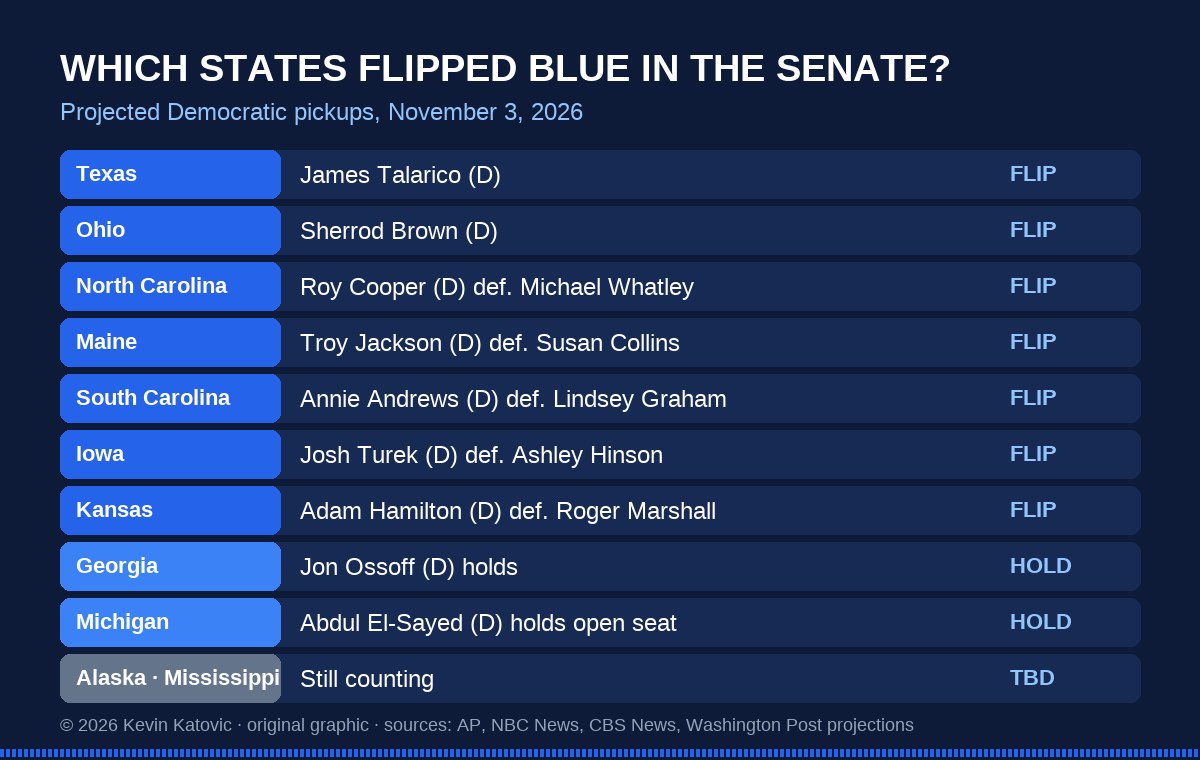
| Texas | James Talarico (D) | Flip to Democrats |
| Ohio (special) | Sherrod Brown (D) | Flip to Democrats |
| North Carolina | Roy Cooper (D) over Michael Whatley (R) | Flip to Democrats |
| Maine | Troy Jackson (D) over Sen. Susan Collins (R) | Flip to Democrats |
| South Carolina | Annie Andrews (D) over Sen. Lindsey Graham (R) | Flip to Democrats |
| Iowa | Josh Turek (D) over Ashley Hinson (R) | Flip to Democrats |
| Kansas | Adam Hamilton (D) over Sen. Roger Marshall (R) | Flip to Democrats |
| Georgia | Sen. Jon Ossoff (D) over Mike Collins (R) | Democratic hold |
| Michigan | Abdul El-Sayed (D) over Mike Rogers (R) | Democratic hold (open seat) |
| Florida (special) | Sen. Ashley Moody (R) | Republican hold |
| Alaska | Too close to call | Counting |
| Mississippi | Scott Colom (D) vs Sen. Cindy Hyde-Smith (R), separated by a few dozen votes | Counting |
A few of these results would have sounded impossible a year ago. Kansas is sending a Democrat to the US Senate for the first time in nearly a century, according to The Washington Post. Maine ended Susan Collins’s long run in the chamber. Roy Cooper becomes North Carolina’s first Democratic senator in almost two decades. And in South Carolina, Lindsey Graham, one of the best-known Republicans in Washington, lost to pediatrician Annie Andrews.
Which states flipped blue?
In the Senate, seven: Texas, Ohio, North Carolina, Maine, South Carolina, Iowa and Kansas. In the House, Democrats gained seats across suburban districts in nearly every region, which is why the projected majority is so large. If Mississippi’s count holds for Scott Colom, that would be an eighth Senate flip.
The Texas midterm elections 2026: Talarico succeeds where Beto fell short
Texas is the result people will talk about for years. State Representative James Talarico flipped the seat, the first Democratic Senate win in Texas in decades. The comparison everyone is making is with Beto O’Rourke, who came within about 2.6 points of Ted Cruz in 2018 and became the face of “Texas is turning blue” talk that never quite arrived. O’Rourke stayed out of this race; Talarico finished the job. It also matters for anyone building in Texas: the state’s grid and power prices for big industrial users are a big reason so much industry is moving there, and that does not change with a new senator.
2026 US House election results
All 435 seats in the US House of Representatives were on the ballot. Before the election, Republicans held 218 seats and Democrats 214, with one independent and two vacancies, so Democrats only needed a handful of pickups. Instead they won a wave.
| Before election | After (projected) | |
|---|---|---|
| Democrats | 214 | 250 or more (MS NOW); up to 258 (NBC / Decision Desk HQ) |
| Republicans | 218 | About 177–185, depending on uncalled races |
| Majority needed | 218 | 218 |
| Speaker | Mike Johnson (R) | Hakeem Jeffries (D), expected |
The exact number is still moving. NBC’s live House results page showed Democrats winning 218 confirmed seats overnight, with its Decision Desk projection at 258. CBC reported 208 seats called for Democrats and 125 for Republicans as of about 1:20 a.m. Eastern, with hundreds still being counted. Whatever the final figure, a gain of 35 to 45 seats is a blue wave by any definition, and some commentators are already calling it a blue tsunami.
Did Trump lose the midterms? Trump’s reaction to the results
Technically Donald Trump was not on the ballot, and that is exactly how he framed it. According to RTÉ and NBC News, Trump said the results were not a judgment on him, argued that Republicans would have won “in a landslide” if he had been running, and shifted blame to other Republicans. Before the results came in he posted a string of angry messages about Fox News’s election coverage. He also told The New York Times that he would accept the results, which ended speculation that he might challenge the outcome.
Voters seem to see it differently. Exit polling cited by NBC’s TODAY found that nearly half of midterm voters said opposition to Trump was one reason for their vote. Historically, the president’s party almost always loses seats in a midterm, but losing both chambers by these margins is a much bigger rebuke than the usual swing.
For the latest Trump news today, the questions are what he does with a Congress that can now block his agenda, launch investigations and hold up his nominees. I wrote about the more dramatic possibilities, including impeachment and the 25th Amendment, before the votes were counted. The short version still stands: winning Congress does not remove a president, and conviction in the Senate needs 67 votes, far more than Democrats will have.
Is Trump a Republican or a Democrat?
It is one of the most-searched questions of the night, so here is the clear answer: Donald Trump is a Republican. He won the presidency as the Republican nominee in 2016 and 2024. The confusion comes from his past. Over the years he was registered as a Republican, then with the Reform Party, then as a Democrat for most of the 2000s, then briefly as an independent, before returning to the Republican Party in 2012. He has led the GOP ever since.
Who is the leader of the Democratic Party?
When a party does not hold the White House, it has no single official leader. Right now the Democratic Party is led by three people in practice:
- Ken Martin, chair of the Democratic National Committee, who runs the party organization.
- Hakeem Jeffries of New York, the House Democratic leader, who is expected to become Speaker of the House on January 3, 2027.
- Chuck Schumer of New York, the Senate Democratic leader. With a Senate majority, Democrats will choose their majority leader when the new Congress organizes. Some Democratic senators had questioned his leadership earlier in 2026, so watch that vote.
Beyond them, a new group of winners, including Talarico, Cooper, Brown and Andrews, will shape what the Democrats do with their majority, and the 2028 presidential race starts the moment the new Congress is sworn in.
What happens now that Democrats won?
This is the question people ask after every midterm, and the answer is less dramatic than election night TV suggests. Here is what actually changes on January 3, 2027:
- Committees change hands. Democrats will chair every House and Senate committee, which gives them subpoena power and control over which bills get hearings.
- Trump’s agenda stalls. Republican bills will no longer pass without Democratic votes. Expect fights over government funding and the debt ceiling.
- Nominations get harder. A Democratic Senate can block or slow Trump’s nominees for cabinet posts, judges and the Federal Reserve.
- Investigations begin. Expect oversight hearings on the administration’s spending, foreign policy and use of executive power.
- Vetoes become the main tool. Trump can still veto Democratic bills, and Democrats do not have the two-thirds needed to override.
Markets noticed too. Stocks rose modestly on election day, mainly on a rebound in technology shares, and Wall Street tends to like divided government because it limits big policy surprises. If you want the market side of the night, here is how Wall Street traded election day, and here is what the Fed chair has been saying about rates and the AI boom, since interest rates matter more to most households than who chairs a committee.
Democrats vs Republicans: what the two parties stand for in 2026
For readers outside the US, or anyone trying to make sense of the “Democrat vs Republican” split, here is the simplest honest summary. The Democratic Party generally favours a larger role for government in health care, climate policy and the social safety net, higher taxes on the wealthy and corporations, and protections for abortion access and voting rights. The Republican Party, often called the GOP (Grand Old Party), generally favours lower taxes, less regulation, tighter immigration enforcement and a smaller federal government, and under Trump it has embraced tariffs and an “America First” foreign policy.
In 2026 the campaigns were mostly about prices, tariffs, health-care costs and Trump himself. Democrats ran on the cost of living and on being a check on the president; Republicans ran on the economy and immigration. The results suggest the cost-of-living message landed, especially in suburbs and in states like Iowa and Kansas where farm communities have felt the tariffs.
What is a midterm election in the US?
A midterm election is the US general election held halfway through a president’s four-year term, always on the Tuesday after the first Monday in November. The president is not on the ballot, but almost everything else is:
- All 435 seats in the House of Representatives, whose members serve two-year terms.
- About a third of the 100-seat Senate. In 2026 that meant 35 Senate seats: 33 regular races plus special elections in Ohio and Florida.
- 36 governors, plus state legislatures, attorneys general, judges, mayors and ballot measures.
House vs Senate: what is the difference?
Congress is made of two chambers. The House of Representatives has 435 voting members, with seats split by population, so California has 52 and Wyoming has one. Members serve two years, and the House starts spending bills and impeachments. The Senate has 100 members, two per state regardless of size, who serve six-year terms. The Senate confirms judges and cabinet members, ratifies treaties and holds impeachment trials. “Congress vs Senate” is a common mix-up: the Senate is part of Congress, together with the House.
Why do some states not have Senate elections in a midterm?
Senators serve staggered six-year terms, so only about a third of seats come up every two years. In 2026, 15 states had no Senate race at all. Every state still voted in the midterms, because every state elects House members, and many also elected governors and state officials. That is why some people in states like California or New York asked “why are some states not voting?” when they did not see a Senate race on their ballot.
How many seats did Democrats need to flip the Senate?
Four. Republicans held 53 seats, and with Vice President Vance able to break 50–50 ties, Democrats needed 51. They are projected to have flipped seven, giving them room to spare even before Alaska and Mississippi are called.
When do polls close, and when will the midterm results be released?
On election day, polls closed at different times across six time zones. The first closed at 6 p.m. Eastern in parts of Indiana and Kentucky, most states closed between 7 and 9 p.m. Eastern, and the last polls in Hawaii and Alaska closed at midnight and 1 a.m. Eastern. That is why the midterm election results time stretches late into the night.
Results are “released” in stages. Networks and the Associated Press call races once the outcome is statistically certain, which for most races happened by Wednesday morning. Close races, especially in states that count mail ballots after election day, can take days or weeks. Each state then certifies its official results, usually by late November or December, and the new Congress is sworn in on January 3, 2027.
Where to follow live election results: NBC, MS NOW, CNN, NYT, Fox and DDHQ
Most people followed the night on one of a handful of sources, and they do not always agree in real time, which is why you saw different seat totals on different channels:
- NBC News uses projections from Decision Desk HQ (DDHQ), and Steve Kornacki’s big board was once again the most-watched part of election night.
- MS NOW, the network formerly known as MSNBC, ran a live blog and its own seat estimates.
- CNN and The New York Times ran live election results maps and needles.
- Fox News live coverage relied on its own Fox News Decision Desk.
- The Associated Press race calls are the standard most newspapers and state officials reference.
If you are looking at a US election map or midterms map this morning, remember that the colours show who is leading or projected, not certified results. A few states will change colour as the last ballots are counted.
2024 election results vs 2026: how fast things changed
Two years ago, in the 2024 presidential election, Donald Trump beat Kamala Harris with 312 electoral votes to 226 and won the popular vote, and Republicans took the Senate and held the House. That made the 2026 midterms the first national test of his second term. A swing from a Republican trifecta to a Democratic Congress in two years is large but not unprecedented: Democrats gained 40 House seats in 2018 during Trump’s first term, and Republicans gained 63 in 2010 under Barack Obama.
Senate races 2026: the stories behind the biggest results
Ohio: Sherrod Brown wins his way back
Sherrod Brown lost his Ohio seat in 2024 and came straight back two years later, winning the special election for the seat JD Vance left when he became vice president. It was one of the most expensive Senate races in Ohio history, and Brown ran almost entirely on prices and jobs, the same message he has used for thirty years.
Maine and North Carolina: two long-awaited flips
Democrats had tried and failed to beat Susan Collins in 2020, when polls showed her losing and she won comfortably. This time Troy Jackson, a former logger and state Senate president, closed the deal. In North Carolina, former two-term governor Roy Cooper beat Michael Whatley, the former Republican National Committee chair, in a race that was considered a toss-up for most of the year.
Iowa and Kansas: the farm-state surprises
Iowa and Kansas were not on most early lists of Democratic targets. In Iowa, Josh Turek won the open seat left by Joni Ernst, beating Republican Representative Ashley Hinson. In Kansas, Adam Hamilton defeated Senator Roger Marshall. Both Democrats campaigned heavily on farm income and the cost of tariffs, and both outperformed the polls.
Georgia, Michigan and the still-uncalled races
Democrats also defended their two most exposed seats. Jon Ossoff held Georgia comfortably over Representative Mike Collins, and Abdul El-Sayed won Michigan’s open seat over former Representative Mike Rogers after a bitter campaign. In Mississippi, Scott Colom and Senator Cindy Hyde-Smith were separated by only a few dozen votes on Wednesday morning, so expect a recount fight. Alaska, where counting always takes longer, is also still open.
Midterm polls vs results: how accurate were the polls?
Going into election day, the forecasters leaned Democratic, but not this far. Decision Desk HQ gave Democrats about an 84% chance of winning the House and about 65% for the Senate, and prediction-market traders priced the Senate near 74%, according to CNBC. Very few public polls showed Democrats winning in Kansas or South Carolina. Like 2018, the late-deciding voters broke heavily against the party in the White House, and the final margins were wider than the polls suggested.
What election is coming up next in the US?
After the midterms, the next regular elections are the 2027 off-year races, including governor elections in Kentucky, Louisiana and Mississippi, plus many city and local contests. The big one is the 2028 presidential election on November 7, 2028, when Donald Trump cannot run again under the 22nd Amendment. Expect candidates from both parties to start announcing within months of the new Congress being sworn in.
What does it mean if Democrats win the midterms? My take
I am writing this from Canada, and for us the US midterms matter mostly through trade, tariffs and the economy. A Democratic Congress does not end Trump’s tariffs on its own, because most of them rest on presidential authority, but it does make new trade fights harder and gives Congress a louder voice in any deal. For anyone building or investing across the border, that is a small step toward more predictability.
The other thing I am watching is the money that keeps flowing into AI and energy infrastructure no matter who wins. Kansas, Iowa and Texas, three of the flipped Senate states, are all places where companies are building huge data centers because of land and electricity costs. If you are curious about what Kansas charges large power users, or want to run your own AI build numbers in a couple of minutes, those numbers do not care about party lines.
Politically, this is a blue wave, and in a few states a blue tsunami. The Democratic Party now has two years to show it can do more than win against Trump. History says the hard part starts on January 3.
Résultats des midterms 2026 en bref
Pour nos lecteurs francophones : lors des élections de mi-mandat aux États-Unis du 3 novembre 2026, le Parti démocrate a remporté la majorité à la Chambre des représentants (au moins 218 sièges, avec des projections de 250 ou plus) et au Sénat (environ 54 sièges sur 100, sept sièges pris aux républicains). Le président Donald Trump, républicain, reste en fonction jusqu’en janvier 2029 et dit accepter les résultats. Le nouveau Congrès siège le 3 janvier 2027.
Frequently asked questions about the 2026 midterm election results
Did the Democrats win the midterms?
Yes. Based on network and Associated Press projections on the morning of November 4, 2026, the Democratic Party won a majority in the House of Representatives and enough Senate seats to take control of the Senate in January 2027. Final seat counts will change as the last races are counted.
Who won the Senate in 2026?
Democrats. They were projected to flip seven Republican-held seats (Texas, Ohio, North Carolina, Maine, South Carolina, Iowa and Kansas) for about 54 seats, with Alaska and Mississippi still counting. A majority is 51.
Did Democrats win the House and Senate?
Yes. Democrats passed the 218 seats needed for a House majority on election night, and projections put them at roughly 250 or more seats. In the Senate they were projected to reach about 54 seats.
Did Trump lose the midterms?
Donald Trump was not on the ballot, but his party lost control of both chambers of Congress, and exit polls found nearly half of voters said opposition to Trump was one reason for their vote. Trump said he would accept the results and argued he was not on the ballot.
Is Donald Trump a Republican or a Democrat?
Donald Trump is a Republican. He was elected president as the Republican nominee in 2016 and 2024. Earlier in his life he was registered at different times as a Republican, a member of the Reform Party, a Democrat and an independent, but he has been a Republican since 2012.
Who is the leader of the Democratic Party?
The Democratic Party has no single official leader while it does not hold the White House. Day to day, its leaders are DNC Chair Ken Martin, House Democratic Leader Hakeem Jeffries, who is expected to become Speaker, and Senate Democratic Leader Chuck Schumer.
How many seats are in the US Senate and House?
The Senate has 100 seats, two per state, and needs 51 for a majority. The House of Representatives has 435 voting seats and needs 218 for a majority.
How many Senate seats were up for election in 2026?
35 Senate seats: 33 regular races plus special elections in Ohio and Florida. All 435 House seats and 36 governorships were also on the ballot.
What is a midterm election?
A midterm election is the US general election held in the middle of a president’s four-year term. Voters elect every member of the House, about a third of the Senate, many governors and thousands of state and local officials.
How many House seats were up for election in 2026?
All 435 voting seats in the House of Representatives were up for election, because every House member serves a two-year term. Democrats needed 218 seats for a majority and passed that number on election night.
Is the blue wave bigger than 2018?
It appears so. In 2018, during Trump’s first term, Democrats gained 40 House seats but lost ground in the Senate. In 2026 they are projected to gain more than 35 House seats and seven Senate seats, winning both chambers at once.
When will the final midterm results be released?
Most races were called on election night or the next morning. Close races can take days, especially where mail ballots are counted late. States certify official results over the following weeks, and the new Congress is sworn in on January 3, 2027.
All results in this post are projections reported by the Associated Press, NBC News and Decision Desk HQ, CBS News, CNN, MS NOW, The Washington Post, CBC and RTÉ as of the morning of November 4, 2026. Uncalled races, final seat totals and certified results may differ. This post is commentary, not an official results source.
Images: all three graphics are original, © 2026 Kevin Katovic, all rights reserved. To license an image, email support@kevinkatovic.com.