
This is a personal essay, not a news report. It is about living in the Comox Valley on about $17,000 a year, about trying harder than almost anyone I know and still getting nowhere, and about a system that seems to reward those still here. It is my opinion and my experience. Where I point to facts, I say where they come from.
One thing I want to get to more quickly is the nearly one year I spent at a tile distributor, working for a boss who was openly and flamboyantly gay and who had a personal relationship with someone he worked with. I tolerated his obviously absurd behaviour for nearly a year, and I guess he could no longer tolerate my ability to put up with his absurdity and his situation. I vividly remember him walking past me, talking about Indians in a racist way, calling them “towel heads” and saying, “Who knows what those fucking towel heads think they’re doing,” right before he fired me.
Apparently none of my books can be bought. I’m sure it doesn’t matter which book of mine it was, and no doubt a criminal publisher is no publisher at all.
Racism is still empowered there in Burnaby for people like my boss from decades ago. If I might be able to legally remind you which has so far failed you might quote me. ” Homosexuality is a Disease of the Mind ”
Starting from the wrong premise
I live in the Comox Valley. People who visit see the mountains, the glacier, the water, the farmland and the nice coffee shops, and they think it must be paradise. For some people it is. For people like me it is a very beautiful place to be stuck.
I live on roughly $17,000 a year. That is not a typo and it is not a lifestyle choice. It is what the system decided I am worth, and every month it is spent before it arrives. Rent, food, the phone, the internet, the bank’s interest, and whatever is left over goes into the ideas I keep hoping will finally break through. Like $SCR software, TakeDown Service Subscriptions, SCR token purchases or NFT purchases you know typical ridiculousness that seemed to work for my friend there in Burnaby adding to if you can’t beat them join them. Perhaps that’s the problem someone finally found a way to beat them.
And I do have ideas. A lot of them. I have built websites, tools, calculators and whole projects from nothing, on my own time and with my own money, without investors, without a grant, without a mentor and without anybody returning a phone call. I teach myself things that people with university degrees and six-figure salaries tell me are too complicated. I read the filings. I do the math. I build the thing. And then nothing happens, because nothing in this system is designed to let a person like me get from “good idea” to “paid for it”.
That is the part I want to explain, because I don’t think it is bad luck and I don’t think it is only me. I think the premise is broken from the beginning. The whole structure starts from a lie, and once you start from a lie, everything you build on top of it is a lie too, just a more polished one.
Here is the lie: that what people say they have is what they actually have. That the house is theirs, that the business is profitable, that the title on the door means the person behind it earned it. In my experience almost none of that is true. The house belongs to the bank. The business runs on a line of credit. The title was handed down, or traded for or a continual line of defrauded investors might be paying the bills, or given to the person who was easiest to get along with. Everybody knows this, and almost nobody says it out loud, because saying it out loud would mean admitting that the scoreboard is fake.
Fractional truth and the debt that holds it up
Most of what the people in charge say has some truth in it. That is what makes it work. A politician says the economy is growing, and technically it is, if you average the person who made a million dollars in the stock market with the person who made $17,000 on disability. A company says revenue is up, and technically it is, while it quietly loses billions. A neighbour says business is great, and technically it might be, because the bank just extended the line of credit again.
I call this fractional truth. It is ten percent fact and ninety percent presentation, and the whole economy is held together by it. What really holds it up is debt. Debt lets people look richer than they are. Debt lets a business look healthier than it is. Debt lets a government spend money it doesn’t have and call it investment. And debt does not care where the payments come from. The bank does not ask whether the money that pays down your mortgage was earned honestly or not. It only asks whether the payment cleared.
That is the part that bothers me most. A system that will accept any income of any kind, from anybody, as long as the payment clears, is a system that rewards whoever is most willing to bend the rules. Some of the money going around this valley is earned honestly. Some of it is cash work that never sees a tax form. Some of it is family money passed down with nobody asking where it came from three generations ago. Some of it is borrowed against something that was itself borrowed. The bank takes all of it. The system keeps running. And the person who plays it straight, files everything, discloses everything and borrows nothing he can’t explain is the one who never gets ahead.
In the Comox Valley you can see this clearly because it is small. You can watch the same families, the same contractors, the same real-estate names and the same people on the same boards circle around each other for decades. The money doesn’t really grow. It moves in a circle between the same hands, and every time it passes through the circle a little more of it sticks to the people already holding it. You might also be fascinated with who would pay for 800 or more acres and continue to pay property tax on it yet ” Infrastructure ” is what is all that the city I assume is doing itself sewer, telecom, all the shit in the ground etc, power lines and you do this for 30 years? So obviously I’m smart enough to read the 30 million in taxes that weren’t paid was fraud and that’s the problem I am having all these shit heads keep being above the law because money laundering is obviously going on so I assume the government of canada owns it all. Meanwhile the rest of us are told that if we work hard enough we can get in. We can’t. The circle is closed. It was closed before we got here.
Why the mediocre keep getting empowered
I am going to say something that people in a small town are not supposed to say. A lot of the people who get ahead here are not especially smart, not especially hard-working and not especially generous. They are comfortable, they are agreeable and they are connected. They don’t ask hard questions, and they don’t make anybody else feel uncomfortable by having ideas that are bigger than the room.
That is not an accident. Systems built on fractional truth need people who will go along with it. A genuinely curious person is dangerous to that kind of system, because a curious person checks the numbers. A person who builds things from scratch is dangerous too, because he proves it can be done without the gatekeepers. So the system quietly selects for the opposite. It promotes the person who will sign off on the report without reading it. It funds the project that looks like every other project. It gives the grant to the group that already got the grant last year.
That is what I mean by self-defined mediocrity. Nobody wakes up wanting to be mediocre. But if mediocrity is what gets rewarded, people learn very quickly to define themselves by it. They learn to call it being a team player, or being reasonable, or being realistic. And then, when someone shows up with something genuinely new, the mediocre are the first to tell him it won’t work. Not because they checked. Because it would be embarrassing for them if it did.
Mediocrity might be the real enemy of genius. Not stupidity: stupid people at least know they don’t know. Mediocrity is worse because it is confident. It sits on the committee, it controls the budget, it decides who gets the call back, and it is absolutely sure it is being fair.
Selfishness is part of it too. A lot of people here have theirs, and they have made it very clear they don’t intend to share. They will vote against anything that might raise their taxes, block anything that might lower their property value and ignore anybody who might need something from them. That is not a crime. It is legal, it is normal and it is everywhere. But it means that a person in my position has no ladder. Every rung has someone standing on it, and none of them are moving.
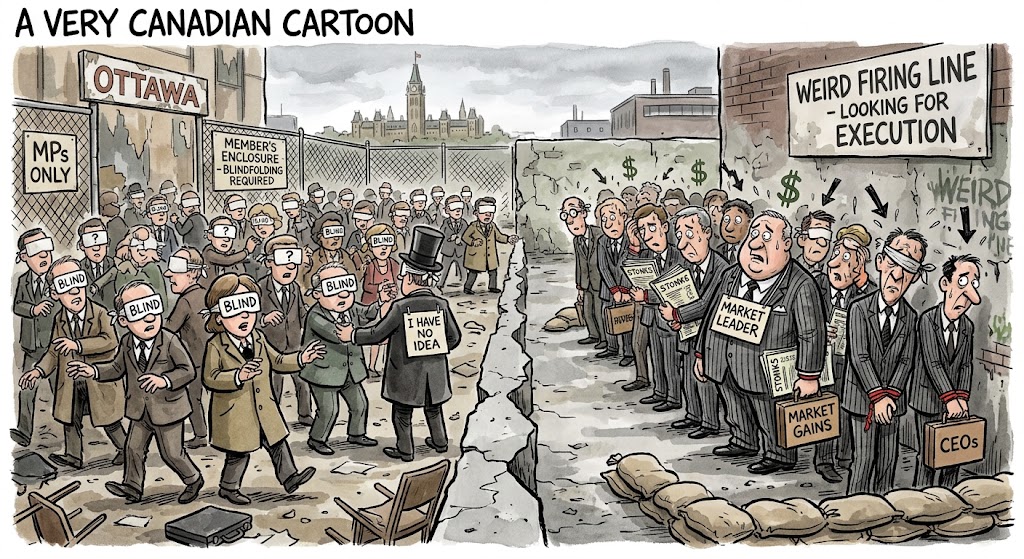 Where the wealth actually gathers
When people talk about unfairness they usually wave their hands. I want to be more specific, because some of this is provable.
Wealth does not spread out evenly. It gathers in very predictable places: in property owned before prices exploded, in pension plans and investment accounts that compound for people who already had money, in boardrooms and executive offices, and in family inheritances. And it gathers among very predictable people. For most of modern history, banks, boards, land titles and family estates in this country were run by and passed between men. That is not an opinion; it is the history of who was legally allowed to own property, open accounts and sit on boards. The leadership of Canada’s big banks and the boards of its biggest companies are still mostly men today. The public reporting on bank leadership and board diversity shows it every year.
At the same time, the people struggling at the bottom aren’t one gender either. Plenty of men like me are on disability, working seasonal jobs or living alone on almost nothing, and plenty of women are raising kids on wages that don’t cover rent. So I don’t think the honest version of this argument is “one gender is greedy”. The honest version is that wealth gathers in old networks, those networks were built for a narrow group of people, and the people inside them are very good at keeping the door shut. Whether the person at the door is a man or a woman, the rule is the same: it gathers, it protects itself and it does not share.
If you have never been inside one of those networks, you can tell where they are by where the money never leaves. Look at who owns the waterfront. Look at who sits on the hospital foundation, the golf club board and the regional district. Look at whose kids get the summer jobs. Look at who gets the contracts. It is a remarkably short list, and it has been a short list for a very long time.
Why I don’t like writing about my own life
I want to be honest about something. I don’t like writing posts like this. Every time I share more about my life, it seems to come back to hurt me. I tell a bank about my situation, and it becomes a note on my file. I tell an agency about my income, and it becomes a reason to say no. I tell people what I am building, and they either copy it or decide I am too ambitious for my own good. The more I explain myself, the less anybody seems to want to help.
So it costs me something to write this. It costs me privacy, and it costs me the small amount of dignity that comes from not letting people see how hard it is. But I have decided that keeping quiet costs more. Keeping quiet is exactly what the system counts on.
The theft, the bank and the police
In 2025 I lost money to crypto scammers. My troubles started in February 2025 and got far worse that July, when a fake “recovery” outfit that advertised on Facebook and pretended to be a Toronto law firm convinced me it could get back what I had already lost. It took the money I had, and money I had borrowed on a bank line of credit, and moved it through a chain of crypto wallets into a large exchange. I have the transaction records. I have the wallet addresses. I have the invoices the scammers sent. I traced the money myself, on the public blockchain, all the way to the exchange.
I reported it. I went to the bank. I went to the RCMP. I filed with the Canadian Anti-Fraud Centre, the BC Ombudsperson and the bank’s complaints office, and I am still going. And here is what happened: nobody has refunded a cent. The bank treats the debt as mine and has sent it to collections. ITs just so clear to everyone even if your a complete idiot that’s the point they are attacking me personally every attempt I make to use law correctly or earn money in any way because they indeed are corrupt criminals in charge somehow. The people who could have frozen the money, identified the account holder or flagged the transfers either didn’t, or haven’t told me. The scammers are still out there advertising to the next person. Facebook, Google all keep running there global scams forever unchecked or stopped because this is the childish game they play.
The police part is the one that still makes me angry. When I called the local RCMP, I was told it was a civil matter and that I should deal with it myself when it was obviously a crime and they refused to do there job which in minutes I could lead them to the bybit enforcement trace screen. I recorded that call. Because I followed that advice, I lost time I could not get back, and by the time I learned that what happened to me was a crime under the Criminal Code and should have been investigated as one, I was past a deadline for complaining about how the police had handled it. In my view, being told by police that fraud is “civil” is not just incompetence. It is a failure of the most basic duty they have, and it kept me from getting my evidence in front of the right people in time. I have formally complained about it, and that complaint is still open.
I will say this as plainly as I can: I was the victim of a crime, I did everything a victim is told to do, and every institution I went to found a reason why it wasn’t their job. That is not a system that protects people. That is a system that protects itself.
If you have been targeted the same way, check before you pay anybody who promises to “recover” crypto. I have written about how these schemes work on a free scam website checker, and there is a practical guide to getting fake sites and phishing pages taken down. Neither of those will get your money back. Nothing I tried did. But they might stop you from losing it twice.
An unfair system that goes back centuries
None of this is new. What I am describing is very old, and it has always worked the same way.
For most of history, the people who handled money were the people who knew things about everybody else. The medieval money-changer at the market knew who was in debt and who was about to sell land. The goldsmiths who held other people’s gold in the 1600s noticed that most people never came to collect it all at once, so they lent out what wasn’t theirs and kept the interest. That is where fractional-reserve banking comes from: lending out money that is really somebody else’s, on the bet that not everyone will ask for it back at the same time. The whole modern banking system grew from that idea.
And the people who sat at the counting table always had an advantage. They saw the flows. They knew which merchant was struggling before the merchant’s friends did. They knew which family was about to lose its land. They could lend on bad terms to the desperate and good terms to their friends. That was not a bug in the system; it was the business model. Information about other people’s money was itself a kind of money.
The people who can look you up
Today the counting table is a computer screen, and the question is the same: who can see your money, and what do they do with what they see?
Inside any bank, a lot of people can look up a client. Tellers, branch staff, loan officers, call-centre workers, fraud teams, collections. Banks say access is controlled and logged, and in Canada privacy law says your information can only be used for the purpose it was collected for. I believe most staff follow the rules most of the time. But I have also read enough news stories about employees caught snooping on accounts of exes, neighbours and celebrities to know that it happens. And in a small community, the risk is worse, because the person who can see your account may be someone who knows you, your family, or your business, or who is competing with you.
My suspicion is that it still goes on, quietly. Not always as theft. Sometimes just as knowledge: who is behind on payments, who just got an inheritance, who just made a large deposit, who is selling, who is desperate. In a place like the Comox Valley, where everybody knows everybody, that kind of knowledge is worth a lot. It decides who gets the good deal on a house, who gets offered the job and who gets quietly frozen out.
In theory, a bank should only know what it needs to know at the moment you are standing at the teller. You walk up, you do your business, and the person in front of you should only see what that transaction needs. If every service were an electronic exchange through remote machines, with no local staff able to browse your history, you could in theory shut the human snooping out almost completely. The technology to do that exists. Whether it is actually done depends entirely on each bank’s systems, policies and culture, and on how seriously it audits its own staff.
Which banks protect privacy best? My speculation
I want to be careful here, because I don’t have inside information about any bank’s internal controls, and nobody outside a bank really does. What follows is my speculation, based on how these institutions are structured, not proof about any of them.
Online-only banks with no local branches are, in my view, the most private from the people around you. If there is no branch in your town, there is no local teller who knows your face, your family or your business. The staff who can see your account are in a call centre somewhere else and have no reason to care who you are. They still see everything, and all of it is still logged and reported where the law requires, but the gossip risk drops close to zero.
Big national banks generally have serious access logging and audit teams, because they are heavily regulated and have the most to lose from a scandal. But they also have the most staff, the most branches and the most people who can look you up, including in your own town.
Small local credit unions are where I would be most careful. They often do good work for their communities, and their people are friendly. But in a small town, the person who can see your account might be your neighbour, your ex, your landlord’s cousin or your competitor’s wife. Friendliness and privacy are not the same thing.
Self-custody, holding your own digital assets in your own wallet, is the only option where no employee looks anything up, because there is no employee. But public blockchains are completely transparent: anybody can see the transactions, they just can’t easily see who you are. And the moment you move between your wallet and a regulated exchange or bank, you are back in the system. I wrote a plain-language guide to self-custody wallets and buying a token on Polygon because I think people should understand how it works before they trust anybody else with it.
Why it fails on the first large transaction
Even if you choose the most private bank in the country, the privacy probably fails on the first large transaction. That is how it is designed.
In Canada, cash transactions of $10,000 or more get reported to the federal financial-intelligence agency, FINTRAC, and so do transactions anybody at the bank considers suspicious, whatever the amount. Large wires and international transfers are reported too. Banks can freeze accounts, hold funds and ask you to explain where your money came from. The stated reason is fighting money laundering and terrorism, and some of that is real. But think about who it actually catches.
The wealthy have lawyers, accountants, holding companies and trusts. Their big transactions are expected and explained before they happen. The person who finally gets a break, sells something he built, or receives a large payment for the first time in his life is the one who gets the hold, the phone call, the form, the delay and the suspicion. The system that never noticed the scammers draining my line of credit would notice immediately if I ever made real money.
That is what I mean when I say the system is designed to stop people from earning much like myself that would undeniably deserve more than any higher paid person literally examining me where they the fraud legitimately is because there in power and undeserving seeking me out who is more talented again empowering these pieces of shit looking for my real money and it continues to go on. Not because there is a conspiracy in a back room. Because every layer of it, from the rules on large transactions to the interest rates to the fees to the credit scores, was built by people who already had money, to protect people who already have money. When the outsider tries to move up, the machine reads it as a threat. When the insider does the same thing, the machine calls it business as usual.
Spreading thin: why pooling from the many fails
Here is the part that makes me call it hypocrisy.
The whole system runs on taking small amounts from a great many people and pooling them for a few. A fee here, interest there, a tax, a service charge, a monthly subscription, a few cents on every share trade. Each amount is small enough that nobody fights it. Together they add up to fortunes. That is how banks make money, how governments fund themselves, how asset managers get rich and how the stock market rewards the people already in it.
The same people who live off that trickle are the first to tell the rest of us to be responsible, to budget, to stop expecting handouts. They lecture people on $17,000 a year about personal responsibility while they collect a small cut of everybody’s paycheque. They say things are bigger and better than they are, because confidence is what keeps the money flowing in. Politicians do it with the economy. Executives do it with their companies. Public markets do it every quarter. I have watched companies lose tens of billions of dollars and still be worth more every month, because the story is better than the numbers. I have been tracking one of those stories in detail, a possible record-setting AI listing on the public market, where the losses are measured in tens of billions and the valuation talk is in the trillions.
That is why my title asks whether the people in charge are self-defined mediocrities or hypocrites in training. I think most of them start out as the first and turn into the second. They start out average, they get rewarded for being agreeable, and by the time they are in power they have learned to say one thing and live another. They preach saving while they borrow. They preach hard work while they earn from other people’s work. They preach fairness from inside a system they know is unfair, and they take their small cut of everybody, forever to continue to power a unbelievable lie perhaps the irony of the 864 acres in Union Bay, BC Canada.
And the strange thing is that pooling small amounts from the many is exactly why this fails. A system that only works by taking a little from everybody can never let everybody get ahead, because then there would be nobody left to take from. It needs a permanent bottom. It needs people like me.
Why do you keep attacking me?
Sometimes it feels personal. It feels like the whole thing is watching me and pushing back every time I try. I build something, and it gets ignored. I report a crime, and I’m told it’s my problem. I ask for help, and I’m told I don’t qualify. I make a little progress, and the next bill takes it.
Meanwhile I look at the people at the top: the ones who play golf on a Tuesday afternoon, sit courtside at basketball games and make millions a year from investments, endorsements and owning the right things. I’m not saying any one of them knows my name. They don’t have to. The system works for them automatically, the way it works against me automatically. I study astrophysics, artificial intelligence, blockchain and markets in my spare time, for free, because I find them fascinating, and nobody pays me a cent for any of it. They tee off.
And I have to ask: how many cowards hide behind people like me? How many people know the system is rigged, benefit from it quietly, and let the person at the bottom take the blame for being poor? How many people are kept comfortable by the very structure that keeps me stuck, and would rather not think about it?
Those who can’t, teach
There is an old saying: those who can, do; those who can’t, teach. I used to think it was unfair to teachers. Now I think it describes something real about how power works, and my own work history is a good example.
I have done real work my whole life. I drove a Class 4 forklift at a national freight terminal in Edmonton, unloading scheduled runs against the clock and re-weighing freight so the billing was right and I really admired Mike Buckley and agreed in the moment it was just impossible to do better than this. I ran a Raymond reach truck in warehouses in Delta and Burnaby, putting freight into five-level racking. I picked orders in a freezer at a vegetable warehouse. I managed a warehouse for an electronics chain in Calgary: inventory control, scheduling, returns, warranty repairs and supervising staff. I was a service writer at a truck dealership, opening work orders and running payments. I opened a new branch for an industrial supplier in Courtenay, set up the shelving and the first stock myself, and ran inventory and inside sales. I drove a tow truck on this island, doing roadside assistance and accident recovery, including calls for the RCMP and ICBC some agents which were also noticeably corrupt tried even starting a fake claim against my insurance for a made up accident to there property fence in Buckley Bay. I did bodywork, priming, painting and glass. I detailed cars. I ran my own small business for more than two years.
The job I loved most was receiving manager at a tile distributor in Burnaby. For about a year I unloaded pup trailer after pup trailer, stacked pallets of stone, ceramic and slate five levels high with a Raymond reach truck, received the daily containers, put every pallet where the computer said it was, and loaded customers’ vehicles. It was hard, physical, precise work, and I was good at it. I looked forward to going in.
Then it ended, and the way it ended taught me a lot about who gets to decide things. A few days before I was let go, my boss said to me, in these exact words: “Who knows what those fucking towel heads think they’re doing.” He was talking about Indian people. I have never forgotten it. This was the man who held my job in his hands: someone who openly sneered at an entire group of people because of where they came from, and whose own personal relationships inside the company never seemed to count against him. A few days later he fired me. I got about two weeks’ severance and had to start over looking for work.
That is the irony I keep coming back to. The person judging me again whether I was good enough was the one person in the building openly showing contempt for others. Nobody checked his attitude or his judgment. Nobody asked whether the favourites around him had earned their place. The system simply trusted the person with the title, and the person who actually did the work walked out with two weeks’ pay. It felt like a role designed to make capable people answer to somebody who was worse at the job and worse as a person, and to make them swallow it.
Every one of those jobs was doing, not talking. Every one of them had a clear result: the truck got loaded or it didn’t, the freight was where the system said or it wasn’t, the car was fixed or it wasn’t. And every one of them had a person above me, often someone who had never done the job, telling me how to do it better.
That is my theory. In this system, the people who can do, do, and the people who can’t, supervise, regulate, approve, fund, lecture and teach. They skip the process of getting to know the work, and they skip the process of getting to know the person doing it most likely because if they were smart private business people they would be earning it that way not on there next government or market scam. They don’t need to understand what I can do, because their job is to decide whether I am allowed to do it. And because they never learned the work, they can’t recognise when someone is genuinely better at it than they are. So they fall back on the only thing they understand: whether the person is agreeable, familiar and safe. That is how mediocrity keeps choosing itself.
I am not saying I am smarter than everybody I just obviously am. I am saying I have been tested by real work in a way most of the people judging me never have because again its my own skill and high standards that you probably will never meet forget trying to exceed it, and I have taught myself things most of them never will. That should count for something. In this system it doesn’t.
What would actually help
I don’t want this to be only a complaint, so here is what I think would actually change things, at least here. Besides the obvious billionaire I deserve to be so buy 1 billion $SCR tokens we will work this out later. You bastards haven’t given me anything in 17 years why not start for real and stop being punks in government and or a public company. Obviously if you were half as smart for me you would know its the quiet successful private companies we should be keeping a eye on not the EASY TO SEE shit disturbers that make fuck all, as I have been described in the past expecting someone to at least be able to live up to maybe a fraction of my ethics. Only fail and continue there pathetic fraudulent 72,000 or more a year job. Like I said I’m dying to become a hypocrite hurry up by those tokens.
- Treat fraud as fraud. When someone reports a crypto or investment scam, the police should take the report as a criminal matter, give a file number and tell the person their options in writing. Nobody should lose their rights because an officer on the phone called it “civil”. The rcmp don’t don’t decide whats a crime yet in your laughable government they obviously do. So try not to use criminal force again eh? Your absurd already why not show up with military this time at my door.
- Make banks share the loss when their systems fail. If a bank lets a customer drain a credit line into a known scam pattern without a warning or a hold, it should carry some of that loss, not just send it to collections.
- Lock down who can look you up. Every bank should limit local staff access to the transaction in front of them, log every lookup and tell customers, on request, who viewed their account and why.
- Back builders, not connections. Local grants and economic-development money should go to people with working prototypes and real results, judged by people who understand the work, not to whoever got it last year.
- Stop punishing the first big win. Compliance checks on large transactions should come with clear timelines and a real person to talk to, so the outsider who finally makes money isn’t treated as a criminal for it.
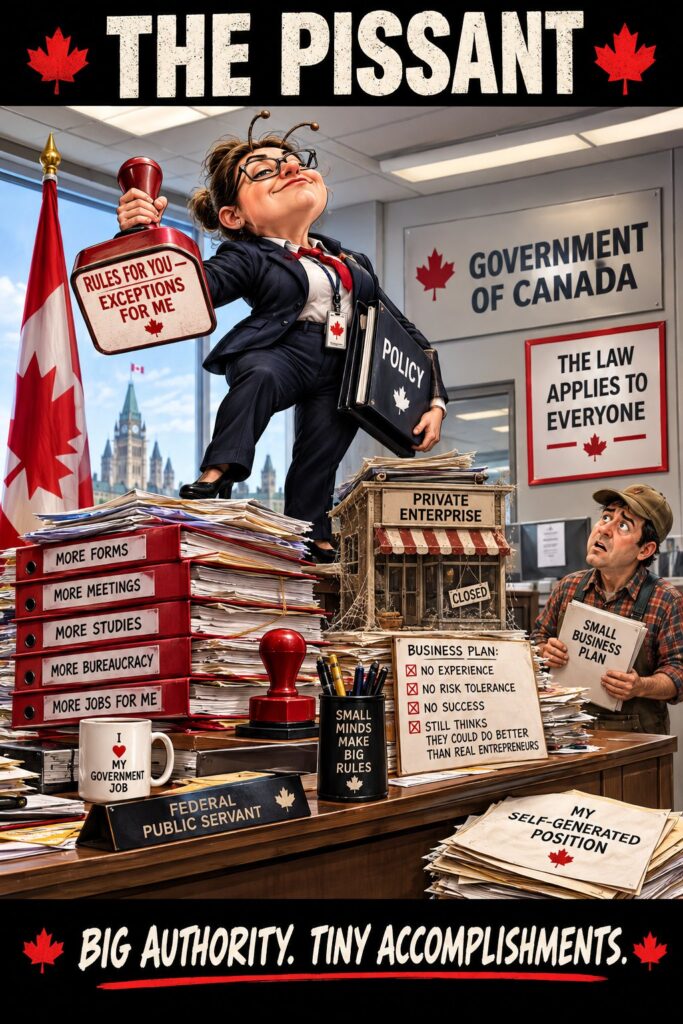
AI-generated satirical illustration; fictional character
None of these are radical. Most of them already exist somewhere stop being a obvious thorn in my side and pissant. They just don’t exist for people like me, here.
Why I keep building anyway
So why do I keep going? Because the alternative is to become one of them: to stop asking questions, stop building and accept the fractional truth as the whole truth. I won’t do that.
I keep building because the work is real even when the reward isn’t. The tools I make work. The research I do is accurate. The AI data center build configurator I built from scratch prices real projects with real numbers, and I built it without a single dollar of outside money. That is the kind of thing this system says a person on $17,000 a year can’t do. I did it anyway.
If you are reading this from the Comox Valley, or from any small place where the same names keep winning, I want you to know it is not just you. You are not lazy, stupid or imagining it. The ladder really is crowded, the circle really is closed, and a lot of the people telling you to climb are standing on your hands.
But the people who can actually do things still matter. Maybe more than ever. Sooner or later fractional truth runs out of fractions. When it does, the people who know how to build will still be here.