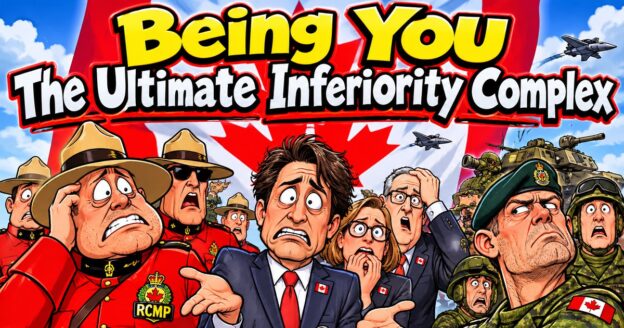
I have a theory, and like all the best theories it came to me while deleting spam. Somewhere out there sit the biggest bank accounts on the planet. Not in the glass towers you see on the news. No. They sit in places you need two connecting flights and a small propeller plane to reach, behind a brass plaque on a building with no actual employees inside. And the people who own those accounts all suffer from the same condition. I call it the Vicious Inferiority Complex.
Doctors have not named it yet. Doctors are busy. So I will. Remember if the grammar and structure and spelling are all perfect chances are you wanted to see me in a state that was flawless human beings aren’t but I guarantee in nearly all waking moments I am infallible and I truly mean that.
Where the world’s biggest bank accounts actually live
Here is the part that is not a joke. Economists who study this, most famously Gabriel Zucman and his colleagues, estimate that roughly a tenth of the entire world’s GDP is parked offshore in tax havens. Trillions of dollars. A lot of it ends up registered in small, sunny, far-from-everything jurisdictions: tiny island territories, little countries with big banking laws, and P.O. boxes that receive more money in a day than the local hospital sees in a decade.
That is my first point. When I say the largest bank accounts are “held in third world countries”, I do not mean the people who live there are rich. Quite the opposite. The locals mostly get the heat, the hurricanes and a nice view of the yachts. The money just uses their address the way a teenager uses a friend’s house to get mail his parents should not see. If you want to see how normal people think about where their money sleeps at night, compare that circus to a sober look at managing wealth without the theatrics.
Symptoms of the Vicious Inferiority Complex
A regular inferiority complex makes you quiet. A vicious one makes you loud. Very loud. Expensively loud. The sufferer has more money than several countries, and still wakes up every morning worried that nobody has thought about him in the last eleven minutes.
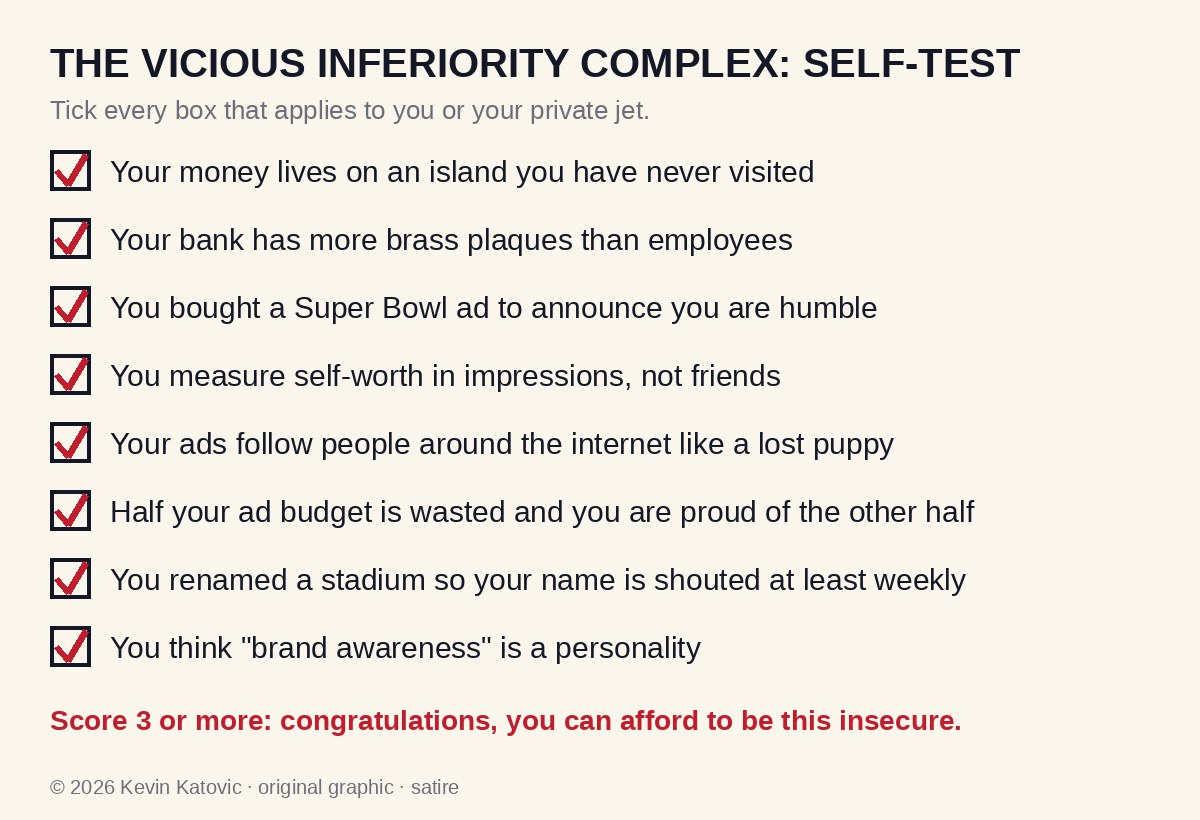
Classic symptoms include:
- Owning a bank account on an island you have never visited, and a yacht you have visited twice.
- Renaming a stadium after yourself so that a crowd of 60,000 strangers shouts your brand every Sunday.
- Buying a Super Bowl ad to tell the world how humble you are.
- Measuring personal worth in “impressions” instead of friends.
- Calling it “thought leadership” when you post a photo of yourself at a conference.
Ordinary insecure people buy a sports car. Insecure people with a trillion dollars buy the entire attention span of the human race.
How they “empower themselves to affect real change”
This is the part of my theory I find genuinely fascinating. The sufferer does not want to change the world by doing anything difficult, like building a hospital or answering an email. He wants to change the world by being seen changing the world. And the fastest way to be seen is to buy it.
So the money comes back from the island, takes a quick bath in a holding company or three, and lands in the most powerful empowerment tool ever invented: advertising. Global ad spending is now estimated at around one trillion US dollars a year, according to the big agency forecasters. One trillion. That is a million million dollars, every year, spent convincing you to feel something about a logo.
Real change, Vicious Inferiority Complex style, looks like this:
- Step 1: Hide the money far away so nobody can count it.
- Step 2: Spend a slice of it everywhere so nobody can ignore you.
- Step 3: Hold a press conference about transparency.
- Step 4: Repeat until knighted.
The trillion-dollar problem: most of those ads do not work
Half the money I spend on advertising is wasted; the trouble is I don’t know which half.
Usually credited to department store pioneer John Wanamaker, more than a hundred years ago
A century later, the half is still missing, and it has grown. A typical online banner ad gets clicked by roughly one person in a thousand who sees it, and many of those clicks are thumbs slipping on phones. Fraud researchers estimate that bots, fake websites and click farms swallow tens of billions of advertising dollars every year. Some of the “people” seeing those ads are servers in a warehouse, watching videos to themselves in the dark. Which, honestly, is the most relatable thing in this whole story.
Then there are the ads you have personally experienced:
- The ad for the vacuum you bought yesterday, which now follows you around the internet for six weeks like a sad puppy.
- The skippable video you skipped so fast it never loaded.
- The sponsored post from a brand that thanks you for your loyalty, which you have never shown.
- The billboard on the highway that you read at 110 km/h and remember only as “something blue”.
Search engines worked this out years ago. Google now openly rewards pages that show real experience and expertise, which is a polite way of saying shouting louder does not make you more right. The Vicious Inferiority Complex has not received that memo. It was sent by email. It went to spam.
Why the theory makes sense to me
I spend a ridiculous amount of time looking at junk. Spam, phishing, fake “Ana” romance lures, crypto recovery scams, offers to rank my website number one by Tuesday. And every one of them is the same pattern at a smaller scale: hidden money, borrowed addresses, and a desperate need for attention that is far more confident than it is effective.
The billionaire with the Vicious Inferiority Complex and the spammer in a rented server room are, I believe, the same personality with different budgets. Both hide where the money really lives. Both blast messages at people who never asked. Both measure success by how many people saw them, not by how many people they actually helped.
A modest cure
If I could prescribe something, it would be this: put the money somewhere you are not embarrassed to say out loud, and spend it on things that do something. Build things that produce value whether or not anybody claps. A data center that heats a greenhouse. A power plant that keeps the lights on. If you are curious what that kind of spending looks like in real numbers, Canada’s AI data center building spree is a better use of capital than most ad campaigns, and you can price out an actual AI server room down to the cooling bill before deciding whether to build one.
And if you insist on holding a reserve of something, at least pick one that cannot be spent on a blimp.
The bottom line
My theory, stated plainly: some of the biggest piles of money on Earth are parked at faraway addresses by people who are, deep down, terrified of being ordinary. They empower themselves the only way they know how, by buying attention by the trillion. Most of that attention bounces off the rest of us like rain off a windshield.
The good news is that the cure for the Vicious Inferiority Complex is free. It is called being useful. The bad news is that nobody has bought an ad for it yet.
Images © 2026 Kevin Katovic. The featured image is an AI-generated satirical illustration, not a real event; no person, police force or military shown is affiliated with or endorses this post. Contact support@kevinkatovic.com to license the images.
I’d love too of course. Didn’t I sign the proper forms at 19 Wing Comox? Your going to love it in Pakistan.

Not sure if its delusional for audio or even if that’s a real word.