Nobody can reliably predict the Polygon crypto price, but you can test predictions against math. POL trades at about $0.0763 with roughly 10.66 billion tokens in circulation, a market cap near $813.6 million. Every price target implies a market cap, and that is the fastest way to tell a reasonable Polygon price prediction from a fantasy.
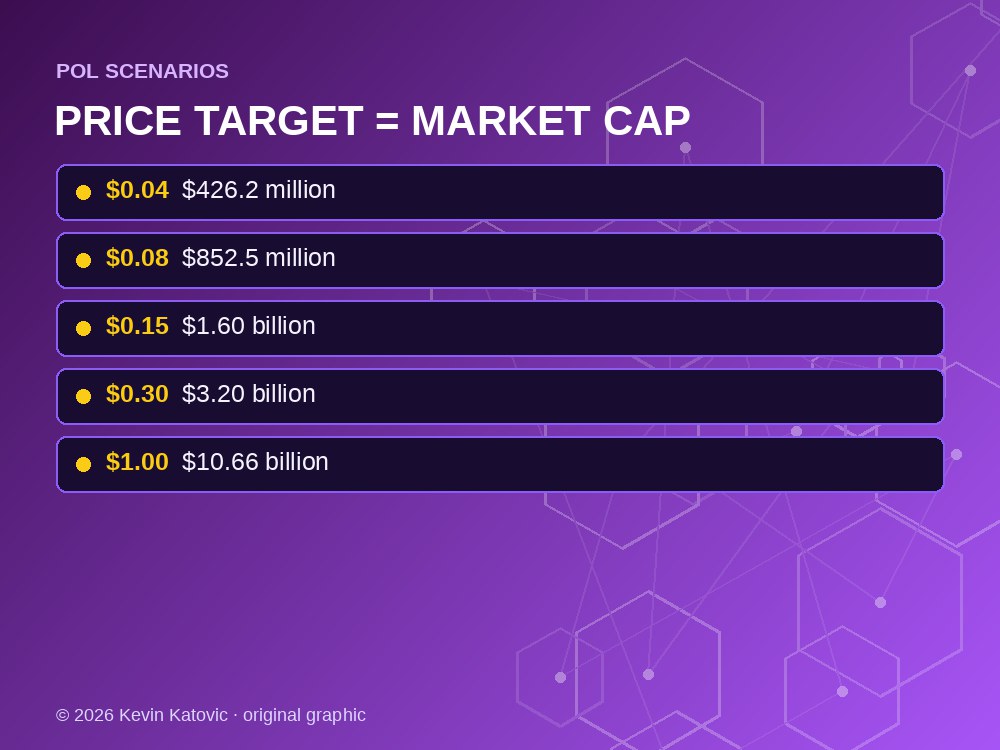
Polygon Price Prediction Scenarios
| Scenario | POL price | Implied market cap | What would have to happen |
|---|---|---|---|
| Bear | $0.04 | $426.2 million | Altcoin market keeps bleeding, emissions add supply |
| Flat | $0.07–0.09 | $745.9 million–$959.0 million | Range-bound, payments growth offsets supply |
| Recovery | $0.15 | $1.60 billion | Crypto rally plus visible stablecoin volume |
| Strong bull | $0.30 | $3.20 billion | Full altcoin season, Polygon back in the top 30 |
| Back to $1 | $1.00 | $10.66 billion | Would need a top-10-sized valuation |
Notice the last row. Getting POL back to $1 would mean a valuation over $10 billion with today’s supply, and supply keeps growing. The old MATIC high of $2.92 would mean roughly $31.12 billion. That is not impossible in crypto, but it is a very different bet from “Polygon goes up a bit”.
What Could Push the Price Up
- A broad crypto bull market led by Bitcoin and Ethereum.
- Real stablecoin and payment volume on Polygon PoS, which raises gas usage and staking demand.
- Agglayer adoption by other chains that choose POL for security.
- Governance reducing or ending new emissions.
What Could Push It Down
- Continued altcoin weakness: POL is already down 44% in a year.
- Supply growth from emissions with no matching demand.
- Competition from other payment chains.
- Controversy, for example over the proposed hard fork to move POL out of blocked addresses.
How to Read Price Predictions Online
Many “Polygon price prediction 2026–2030” pages are generated by algorithms or written to sell you something. Ask three questions: what market cap does the target imply, what is the time frame, and what would need to happen? If a page cannot answer those, ignore it. Diversification matters more than any single call, which is the point of which coins fit a strategic reserve idea. And remember that some Polygon projects are openly for fun; here is what makes a parody NFT a parody.
My own bias is toward things with physical costs I can measure, like building a small crypto data center at home or per-megawatt costs for AI and mining sites. If that is your style too, plug your own assumptions into an AI build model.
Why Most Price Predictions Fail
Crypto prices are driven by sentiment, liquidity and events nobody can schedule, such as exchange failures, regulation and big macro shifts. Models that extrapolate past trends tend to break exactly when they are needed most. Even professional analysts with good data often get crypto badly wrong. That is why a range of scenarios is more useful than one precise target.
A Simple Framework You Can Reuse
- Step 1: pick a target price and multiply it by circulating supply to get the implied market cap.
- Step 2: compare that market cap with tokens that are already that size today.
- Step 3: ask what Polygon would need to achieve to deserve that ranking.
- Step 4: adjust for supply growth over your time frame.
- Step 5: decide how much you could lose if you are wrong, and size your position accordingly.
Supply Growth Changes Long-Term Targets
If POL’s supply keeps growing around 2% a year, in five years there would be roughly 11.8 billion tokens. At that supply, a $0.15 price would imply about $1.76 billion, and $1 about $11.77 billion. The further out a prediction goes, the more supply growth matters.
What Professional Forecasts Usually Ignore
Many published forecasts skip governance risk, the chance that emissions change, and competition from other payment chains. They also rarely account for how thin crypto markets get in a crash. Those blind spots are why I trust scenarios that show their assumptions over neat charts that just draw a line upward.
So, What Is My Polygon Price Prediction?
I do not make one. I watch adoption numbers, the broad market and governance decisions, and I treat any POL position as a high-risk holding that could go to a fraction of today’s price or multiply in a strong bull market.
Signs a Prediction Site Is Not Worth Your Time
- It gives exact prices years ahead with no assumptions shown.
- Every scenario goes up.
- It pushes you to buy through a specific link or bonus code.
- It never mentions supply, competition or risk.
A trustworthy analysis tells you what would make it wrong. If a prediction cannot do that, treat it as marketing.
Use the scenario table as a reality check, not a promise. Today POL is about $0.0763; whether it ends up at $0.04 or $0.40 will depend on things that have not happened yet, and anyone who claims certainty is selling something.
Stay curious, stay sceptical, do your own homework, and size every position for the possibility that you are wrong.
If you would rather take a small, speculative position on Polygon, you can  buy crypto with the SCR Auto-Buy page, which turns POL or any Polygon token into $SCR in one send.
This article is general information, not financial advice. Crypto prices move fast and you can lose money. Check the live price before you buy or sell anything.
Frequently Asked Questions
What is a realistic Polygon price prediction?
There is no reliable forecast. Test any target by multiplying it by about 10.66 billion POL: $0.15 implies roughly $1.60 billion, $1 implies over $10 billion.
Can Polygon reach $1 again?
It would need a market cap above $10 billion at today’s supply, more than 12 times its current value. Possible in a strong bull market, but far from certain.
Will Polygon reach its old high of $2.92?
That would imply a market cap around $31.12 billion with today’s supply, which would put it among the very largest cryptocurrencies.
Is this financial advice?
No. These are scenarios to help you think, not predictions or recommendations.
Images in this post: © 2026 Kevin Katovic · original graphic. © 2026 Kevin Katovic, all rights reserved. To license an image, email support@kevinkatovic.com.