 Every Mad scientist in every movie gets funded eventually. Usually it happens right after a stern man in a suit says “we’re pulling your grant,” and usually it comes from somewhere strange. Real life is less dramatic and has more paperwork. Here is where things stand with the grant, and what happens if it comes through.
Where the Grant Stands
Back in October I wrote about the Compound Grants “Dapps and Ideas Domain” proposal on Questbook for the on-chain licence layer behind the AI Build Configurator. The proposal asks for $43,000 over four milestones, and it is still marked “submitted” with no reviewer decision yet. Nothing has been approved, and nothing has been paid. Good luck with your investigation and remember to pay out the ” EYE BONKER “
The work hasn’t waited for a decision, though. The licence passes are live on Polygon mainnet, and anyone can look up any licence pass on Polygon in a few seconds. If you like reading release notes the way some people read thrillers, there’s also the version-by-version build log.
Step One After Approval: A Sole Proprietorship
If the grant is approved, the money needs somewhere proper to land. The plan is to set up a sole proprietorship in British Columbia right after approval, not before. A sole proprietorship is the simplest business structure in Canada: there’s no separate company, the owner and the business are the same person for tax purposes, and the income goes on a personal return.
The basic checklist looks like this:
- Register a business name with BC Registries, if the business will use a name other than the owner’s own legal name.
- Get a CRA business number, which the bank and the grant paperwork will both ask for.
- Open a separate bank account so grant money never mixes with personal spending.
- Watch the GST small-supplier threshold: registration becomes mandatory once taxable sales pass $30,000 over four consecutive calendar quarters.
- Report business income and expenses on form T2125 with the personal tax return, where the six-digit industry code goes.
What NAICS 513210 Means
That industry code comes from NAICS, the North American Industry Classification System that Canada, the United States and Mexico share. Code 513210 is “Software Publishers”: businesses that design, develop and publish software, and that sell or licence it to others. The 2022 revision moved software publishing into its own spot in the 513 publishing group, so you will still see the old code 511210 in older guides.
It’s the right fit here because the product is licensed software: an annual licence for a configurator widget, with each licence recorded as a pass on the blockchain. It isn’t custom programming for a single client, which falls under a different code, and it isn’t a crypto exchange or a financial service. Getting the code right matters more than people think, because it follows the business onto tax forms, statistics surveys and future grant applications. (This is general information, not tax advice. An accountant should sign off on the real setup.)
Hollywood’s Grant Office Never Says No for Long
Movies love the funding crisis because it’s the perfect second-act problem. The scientist is right, the committee is wrong, and the money shows up just in time.
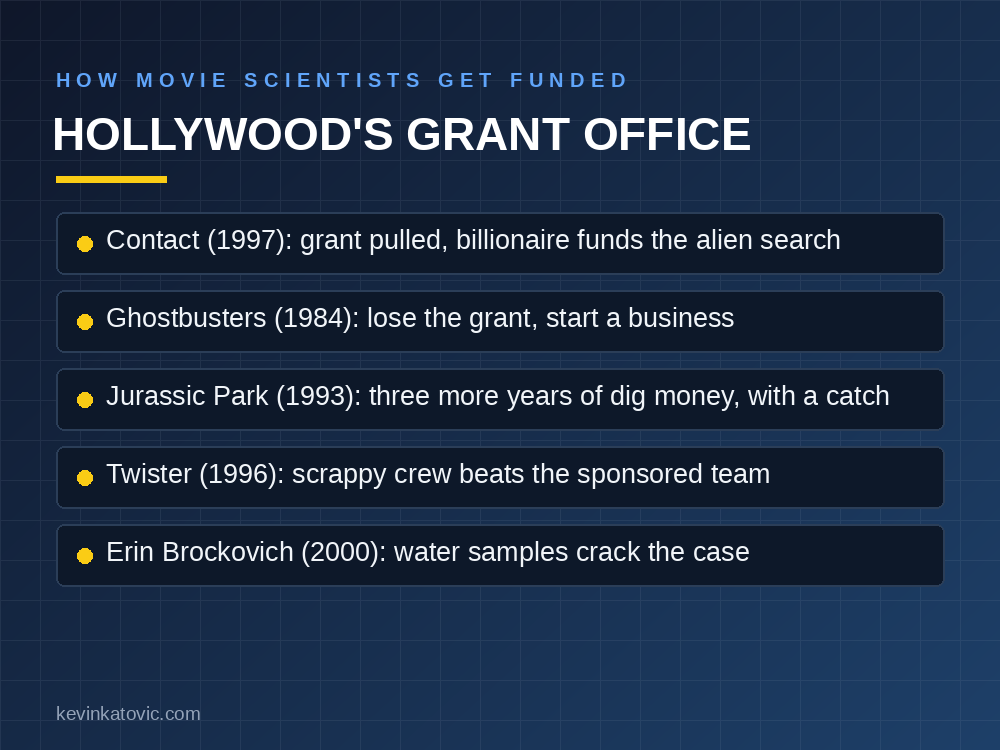
Contact (1997) is the classic. Jodie Foster’s Ellie Arroway spends her life listening for signals from space, and her grant gets yanked by David Drumlin, a science adviser who calls the whole idea a waste. She goes door to door to corporations with her pitch and gets laughed out of boardrooms, until the mysterious billionaire S.R. Hadden quietly funds her. She ends up at the Very Large Array in New Mexico with headphones on, and then she hears it. A private backer funding the search for aliens is the most movie thing ever, and it is also roughly how a lot of real alien-hunting got paid for.
Ghostbusters (1984) is the opposite story. Venkman, Stantz and Spengler lose their university grant and get thrown off campus by a dean who has had enough. Their answer is to go into business, with Ray mortgaging his parents’ house to fund it. Lose the grant, start a business: that’s the most honest small-business plan in film history, and it ended with a firehouse and a logo everyone still recognizes.
Jurassic Park (1993) does the grant pitch in reverse. Alan Grant’s dig is running out of money, and John Hammond shows up offering to fund it for three more years if Grant and Ellie Sattler will spend a weekend endorsing his park. They take the deal. The lesson: always read the fine print on the funding offer, especially if it involves an island.
Twister (1996) puts a scrappy storm-chasing crew with a homemade sensor rig up against a slick rival team that has corporate sponsors and matching black vans. The underfunded team gets the data. Hollywood is consistent about this: the shiny sponsored team always loses.
And then there are the water samples. In Erin Brockovich (2000), Erin isn’t a scientist at all. She’s a legal clerk who keeps driving out to Hinkley, California, collecting records and water samples until the evidence of contaminated groundwater can’t be ignored. The movie makes sampling look heroic, which it is. Water still matters in tech today, and data centres think hard about it, which is why it’s worth checking what air versus liquid cooling actually costs per year before anyone picks a cooling plan.
Why the Movies Get It Half Right
Movies get the emotional part right. Funding really does feel like the whole story when you’re waiting on it. What they skip is the paperwork: the milestones, the reporting, the business number, the separate bank account, and the industry code on page one of the tax form. Nobody makes a montage of somebody opening a business account at the credit union.
So that’s the plan. Wait for the committee, keep building while I wait, and if the answer is yes, set up the sole proprietorship under NAICS 513210 and do it properly. If the answer is no, there’s always the Ghostbusters route. In the meantime, if you need something to look at while we all wait for a signal from space, here’s a crew of cats in spacesuits. I’ll post an update when the reviewers decide.
What is the “Bank of NVIDIA”?
The phrase “Bank of NVIDIA” refers to a new type of financing emerging around NVIDIA’s AI computing infrastructure. It is not a traditional bank like RBC, TD or BMO, and it is not an ordinary personal-loan program.
On August 10, 2026, NVIDIA announced partnerships with six major financial institutions to establish financing platforms intended to mobilize more than US$500 billion in third-party capital for AI infrastructure.
The partners are:
-
Apollo
-
BlackRock
-
Blackstone
-
Brookfield
-
Goldman Sachs
-
KKR
The idea is to make expensive AI infrastructure financeable, much like commercial real estate or industrial equipment.
How does the financing work?
Imagine a company wants to build an AI data centre in British Columbia. It needs millions of dollars to purchase NVIDIA GPUs, servers, networking equipment, cooling systems and electrical infrastructure.
Traditionally, the company would have to raise the money itself or borrow from a bank.
The new financing model is designed to let independent financing institutions fund the infrastructure, using the equipment, customer contracts and anticipated computing revenue as part of their lending assessment.
In other words, the computing equipment can become an asset supporting the loan, rather than the borrower having to finance everything using conventional business credit.
NVIDIA supplies the technology ecosystem; the financial partners provide the capital and independently evaluate the projects.
1. An actual application route: USD.AI
There is another important development: USD.AI has an actual GPU financing application process.
It is particularly interesting for BC because on September 23, 2026, USD.AI announced a US$128.9 million financing facility for NVIDIA GB200 systems being deployed in British Columbia. The borrower was a publicly listed GPU cloud operator.
USD.AI GPU financing
Up to 80%
Of qualifying GPU deployment costs
Published financing terms:
-
Fixed or floating interest rates.
-
Three-to-five-year loan terms.
-
GPUs serve as collateral.
-
At least 20% equity contribution.
-
Financing for new or already-deployed GPUs.
Apply for GPU financingUSD.AIApplication and enquiries: originations@usd.ai
What you need to apply
USD.AI identifies five main requirements:
-
A customer contract or letter of intent showing who will purchase your computing capacity.
-
A purchase quotation for NVIDIA GPUs and associated hardware.
-
A data centre or colocation agreement, including electricity and installation arrangements.
-
Proof that you have at least 20% of the project cost available.
-
A company profile explaining ownership and operations.
The company evaluates the expected revenue from the GPUs, the customer contracts and the hardware itself.
Important: USD.AI is an independent financing provider, not NVIDIA’s bank. Its Canadian transaction demonstrates that BC deployments have received financing, but your own Canadian company would still need individual approval and confirmation that its ownership and security arrangements qualify.
2. Government-backed loans available in BC
Another possibility is the federal Canada Small Business Financing Program.
Canada Small Business Financing Program
C$1.15 million
Maximum combined financing per borrower
|
Financing |
Maximum |
|---|---|
|
Term loans |
$1,000,000 |
|
Equipment and leasehold improvements portion |
$500,000 |
|
Intangible assets and working capital |
$150,000 |
|
Line of credit |
$150,000 |
Small businesses and start-ups operating in Canada with annual gross revenue of $10 million or less can qualify.
You apply through a participating bank or credit union, not directly through the government. Equipment, including computer hardware and software, can qualify. The lender makes the approval decision. There is also a 2% registration fee.
3. Business Development Bank of Canada (BDC)
BDC also offers equipment financing for Canadian businesses.
Its published equipment-loan requirements include:
-
Business based in Canada.
-
At least 12 months generating revenue.
-
Good credit history.
-
Financial statements and financial projections.
You can apply online.
Which loan are you actually looking for?
There is an important difference between borrowing as an individual and borrowing through a company.
1. Who would be applying?
2. What would the loan finance?
3. Approximately how much financing?
4. Does the business currently generate revenue?
The distinction matters because the NVIDIA financing ecosystem is opening up institutional-scale financing for AI infrastructure, whereas a personal borrower cannot simply apply for a share of the announced $500 billion.