
The price of Polygon today is about $0.0763 per POL (November 25, 2026 (5:40 p.m. Pacific)). It is set by trading on hundreds of exchanges, but six forces explain most of the moves: Bitcoin, interest rates, supply, network usage, staking, and news. Here is each one, with what it is doing to the price of Polygon right now.
The Price of Polygon Right Now
| Metric | Value |
|---|---|
| Price | $0.0763 / C$0.1086 |
| 24 hours | +1.7% |
| 30 days | -16.1% |
| 1 year | -44.0% |
| From all-time low | +13% |
1. Bitcoin and the Wider Market
Altcoins follow Bitcoin, usually with bigger swings. When risk appetite fades in stocks, crypto tends to fall too. November 2026 has been choppy, as you can see in how the S&P 500’s AI trade rebounded on election day and why the Anthropic IPO did not stop the selloff.
2. Interest Rates
Higher rates make speculative assets less attractive, and lower rates do the opposite. Central bank commentary moves crypto more than most people expect; here is what Kevin Warsh said about AI and stocks.
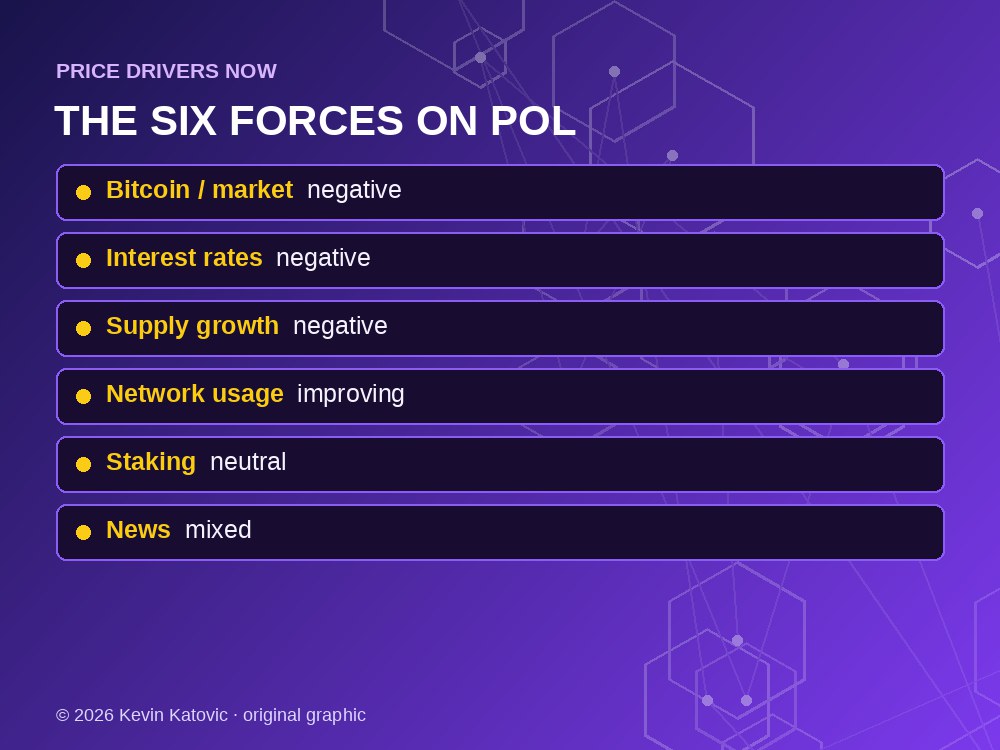
3. Supply
POL’s supply grows from designed emissions (about 2% a year) and now stands at roughly 10.66 billion tokens. That is a slow, steady headwind.
4. Network Usage
Transactions burn base fees and create demand for POL as gas. Polygon’s payments push (SoFiUSD, Nuvera, Bennu) could raise usage, but each transaction pays only a fraction of a cent.
5. Staking
Staked POL is locked up securing the network, which reduces the amount available to sell. Rising staking participation is quietly bullish; falling participation the reverse.
6. News and Governance
Upgrades like Agglayer v1.0 tend to produce short pops. Controversial decisions, such as the proposed hard fork to recover 70.49 million POL from blocked addresses, can cut either way depending on how traders read them.
Putting It Together
Right now four of the six forces lean negative (market, rates, supply, sentiment), which matches the 44% yearly decline. A turn in the broad market would matter most. For my own planning I prefer inputs I can measure, like a server power consumption calculator, or price an AI build before you commit.
How These Forces Interact
The six forces rarely act alone. A falling Bitcoin often coincides with rising rate fears, which makes traders less patient with long-term stories like payments adoption. In those markets, supply growth becomes more visible because nobody is buying the extra tokens. In a bull market the opposite happens: rising Bitcoin, easier money and good news reinforce each other, and dilution barely registers.
Short-Term vs Long-Term Price Drivers
| Horizon | Main drivers | What to watch |
|---|---|---|
| Hours to days | Bitcoin moves, liquidations, news | Order books, funding rates |
| Weeks to months | Market sentiment, rates, partnerships | Macro news, Polygon announcements |
| Years | Adoption, supply, competition | Usage data, governance, stablecoin volume |
The Role of Liquidity
With about $51.3 million traded per day, POL is liquid enough that most retail orders barely move the price. Large holders are a different story: selling tens of millions of tokens at once would push the price down noticeably. That is one reason news about big wallets, treasury moves or unlocks can move the price of Polygon more than routine announcements.
Why Good News Sometimes Lowers the Price
It is common to see a token fall after a positive announcement. Traders often buy before an expected event and sell when it happens, which is the classic “buy the rumour, sell the news” pattern. Agglayer v1.0 and the payments partnerships were anticipated, so much of their effect may have been priced in before the announcements.
Questions to Ask Before Reacting to a Price Move
- Did Bitcoin move the same way?
- Was there real Polygon news, or just noise?
- Is the volume unusually high?
- Has anything changed about supply, staking or governance?
If the answer to the first question is yes and the others are no, the move probably says more about the market than about Polygon.
The Price of Polygon: What I Would Watch Next
Stablecoin supply on Polygon, the share of POL staked, governance decisions on emissions, and the timing of the recovery hard fork. Those four signals will tell you more about where the price of Polygon is heading than any chart pattern.
Price of Polygon in Canadian Dollars
For Canadian readers, one POL is about C$0.1086. The same six forces apply, plus one more: the USD/CAD exchange rate. A stronger loonie lowers the CAD price of POL even if nothing else changes, and a weaker loonie raises it.
The Bottom Line on the Price of Polygon
Most of the time, the price of Polygon is a story about the whole crypto market rather than Polygon itself. Over longer periods, supply and real adoption take over. If you want to understand where POL is going, watch both levels: the market mood this week and the usage numbers this year.
Check those signals regularly, keep a long-term view, and do not let one dramatic day decide your strategy.
Patience and a clear plan matter more than reacting to every swing in the price of Polygon.
Think the price of Polygon is near a floor?  buy crypto with the SCR Auto-Buy page, which turns POL or any Polygon token into $SCR in one send.
This article is general information, not financial advice. Crypto prices move fast and you can lose money. Check the live price before you buy or sell anything.
Frequently Asked Questions
What is the price of Polygon today?
About $0.0763 (C$0.1086) per POL on November 25, 2026 (5:40 p.m. Pacific).
What affects the price of Polygon most?
Broad crypto market direction, led by Bitcoin, has the biggest effect, followed by interest rates, supply growth, network usage, staking and news.
Does Polygon follow Bitcoin?
Usually, and with larger percentage swings in both directions.
Can network upgrades raise the price of Polygon?
They can cause short-term moves, but sustained price gains generally need broad market strength and real demand growth.
Images in this post: © 2026 Kevin Katovic · original graphic. © 2026 Kevin Katovic, all rights reserved. To license an image, email support@kevinkatovic.com.