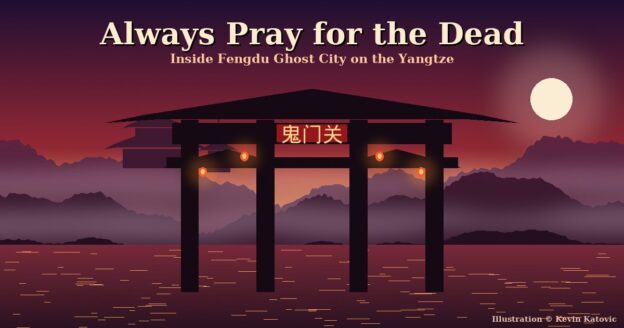
A soul does not travel alone. In China, for more than two thousand years, the living have walked beside the dead with incense, paper offerings and prayer. Nowhere is that journey drawn more vividly than in Fengdu, the City of Ghosts, high above the Yangtze River.
A Story in the Old Style: The Lantern-Maker’s Crossing
Long ago, the old tellers say, there lived a lantern-maker in a river town below Ming Mountain. All his life he made red paper lanterns for weddings and festivals, and every lantern he sold, he sold at a fair price. When he grew old and died, his daughter lit one of his own lanterns, burned paper money and incense, and prayed for him every night.
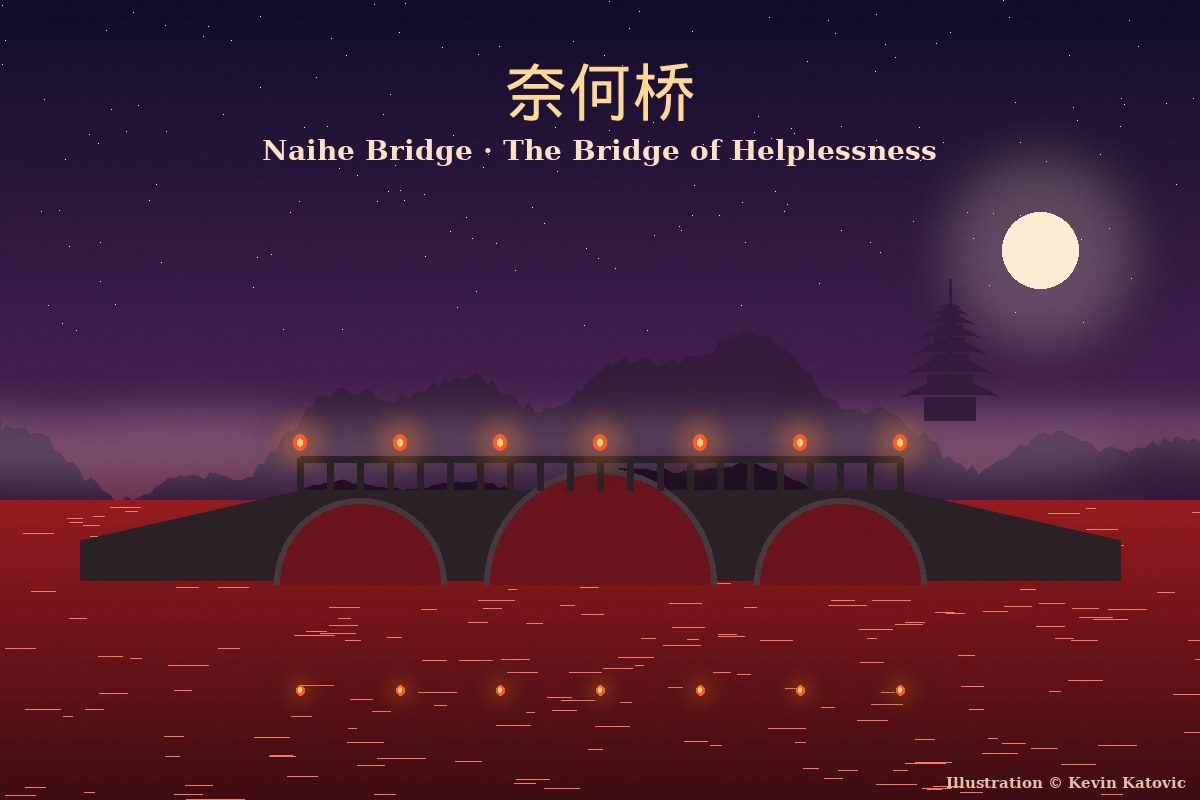
His soul climbed the mountain path in the grey hour before dawn. At the foot of the Naihe Bridge a crowd of spirits trembled, because they knew that the wicked would slip from its stones into the red river below. The lantern-maker was afraid too. He remembered a coin he once kept that was not his, and a promise he once forgot.
Then, far behind him in the world of the living, his daughter’s prayer rose with the smoke. A small light, warm as one of his own lanterns, floated ahead of him over the middle arch. He followed it step by step, and his feet did not slip. At the Ghost Torture Pass the guardians let him through. At the Home-Viewing Tower he looked back one last time and saw his daughter, still kneeling by the lantern. He bowed to her, and walked on to the court of judgment with a light heart.
That, the tellers say, is why you must always pray for the dead. You cannot walk the bridge for them, but you can light the way.
The Real Place: Fengdu Ghost City on Ming Mountain
The story is folklore, but the place is real. Fengdu Ghost City (丰都鬼城, Fēngdū Guǐchéng) is a hillside complex of temples, shrines, gates and statues on Ming Mountain (Mingshan), on the north bank of the Yangtze River in Fengdu County, Chongqing. For centuries Chinese people have pictured it as the capital of the underworld, the place where every soul is judged before it moves on.
Its name comes from a legend. During the Han dynasty, two officials named Yin Changsheng and Wang Fangping are said to have retired to Ming Mountain to practise Taoism, and both became immortals. Put their surnames together and you get Yinwang, which sounds like “King of the Underworld.” Over the centuries the mountain filled with temples, and the site grew into a place where Buddhism, Taoism and Confucian ideas about death, duty and judgment all meet. Some accounts say a great temple showing life in the underworld stood there as early as the Tang dynasty.
Today it is a popular stop on Yangtze River cruises, and the temples are visited by pilgrims and tourists alike. The climb up the mountain is a walk through the afterlife itself, gate by gate.
The Arch and the Bridge: Tests for Every Soul
Naihe Bridge (奈何桥), the Bridge of Helplessness
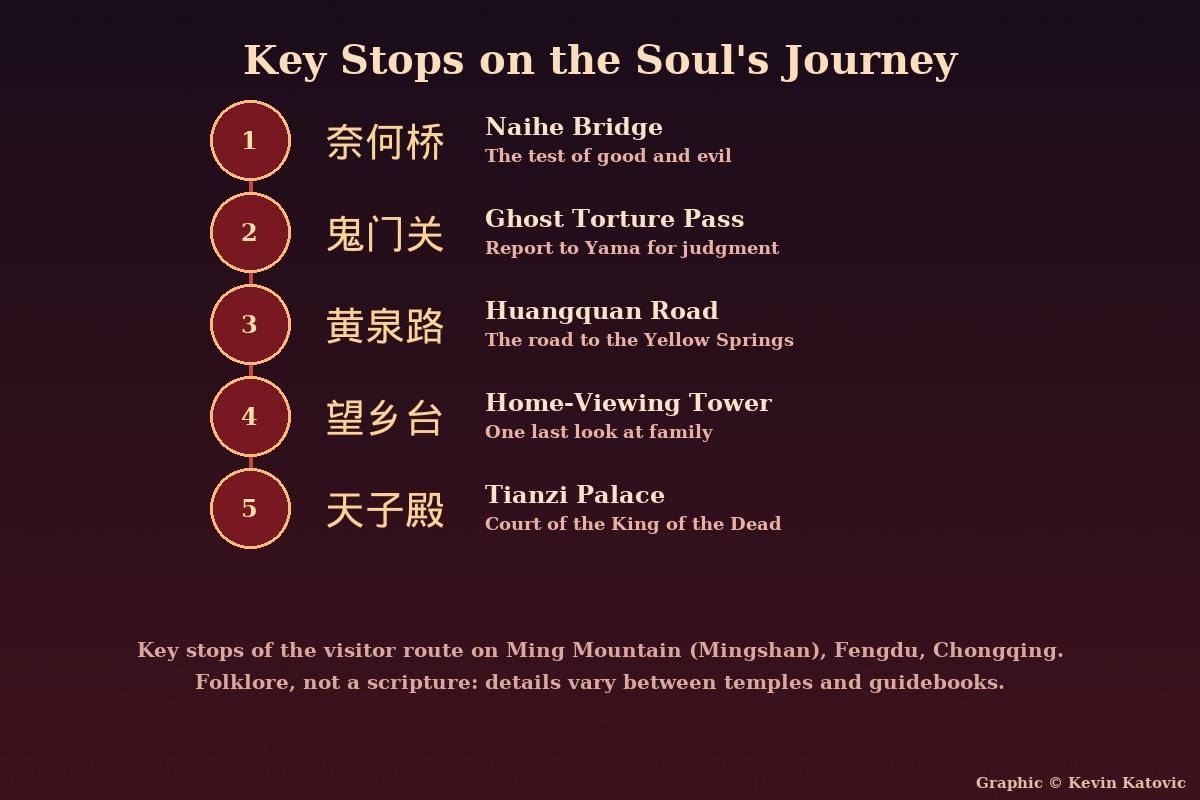
The first great test is the Naihe Bridge, sometimes translated as the Bridge of Helplessness or the Nothing-Can-Be-Done Bridge. The stone bridge in Fengdu is said to date from the Ming dynasty and has three arches. In the folklore it links the world of the living with the underworld. Good souls cross it safely, but the wicked are said to fall into the Blood River Pool beneath it. Only the middle arch is used for the test, and local custom has different ways of crossing depending on whether you are a man or a woman, young or old, married or single.
In wider Chinese folklore, a soul at this bridge also meets Meng Po, the old woman who serves the Soup of Forgetting, so that the soul can let go of its past life before it is reborn.
Ghost Torture Pass (鬼门关), the Gate of the Dead
The arch you remember is most likely the Ghost Torture Pass, also called the Gate of Hell. This is where, in the legend, the dead must report to Yama, the King of the Underworld, to be judged for the lives they lived. The pass is lined with huge statues of demons and guardians, with fierce faces meant to make visitors think hard about their own deeds.
Huangquan Road (黄泉路) and the Home-Viewing Tower (望乡台)
Chinese tradition calls the underworld the Yellow Springs, and the road there is Huangquan Road. Along the way, the stories say, stands the Home-Viewing Tower, where a soul is allowed one last look back at the family it left behind. It is one of the most tender ideas in the whole tradition: even on the road to judgment, the dead still think of home.
Tianzi Palace (天子殿), the Court of the King
At the top stands the Tianzi Palace, the Palace of the Son of Heaven. It is the oldest and largest temple on Ming Mountain, with its present buildings dating back about 300 years. Here the King of the Underworld holds court, surrounded by scenes of judgment and punishment carved and painted to show the fate of thieves, liars and the cruel. It is frightening by design, but the lesson underneath is simple: live honestly, because every life is weighed.
The River Rose, but the Ghost City Stayed
Fengdu has also lived through a real-world ending. When the Three Gorges Dam raised the Yangtze, part of the old town of Fengdu was submerged and most of its residents were moved to a new city built on higher ground across the river, starting in 1999. The temples of Ming Mountain sit high enough on the hillside to stay above the water, and the mountain is now a peninsula. The Three Gorges Dam is the biggest hydro plant on Earth, and it is a reminder of how much every megawatt of steady power is really worth and of how tightly great rivers and modern machines are now tied together.
Fengdu still holds a large temple fair, a festival of ghosts and gods, around the third day of the third lunar month, and visitors say it gets busier every year.
Why We Always Pray for the Dead
Fengdu is the most dramatic picture of an idea that runs through Chinese life everywhere: the living and the dead still owe each other something. Families honour their ancestors at home altars all year. At the Qingming Festival in spring they sweep the graves, bring food and burn incense. During the Hungry Ghost Festival, in the seventh lunar month, they set out offerings for wandering spirits who have no one to remember them, and float lanterns on rivers to guide them.
The meaning is the same in every one of these customs, and in the story of the lantern-maker: a prayer costs nothing, and it may light someone’s way across the bridge.
Visiting Fengdu Ghost City
- Getting there: Fengdu is downstream of Chongqing city on the Yangtze, and most visitors come as a half-day stop on a Three Gorges cruise. It can also be reached by road from Chongqing.
- The climb: the route up Ming Mountain has many steps; a chairlift covers part of the way.
- Customs: visitors often try the old tests for luck, such as crossing the middle arch of the Naihe Bridge. Treat the temples with respect: they are still places of prayer.
- Best time: spring and autumn are the most comfortable; the temple fair in the third lunar month is the busiest.
Planning big things in faraway places always starts with the same questions about land, power and people. If you are curious how that works for modern buildings, this is how sites for huge new facilities get picked, and this overview shows what it takes to keep large infrastructure running. And if you want to rough out the cost of a project of your own, try the AI Build Configurator from Strategic Crypto Reserve.
Frequently Asked Questions
Where is Fengdu Ghost City?
Fengdu Ghost City is on Ming Mountain (Mingshan), on the north bank of the Yangtze River in Fengdu County, Chongqing, China. Most visitors arrive as a stop on a Yangtze River cruise.
Why is Fengdu called the City of Ghosts?
Legend says two Han dynasty officials, Yin Changsheng and Wang Fangping, practised Taoism on Ming Mountain and became immortals. Joined together, their surnames sound like Yinwang, the King of the Underworld, and the mountain became known as his capital.
What happens at the Naihe Bridge?
In Fengdu folklore the Naihe Bridge, or Bridge of Helplessness, is the first test of a soul. The good cross safely, while the wicked are said to fall into the Blood River Pool below. Visitors still walk the middle of its three arches for luck.
Was Fengdu flooded by the Three Gorges Dam?
Part of the old town of Fengdu went under the reservoir and its residents were moved to a new city built across the river from 1999. The temples on Ming Mountain sit high enough on the hill to survive, and the mountain is now a peninsula.
All images in this post are original illustrations by Kevin Katovic. © 2026 Kevin Katovic. All rights reserved.
“The great mountain is crumbling! The ridge-pole is breaking! The wise man is withering!”
— Confucius, as recorded in Records of the Grand Historian.
He reportedly died in 479 BCE, aged 73.