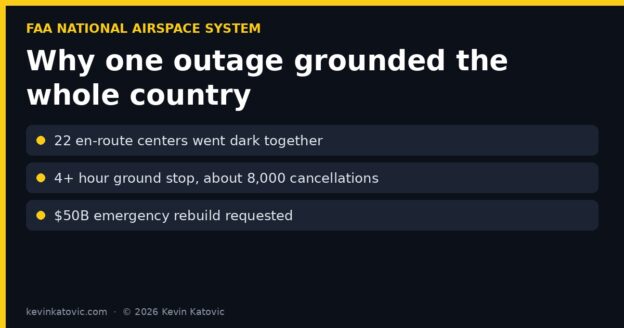
Most Americans never think about the National Airspace System until it stops. On Friday, November 13, 2026, it stopped. A communications outage hit all 22 en-route control centers, departures were held across the country for more than four hours, and almost 8,000 flights were cancelled. Here’s what the system is and why it’s so fragile.
What is the FAA National Airspace System?
The National Airspace System (NAS) is everything that keeps U.S. flights moving: the airspace itself, plus the radars, radios, navigation aids, airports, control towers, computers, rules and roughly 14,000 controllers who manage about 45,000 flights a day. The FAA runs it in layers:
| Layer | What it does | How many |
|---|---|---|
| Command Center | Plans national traffic flow | 1 (Virginia) |
| En-route centers (ARTCCs) | High-altitude traffic between airports | 22 |
| TRACONs | Approaches and departures near busy airports | About 150 |
| Control towers | Runways and ground movement | 500+ |
Why one outage can stop the whole country
The 22 en-route centers hand flights to each other all the time. If their voice and data links go down together, nobody can safely hand off a plane, so the FAA stops new departures until the links come back. That’s what happened on November 13. Transportation Secretary Sean Duffy blamed outdated communications equipment that became overloaded. Officials also said they were looking at conflicts between that old gear and newer equipment being installed. They said there was no sign of a cyberattack, and the new AI planning tool had nothing to do with it.
Modernizing the NAS
The fix everyone agrees on is expensive. The FAA’s newest AI layer, the SMART system from Air Space Intelligence, went national three days before the outage. Underneath it, though, much of the network still runs on decades-old copper, radios and computers. Duffy has now asked Congress for $50 billion in emergency funding to rebuild it. Whether that money comes through depends partly on the new Congress after this month’s midterm results.
Big infrastructure upgrades always come down to the same three things: power, redundancy and capital spending. Private data centers have the same problem at a smaller scale, and here’s how one AI and crypto infrastructure site handles backup power and cooling. For the money side, this explains what goes into data-center capital spending, and here’s what a new facility costs, line by line.
If you’re planning computing for anything mission-critical, run your numbers through the AI Build Configurator before you sign anything. It shows what redundancy really adds to the bill.
My take
The National Airspace System is a great piece of engineering, with a lot of patching underneath. Adding smart software on top is fine, but the radios and wires underneath have to be rebuilt first, or AI just ends up sitting on the same weak spot.
FAQ
What is the National Airspace System?
The FAA’s network of airspace, radars, radios, navigation aids, airports, control facilities, rules and controllers that manages U.S. air traffic.
Why did the FAA ground all flights on November 13, 2026?
A communications outage affected all 22 Air Route Traffic Control Centers at once, so controllers could not safely hand off flights. Departures were held for more than four hours.
Was the November 13 outage a cyberattack?
Officials said there was no evidence of a cyberattack and pointed to outdated, overloaded communications equipment.
How much will it cost to modernize the National Airspace System?
The Transportation Secretary asked Congress for $50 billion in emergency funding to rebuild the air traffic control system.
Sources: FAA statements, CNBC, Axios, PBS NewsHour and Washington Times coverage of the November 13, 2026 ground stop; FAA facility counts from public FAA materials. Opinion and commentary, not financial advice.
Cover graphic © 2026 Kevin Katovic, all rights reserved. To license it, email support@kevinkatovic.com.