 Jensen Huang is out as Nvidia’s CEO. CNBC reported his resignation on November 12, Colette Kress is running the company as interim CEO, and the stock closed at $162.85 today, down from $213.66 just two weeks ago. Now everybody on my feed is asking the same question: when does he dump all his shares?
So let’s do the math nobody on TV wants to do. And then let’s ask ourselves, honestly: are you retarded? Because a lot of the takes I’m reading suggest some of us might be.
How many Nvidia shares does Jensen Huang own?
About 870.51 million shares. Nvidia’s 2026 proxy statement put his beneficial ownership at roughly 870.6 million shares as of March 23, 2026, or about 3.58% of the company. That number includes shares held through his trusts and partnerships, plus some held by his family foundation (which he isn’t allowed to just cash out for himself).
At today’s close of $162.85, that pile is worth about $141.8 billion. Every $1 the stock moves changes his net worth by about $870 million. Nvidia has only one class of stock and no super-voting shares, so he controls 3.58% of the votes and nothing more. For background on the week that got him here, see the Megaspeed story that kicked off Nvidia’s worst week in years.
“He doesn’t work there anymore, so why would he keep investing in Nvidia?”
This is the part where people need to slow down. Huang isn’t “investing” in Nvidia. He founded it in 1993, and those shares are what’s left of 33 years of building it. Owning stock and having a job are two completely different things. You don’t have to work at Apple to own Apple, and you don’t have to sell Apple when you stop working somewhere.
Plenty of founders leave the top job and keep most of their stock. Jeff Bezos stepped down as Amazon’s CEO in 2021 and is still one of its biggest shareholders. Bill Gates left day-to-day work at Microsoft years ago and trimmed his stake slowly, on a schedule, over about two decades. Leaving the CEO chair doesn’t create any rule that you have to sell.
There are also very good reasons not to sell in a hurry:
- Taxes. His cost basis is close to zero. Sell it all and a combined federal and California capital gains rate of roughly 37% could hand the government something like $50 billion. Holding, gifting to a foundation or passing it on through trusts is far more tax-efficient.
- He’d crash his own net worth. If the market sees the founder dumping 3.6% of the company, the price drops, and every share he still holds is worth less.
- Insider rules still apply for a while. Former executives are usually still treated as insiders for some time after leaving, and company trading windows and Rule 144 limits don’t vanish the day you resign.
And here’s the other thing people keep getting wrong: Nvidia doesn’t sell his shares. He does. The company can buy back its own stock, but it can’t put the founder’s personal holdings up for sale. Any sale by Huang has to show up in a Form 4 filing with the SEC within two business days. Filings show he made no open-market sales from January through September 2026. As of today I haven’t seen a filing showing he’s started selling since he resigned.
OK, but if he did sell everything, how long would it take?
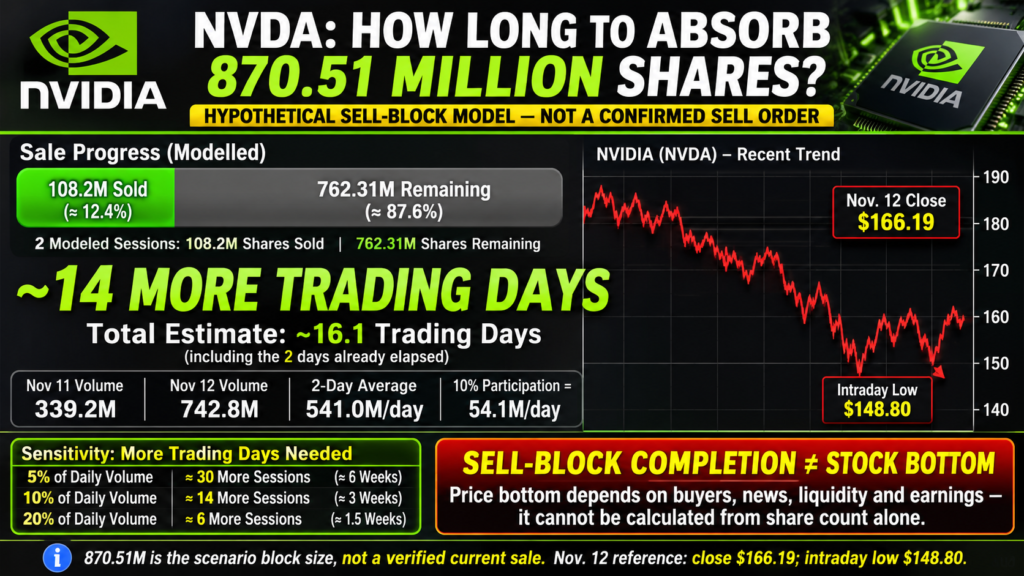
In all honesty, it depends on how much damage he’s willing to do to the price. Over the last three months, an average of about 145 million NVDA shares changed hands per day. This week was wild: 747.7 million shares traded on November 12 alone, the day the resignation news broke.
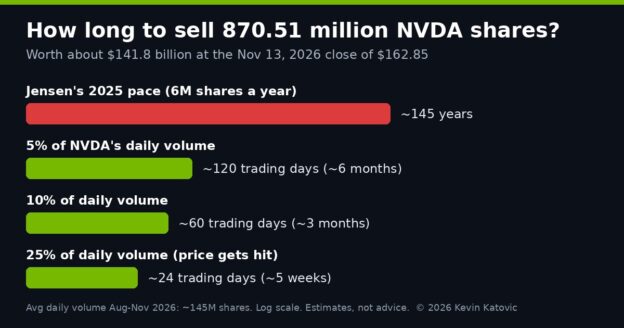
Big holders who don’t want to tank a stock usually sell a small slice of the daily volume. Here’s what that looks like for 870.51 million shares:
| Selling speed | Shares per day | Time to sell 870.51M |
|---|---|---|
| His 2025 pace (6M shares in the second half of the year) | ~24,000 | ~145 years |
| 5% of daily volume | ~7.3 million | ~120 trading days (about 6 months) |
| 10% of daily volume | ~14.5 million | ~60 trading days (about 3 months) |
| 25% of daily volume | ~36 million | ~24 trading days (about 5 weeks), and the price takes a beating |
| Block trades / secondary offering | Tens of millions at once | Days to weeks, sold to big funds at a discount |
Then there’s the legal speed limit. As long as he’s still considered an affiliate, Rule 144 caps his sales in any three-month window at the greater of 1% of Nvidia’s shares outstanding (about 243 million shares) or the average weekly trading volume over the previous four weeks. With volume this high right now, the second test is the bigger one, so the law isn’t really what stops him. The market is.
So the realistic answer is somewhere between three months and a year if he truly wanted to sell everything without blowing up the price, and much longer if he does what most founders actually do, which is sell a little at a time on a pre-set 10b5-1 plan. At the pace he sold in 2025, he’d finish sometime around the year 2170.
So are you retarded?
Here’s the test. If your trade this week was “Jensen quit, so he’s going to dump 870 million shares tomorrow, so I’m shorting everything,” ask yourself honestly: are you retarded? He can’t dump them tomorrow without wrecking his own fortune, there’s no filing saying he’s selling, and every sale he makes will be public within two business days. You won’t need a rumour. You’ll see it on EDGAR.
What actually moves NVDA from here is Tuesday’s earnings and whatever Kress says about guidance, not the imaginary fire sale. If you want to compare Nvidia with the rest of the AI trade, I keep an eye on 42 AI data center stocks charted side by side, and AMD’s last quarter is a decent read on whether AI chip demand is cooling.
Meanwhile, the GPUs keep shipping no matter who runs Nvidia, and every one of them needs power. If you want to know what a megawatt of AI capacity really costs, here’s a state-by-state breakdown of what one megawatt of data center costs to build. And if you’re planning a real build, this configurator prices a whole GPU hall, chips, power and cooling, before the next headline hits.
FAQ
How many Nvidia shares does Jensen Huang own?
About 870.5 million shares, or about 3.58% of Nvidia, according to the 2026 proxy statement (as of March 23, 2026). That includes shares held through trusts, partnerships and his family foundation. At the November 13, 2026 close of $162.85 they were worth about $141.8 billion.
Is Jensen Huang selling his Nvidia shares after resigning?
As of November 13, 2026 there was no public filing showing he had started selling after his resignation. Filings show no open-market sales from January through September 2026. Any sale must be reported on a Form 4 within two business days.
How long would it take Jensen Huang to sell all his Nvidia shares?
At 10% of Nvidia’s average daily volume of about 145 million shares, roughly 60 trading days (about 3 months). At 5%, about 6 months. At his 2025 pace of 6 million shares, it would take about 145 years.
Does Nvidia sell Jensen Huang’s shares?
No. The shares belong to Huang and his trusts, so only he can sell them. Nvidia can only buy back its own stock.
Sources: Nvidia 2026 proxy statement (via secondary reports), SEC Form 4 filings, CNBC (Nov 12, 2026), Bloomberg (June 2025) and Yahoo Finance price and volume data through the Nov 13, 2026 close. Volume-based timelines are my own estimates. This is opinion, not financial or tax advice.
Chart © 2026 Kevin Katovic, all rights reserved. To license it, email support@kevinkatovic.com.