 I live in the Comox Valley, and I love it here: the mountains, the water, the people who actually build things. But after years of watching how this place works, I’ve come to an uncomfortable conclusion. The Comox Valley economy is going the way of most small Canadian towns. Without a real private sector that keeps people employed long after the ribbon-cutting, a town slowly empties out, ages and gets more expensive for the people who stay.
A government town wearing a resort town’s clothes
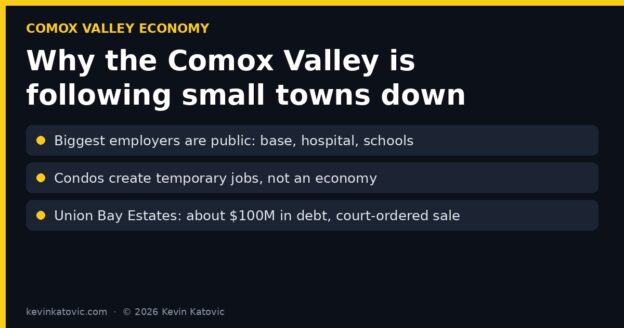
Look at who the big employers are. The region’s largest employer is CFB Comox (19 Wing), with roughly a thousand military members and a couple of hundred civilian staff. After that come the hospital, the school district, North Island College, local governments and the Regional District. Over half of local jobs are in services. Logging, once the backbone, faded decades ago. Tourism and Mount Washington help, but they’re seasonal.
None of those public jobs are bad jobs, and plenty of people in them work hard. The problem is that they don’t create wealth on their own. They’re paid for by taxes, and in a valley without a deep private sector, a big share of those taxes comes out of the same households and small businesses that are already stretched. When a region’s main industry is administering itself, the money goes in a circle. It doesn’t grow.
The hypocrisy problem
Here’s what bothers me most. In my experience, a lot of the loudest voices on what Comox Valley residents should pay, build or be allowed to do belong to people whose own paycheque comes from the public purse, provincially, federally or at the municipal and regional level. They’ve built careers by creating more positions, more programs and more process, not more businesses. Then they turn around and treat the residents who fund all of it as the problem.
I’ve seen it in council chambers, in permit counters and in how new rules land on people who are just trying to run a shop, a trade or a startup. The tone is too often adversarial: more fees, more studies, more reasons why not. A government that can’t grow an economy shouldn’t keep looking for new ways to tax the one it has. That’s not a conspiracy. It’s an incentive problem. If your job depends on the budget, you’ll always find a reason the budget should be bigger.
Condos are a temporary job, not an economy
Drive around Courtenay and Comox and you’ll see the valley’s main growth strategy: condos. Riverwalk on Cliffe Avenue. 1700 Balmoral in downtown Comox, with 40 suites and 5 penthouses. Newport Village on Kilpatrick Avenue. Dozens more have gone up over the decades, each sold as a sign of progress.
Construction jobs are real, but they’re temporary. The crane comes down, the trades move on, and what’s left is more people needing services, more pressure on roads and water, and the same thin base of employers. A condo is a place to live. It’s not a place to work. Building homes for retirees and remote workers moving here from elsewhere doesn’t build a local economy. It imports one and hopes it sticks.
Union Bay Estates: what happens when the plan is real estate
If you want the clearest example of how fragile real-estate-led growth is, look at Union Bay Estates, the 789-acre Kensington Island Properties development just south of Courtenay. It was pitched for decades as a whole new community. Instead it ended up in B.C. Supreme Court. Reports put the developer’s debt at roughly $80 million by early 2024 and close to $100 million across its creditors. The court ordered the land sold, conditional foreclosure orders followed, and a court-approved sale came in December 2025.
The fallout reached well beyond the investors. Commitments the developer made to share the cost of water and sewer infrastructure with the K’ómoks First Nation were thrown into doubt. Twenty-eight acres of contaminated land had earlier gone to the province. After all those years of approvals, master development agreements and zoning, the valley got lawsuits instead of a town. That’s what happens when “economic development” means “land development.”
Why Calgary and Edmonton work and Vancouver Island doesn’t
Alberta’s big cities run on a different model. Energy, agriculture, logistics, engineering and a growing tech scene create private-sector jobs that pay well and last. There’s no provincial sales tax, the cost of doing business is lower, and governments there, whatever you think of their politics, see private employers as the point rather than a nuisance.
Vancouver Island has real barriers: geography, ferries, limited land, a smaller population and high costs. But barriers aren’t destiny. Iceland, Norway and plenty of island economies turned cheap clean power and isolation into an advantage. B.C. has some of the cheapest hydro power in North America. Here’s how BC Hydro rates turned the province into a magnet for compute, and what running high-power hardware on Vancouver Island actually looks like. That’s the kind of permanent, power-hungry, high-skill industry a place like the Comox Valley could chase instead of another condo.
What a real Comox Valley economy could look like
- Data and compute. Small modular data centres that use cheap hydro and turn their waste heat into something useful. Heat reuse can warm greenhouses, pools and homes, and if you want to cost one out, this AI data center configurator prices a build down to the rack.
- Make permitting fast and predictable for anyone creating year-round private jobs, not just for subdivisions.
- Measure councils and agencies on private jobs created, not on plans written or staff hired.
- Keep the valley’s character. People love it here for its weirdness and its wilderness, right down to the Cadborosaurus legend in our own waters. An economy can grow without paving that over.
The Comox Valley doesn’t have a people problem. It has a priorities problem. A region can’t tax, permit and condo its way to prosperity. Until the people running it start treating private employers and long-term residents as partners instead of targets, the valley will keep doing what small towns do: getting older, pricier and emptier, one temporary job at a time.
FAQ
What are the biggest employers in the Comox Valley?
CFB Comox (19 Wing) is the largest, followed by public employers such as the hospital, School District 71, North Island College and local governments. Services make up over half of local employment.
What happened to Union Bay Estates?
The developer, Kensington Island Properties, ran up roughly $80 to $100 million in debt. The B.C. Supreme Court ordered the land sold, conditional foreclosure orders followed, and a court-approved sale came in December 2025.
Do condo projects help the Comox Valley economy?
They create construction jobs that end when the building is finished. Long-term, they add residents and service demand but not lasting local employers.
What industries could grow the Comox Valley economy?
Year-round private industries that fit the region: data and compute powered by B.C.’s cheap hydro (with heat reuse), skilled trades, technology and value-added tourism, backed by faster permitting.
Sources: Comox Valley Record and regional reporting on 19 Wing employment; Comox Valley Regional District Union Bay Estates updates (June 2025, August 2026); Green Street News and The Islands’ Grapevine on the court-ordered sale; Fox Island Development Ltd. v Kensington Union Bay Properties Nominee Ltd., 2026 BCSC 441; REW.ca and local listings for Riverwalk, 1700 Balmoral and Newport Village. Opinion and commentary. Facts about Union Bay Estates come from court and news reporting; corrections welcome at support@kevinkatovic.com.
Cover graphic © 2026 Kevin Katovic, all rights reserved. To license it, email support@kevinkatovic.com.