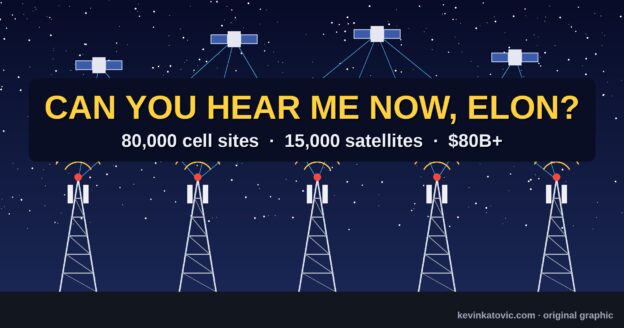
Yahoo Finance ran a short piece this morning with a big headline: “SpaceX Wants to Be Your Mobile Carrier” (Srividya Kalyanaraman, October 23, 2026). The numbers in it are worth slowing down for, because if even half of this happens, the phone in your pocket gets a fourth national carrier that also owns the sky above it.
The numbers, in plain English
- 80,000 cell sites. SpaceX is looking for access to at least 80,000 U.S. cell sites, leased or bought. The U.S. had about 158,500 purpose-built towers in 2025, so that is close to half the country.
- 15,000 satellites. SpaceX has FCC approval to launch 15,000 satellites built to talk straight to ordinary phones, plus low-band spectrum to run them on.
- $80 billion and up. Industry estimates put a nationwide ground network north of $80 billion.
- Crown Castle up 9%. The tower owner, reported to be in talks with SpaceX, jumped 9% on Friday.
- Musk on the earnings call: Starlink Mobile “could become a standalone nationwide wireless carrier.”
Why towers, if you own the sky?
Satellites are amazing at covering a logging road on Vancouver Island at 2 a.m. They are not amazing at pushing video to 40,000 people in a football stadium, or getting a signal through three floors of concrete downtown. Physics wins: the closer the antenna, the faster the phone. That is why a space company suddenly wants dirt, steel and leases.
It is also a change in tone. Back in August, SpaceX was talking about rooftop dishes and “little femtocells” rather than macro towers, and New Street Research analyst David Barden said he was “highly skeptical this is even a real thing.” Today’s report suggests the tower option is very much on the table. As Yahoo notes, nobody knows yet whether these talks turn into binding deals, or how many sites SpaceX actually lands.
Who wins, who sweats
Tower owners like Crown Castle win either way: a fourth big tenant paying rent on steel that already stands is the dream scenario for a landlord. AT&T, Verizon and T-Mobile sweat, because their real moat was never the phones; it was the towers, the spectrum and the decades it took to stitch them together. SpaceX now has spectrum, has the satellites, and is shopping for the towers. That moat just got a lot narrower.
Customers probably win too. A carrier that can fall back to a satellite when the tower is out of reach means fewer dead zones on highways, ferries and back roads. Anyone who has lost a call on the Island Highway knows exactly what that is worth.
The part nobody is talking about: power
Here is my angle. Every one of those 80,000 sites needs power, cooling and backhaul, and the next generation of networks will run AI right at the tower to handle traffic. That is a small data center bolted to every pole. The same questions we ask about AI data centers, cost per megawatt, electricity tariffs by state and cooling, now apply to the wireless network too. If you want to see how those numbers stack up, the AI Build Configurator prices out AI capacity line by line, and there is a handy data center cost per MW by state breakdown.
The bottom line
SpaceX already owns the rocket, the satellites and the dish on your roof. If it gets the towers too, “can you hear me now?” becomes a question for Elon Musk, not Verizon. Watch three things: whether the tower talks become signed contracts, how fast the 15,000 satellites go up, and how SpaceX stitches ground and space into one network. Until then, it is a headline, not a carrier.
Opinion and commentary. Not investment advice. Source: Yahoo Finance, “SpaceX Wants to Be Your Mobile Carrier,” October 23, 2026; Wireless Estimator, August 2026 (Barden quote, femtocell remarks). Cover image: original graphic, kevinkatovic.com.
Obviously not the smart money entering Anthropic