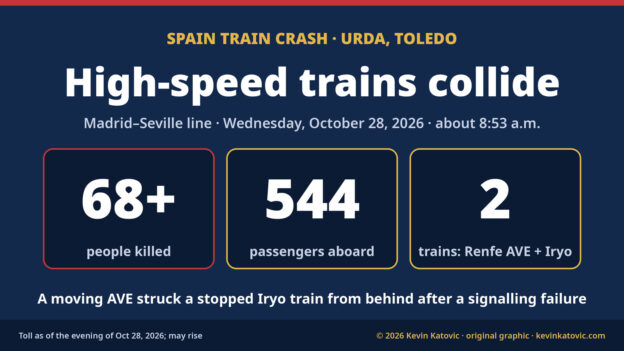
TOLEDO, Spain, Wednesday, October 28, 2026. At least 68 people were killed this morning when a Renfe AVE high-speed train ran into the back of a stopped Iryo train near Urda, in Toledo province, on the Madrid–Seville line. Spain’s transport minister blamed a signalling failure and a control-centre decision to let the AVE move again. It is Spain’s second deadly high-speed train crash this year.
Updated October 28, 2026, evening (Madrid time). This is a developing story; figures are the latest official numbers and may change.
What happened in the Spain train crash
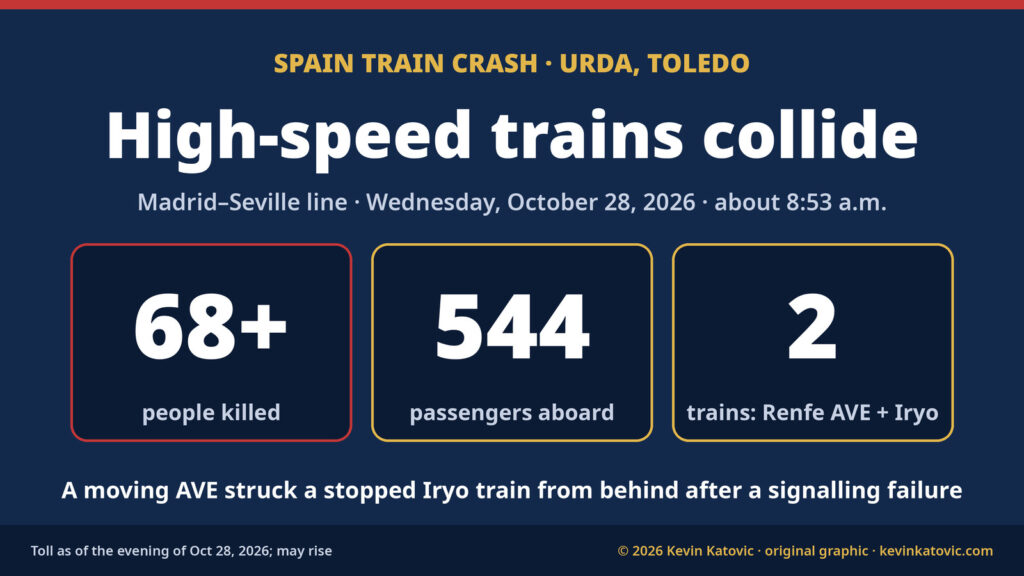
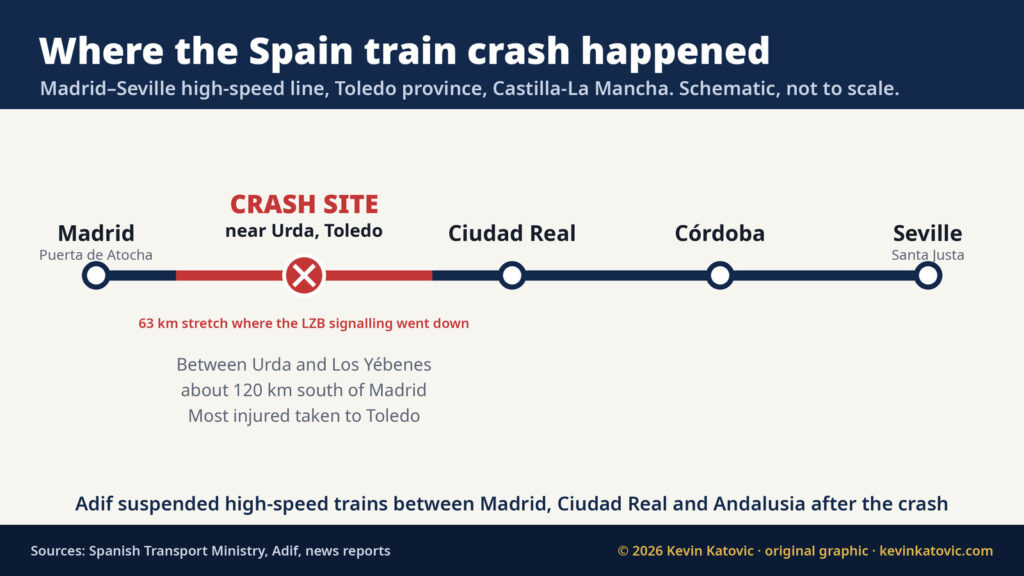
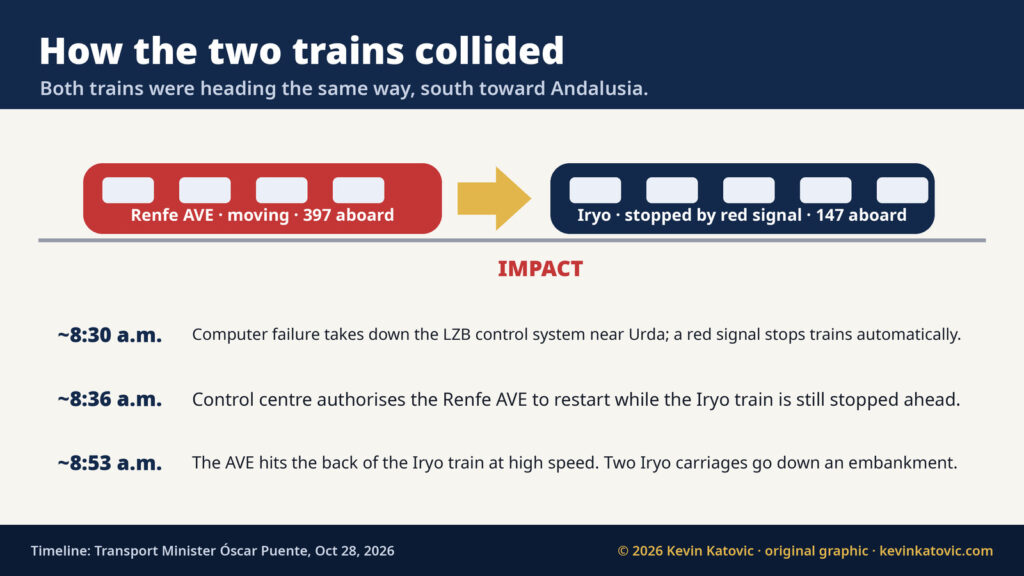
The crash happened at about 8:53 a.m. local time between Urda and Los Yébenes, in the Montes de Toledo countryside about 120 km south of Madrid. Two high-speed trains were heading south on the same track toward Andalusia: a state-owned Renfe AVE travelling from Madrid to Seville with 397 people on board, and a private Iryo train with 147 people on board.
The Iryo train had been stopped by a red signal. The Renfe AVE, cleared to restart by the control centre, hit it from behind at high speed. Two Iryo carriages went down an embankment. Renfe said its train “continued as instructed”; Iryo said its train was struck from behind and that the cause was still unknown.
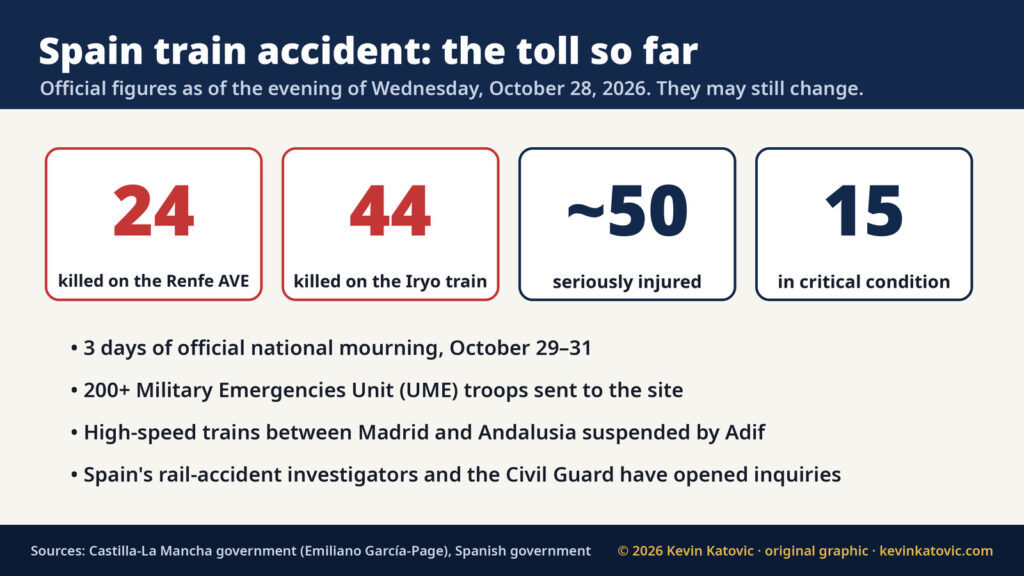
Emergency crews reached the site within about 20 minutes, and more than 200 troops from the Military Emergencies Unit (UME) were sent in. Most of the injured were taken to hospital in Toledo, about half an hour away; Madrid sent extra medical teams and firefighters, and the Los Yébenes town council collected food and supplies.
Watch: the Urda train crash explained in 44 seconds
Spain train accident death toll
The Castilla-La Mancha regional government put the death toll at at least 68 by the evening: 24 people on the Renfe AVE and 44 on the Iryo train. Regional president Emiliano García-Page said about 50 people were seriously injured and 15 were in critical condition, so the number of dead may rise. The U.S. State Department said several American citizens were among the injured.
Prime Minister Pedro Sánchez declared three days of official mourning, October 29 to 31. Andalusia announced its own mourning, and European Commission President Ursula von der Leyen wrote: “Today, Europe mourns with you.”
Why did the trains crash?
Transport Minister Óscar Puente gave the first timeline at midday (Al Jazeera, NBC News):
- About 8:30 a.m.: a computer failure took down the LZB train-control system along a 63 km stretch near Urda station. A red signal was issued and several trains stopped automatically.
- About 8:36 a.m.: with control handed to the Atocha control centre in Madrid, the Renfe AVE was authorised to resume, even though the Iryo train was still stopped on the track ahead.
- About 8:53 a.m.: the AVE struck the Iryo train.
Puente called the decision to restart traffic before the system was restored “erroneous”, against protocol and “inexplicable”, and described the crash as a mix of technical and human error. Sánchez said: “We will get to the bottom of this, and if there was negligence, it will be revealed.” Spain’s rail-accident investigation commission has opened a formal inquiry, and a Civil Guard disaster team is at the site.
Train crashes in Spain this year
This is the second deadly high-speed crash in Spain in nine months. In January 2026, trains from the same two operators collided after a derailment near Adamuz, in Córdoba province, on the same Madrid–Andalusia corridor, killing about 45 people. After that crash the government promised safety checks on lines nationwide. Sánchez said the two crashes appear to have different causes, but called two high-speed accidents in less than a year “unacceptable”.
The Madrid–Seville line opened in 1992 as Spain’s first high-speed railway. The crash also lands in the middle of a snap general election campaign: parties paused campaigning, and Spain’s football federation postponed some Copa del Rey matches.
Travel: Spain trains after the crash
- Adif has suspended high-speed trains between Madrid, Ciudad Real and Andalusia (Córdoba, Seville, Málaga). Check your booking with Renfe or Iryo before going to the station.
- The Spanish railway drivers’ union called a strike for Thursday, October 29, “in defence of railway safety”, so expect more disruption.
- If you are worried about someone who was travelling, contact the train operator. In Spain, call 112 for emergencies. U.S. citizens can contact the U.S. Embassy in Madrid.
Spain train crash FAQ
Where did the Spain train crash happen?
On the Madrid–Seville high-speed line near Urda, in Toledo province in the Castilla-La Mancha region, between Urda and Los Yébenes. That is about 120 km south of Madrid.
How many people died in the train crash in Spain?
At least 68 people were killed, according to the Castilla-La Mancha regional government on October 28, 2026: 24 on the Renfe AVE and 44 on the Iryo train. About 50 people were seriously injured and 15 were in critical condition, so officials warned the toll could rise.
What caused the Spain train accident?
The investigation has only started. Transport Minister Óscar Puente said a computer failure took down the LZB signalling system near Urda at about 8:30 a.m., a red signal stopped the trains, and at about 8:36 a.m. the control centre wrongly authorised the Renfe AVE to restart while the Iryo train was still stopped ahead. He called it a combination of technical and human errors.
Was it a derailment?
It was a rear-end collision between two high-speed trains, not a derailment on its own. The impact derailed carriages, and two Iryo carriages went down an embankment.
Are trains running between Madrid and Andalusia?
Adif suspended high-speed traffic between Madrid, Ciudad Real and Andalusia after the crash, and the railway drivers’ union called a strike for Thursday, October 29. Check Renfe or Iryo before you travel.
Elsewhere: a signalling computer going down is the same single-point-of-failure problem every control room has to plan for. I write about it from the infrastructure side on my other site, from what redundant systems cost over a facility’s life and keeping critical equipment cool when it can’t go down to the source-checking rules I follow on breaking news, plus a running news desk and the AI Build Configurator.
Sources: NBC News; Al Jazeera; CNBC; Euronews (first footage); Mappr (site map and timeline). Official figures from the Castilla-La Mancha regional government and Spain’s Ministry of Transport, as reported on October 28, 2026.
Graphics and video: four original graphics and one explainer video by Kevin Katovic; no crash photographs are used. © 2026 Kevin Katovic, all rights reserved. To license an image, email support@kevinkatovic.com.