
The theme of Polygon news in crypto right now is payments. In the past month Polygon announced a bank-issued stablecoin on its chain, two cross-border payment partners, a wallet-security push and a production release of the Agglayer. Here is why Polygon is chasing payments, who is building, and what it could mean for POL holders.
Polygon’s Open Money Stack
Polygon now markets an “Open Money Stack”: rails for companies that want to move stablecoins and settle payments without building blockchain infrastructure themselves. Its blog in November reads like a payments-industry trade journal, with posts on MPC wallets, embedded wallets, onboarding and the “structural barriers” to scaling crypto payments.
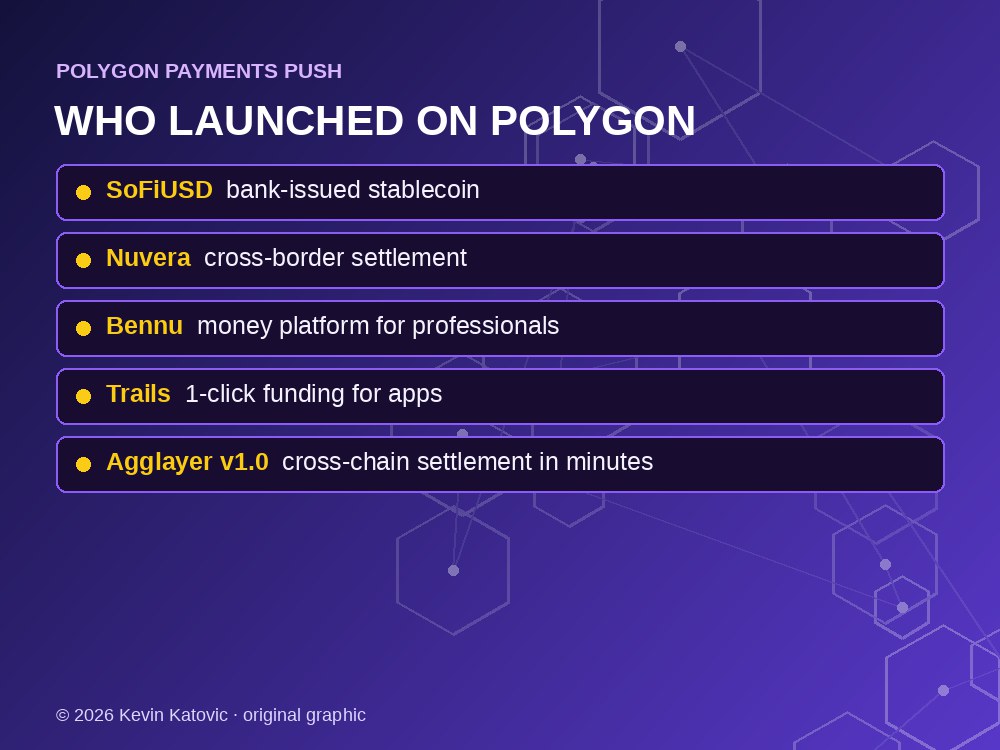
Who Launched on Polygon This Month
| Partner | What it does on Polygon |
|---|---|
| SoFiUSD | Bank-issued US dollar stablecoin lands on Polygon (Nov 12) |
| Nuvera | Cross-border stablecoin settlement (Nov 18) |
| Bennu | Private money platform for global professionals (Nov 24) |
| Trails x Foresight | One-click funding for prediction markets (Nov 11) |
| Trails x Katana | One-click DeFi liquidity (Nov 4) |
Why Payments, Why Now
Stablecoins are the part of crypto that regular businesses actually use. Polygon’s pitch is simple: transfers that settle in seconds for a fraction of a cent, on a chain that already has wallets and exchanges plugged in. The Agglayer, now at v1.0, lets assets move between connected chains in minutes with zero-knowledge proofs, which matters if payments end up spread across many chains.
The Risks Nobody Puts in the Press Release
- Competition: Base, Solana, Tron and others want the same stablecoin flows.
- Token value capture: payments run in dollars; POL only earns from gas and staking, which are tiny per transaction.
- Fraud: wherever money moves fast, scammers follow. If a fake site targets you, use a service that gets scam sites taken down.
- Governance: the proposed hard fork to recover 70.49 million POL from blocked addresses shows the network can act on balances, which some see as a plus for payments and others as a risk.
What It Means for POL
POL trades near $0.0763, down 16% over 30 days. The market has not priced in the payments story yet, and it may never translate one-for-one into token value. Polygon has a lighter side too, like a meme battle arena on the blockchain.
I follow infrastructure news more than token charts, from a calculator for sizing a crypto data center to a weekly AI news roundup. If you build compute, cost out GPUs, power and cooling in one place.
How a Stablecoin Payment on Polygon Works
Picture a company in Canada paying a supplier in Mexico. Instead of a bank wire that takes days and costs tens of dollars, it sends US dollar stablecoins on Polygon. The transfer settles in seconds for a fraction of a cent. The supplier can hold the stablecoins, pay its own bills with them, or convert them to pesos through a local partner. Services like Nuvera exist to handle those conversions and the compliance checks around them.
Why Banks Are Paying Attention
A bank-issued stablecoin such as SoFiUSD choosing Polygon is a signal that regulated institutions see public blockchains as viable settlement rails. Banks care about uptime, costs, compliance tools and the ability to respond to fraud. Polygon’s pitch covers all four, and the proposed recovery of stolen POL shows the network will act in extreme cases, which some institutions may actually find reassuring.
What Could Go Wrong
- Regulation could change how stablecoins are issued or who may hold them.
- An outage or serious bug on Polygon PoS would damage trust with payment partners.
- Partners could move to rival chains if fees or incentives look better elsewhere.
- Fraudsters target new payment flows, so consumer protection must keep up.
Signals Worth Tracking
If you want to know whether the payments strategy is working, ignore partnership announcements and watch usage: stablecoin supply on Polygon, the number of daily active addresses, and the fees burned on Polygon PoS. Rising numbers there would mean real adoption; flat numbers would mean the announcements have not turned into activity yet.
My Take
Payments are the most sensible direction Polygon could take. They are also the hardest market to win, because incumbents are huge and margins are thin. I like the strategy; I would want to see usage climb before I believed it was paying off for POL holders.
How Payments Could Help POL Indirectly
Even though payments settle in stablecoins, every transfer on Polygon PoS still pays a small gas fee in POL, and part of that fee is burned. Payment companies that run their own chains connected through the Agglayer may also rely on POL stakers for security. If payment volume becomes large and steady, those small effects add up to real demand for POL.
That is the real test for this month’s news. Announcements are easy; daily volume is hard. If the payments partners announced in November are still growing a year from now, Polygon’s strategy will look very smart.
I will revisit these numbers as new data comes out.
Prefer to own a piece of a small Polygon project?  buy crypto with the SCR Auto-Buy page, which turns POL or any Polygon token into $SCR in one send.
This article is general information, not financial advice. Crypto prices move fast and you can lose money. Check the live price before you buy or sell anything.
Frequently Asked Questions
What is the Polygon Open Money Stack?
Polygon’s set of payment and stablecoin infrastructure for companies that want fast, cheap settlement without building their own blockchain systems.
Which stablecoin launched on Polygon in November 2026?
SoFiUSD, which Polygon described as America’s first bank-issued stablecoin, landed on Polygon on November 12, 2026.
Does payments growth raise the POL price?
Not directly. Payments settle in stablecoins; POL benefits through gas fees and staking demand, which may be small per transaction.
What is Agglayer v1.0?
The production release of Polygon’s cross-chain layer, announced November 23, 2026, which settles transfers between connected chains in minutes using zero-knowledge proofs.
Images in this post: © 2026 Kevin Katovic · original graphic. © 2026 Kevin Katovic, all rights reserved. To license an image, email support@kevinkatovic.com.