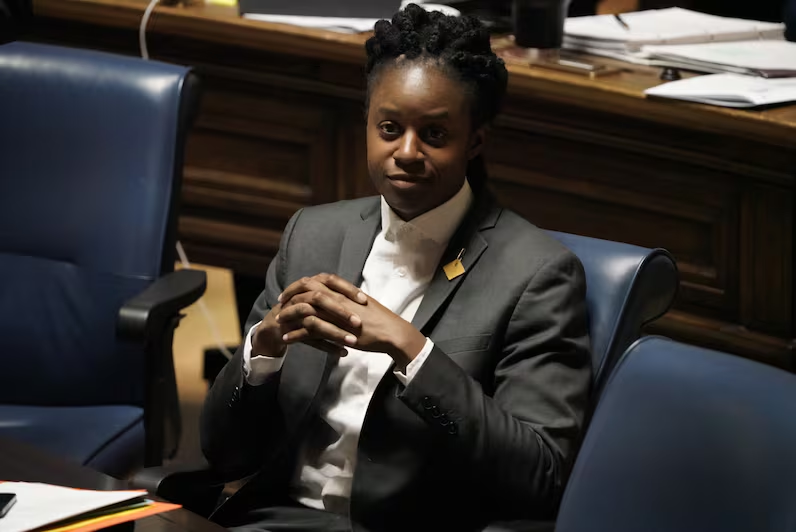
On March 10, Dawson Trail MLA Bob Lagassé stood up before question period and walked out of the Progressive Conservative caucus to sit as an Independent. CBC covered the move, but the obvious questions were left hanging. Was it personal or professional? What does a Manitoba MLA actually take home each month? And did Bob just find himself sitting on a comfortable golden parachute? I put on my detective hat and did the math.
The case file
- Who: Bob Lagassé, 53, MLA for Dawson Trail, southeast of Winnipeg. Before politics he was a foster parent and worked in social services; he is of French and Métis background.
- Record: first elected April 19, 2016, re-elected in 2019 and 2023, every time as a PC, every time with more than half the vote.
- Known for: mental-health advocacy, including his 2024 bill that made the week before Father’s Day Men’s Mental Health Awareness Week.
- What happened: he left the PC caucus on March 10, 2026. The same day, his entire Dawson Trail PC constituency association resigned and the board was dissolved.
- What’s next: he says he will run again, and not for the Liberals or the NDP.
Clue #1: what Bob actually said
Bob called it a matter of his “moral compass.” The tipping point, he told CBC, was the party’s decision to keep Jeff Wharton in caucus after Manitoba’s ethics commissioner found Wharton broke conflict-of-interest rules over the Sio Silica mining project. Wharton, former premier Heather Stefanson and former justice minister Cliff Cullen were all fined over that file.
He also said party discipline muzzles MLAs and stops them from voting the way their people want, pointing to Sio Silica and to hospital concerns in Ste. Anne. In his statement: the people of Dawson Trail “deserve a voice that answers only to them,” not “directives from party headquarters.”
Sio Silica matters a lot in his corner of the province. The proposed silica sand mine in southeastern Manitoba, which would have pulled sand out of the aquifer that many local wells depend on, was a hot issue in his region, and the NDP government rejected it. If your neighbours drink that water, it isn’t an abstract ethics question.
Clue #2: the Obby Khan factor
Bob admitted he and PC Leader Obby Khan didn’t always see eye to eye, then politely refused to say more. Khan, for his part, thanked him for “his service of 10 years”, said disagreements are normal in politics, and said he wouldn’t discuss private conversations. He also said Sio Silica hadn’t come up during his own time as leader.
Here’s the context that makes this interesting: Bob is the fifth PC MLA to head for the exits in four months. Richard Perchotte, Doyle Piwniuk, Kelvin Goertzen and Ron Schuler have all said they won’t run again. The difference is that Bob isn’t retiring. He’s staying, he’s running, and his whole local riding association resigned from the PCs alongside him. That isn’t a man looking for the door. That’s a man moving his furniture.
Clue #3: follow the money
So what does Bob make? Manitoba publishes MLA pay in the Members’ Salaries Regulation. The basic salary for 2026-2027 is $112,273 a year, which works out to $9,356 a month before tax. The Canadian Taxpayers Federation points out that’s more than double what the median American state representative earns.
After federal and Manitoba income tax, CPP, EI and the 9% that MLAs pay into their pension plan, my back-of-the-napkin estimate is that Bob takes home roughly $6,000 a month. His constituency office budget is separate and isn’t personal income, so I’ve left it out.
And how long has he been earning that kind of money? Ten and a half years. When he was first elected in 2016 the basic salary was about $94,500, and it stayed frozen there through 2019. It has climbed since, to $106,603 in 2024, $109,268 in 2025 and $112,273 now. Add it all up and Bob has earned somewhere around $1.04 million in basic MLA salary since 2016.
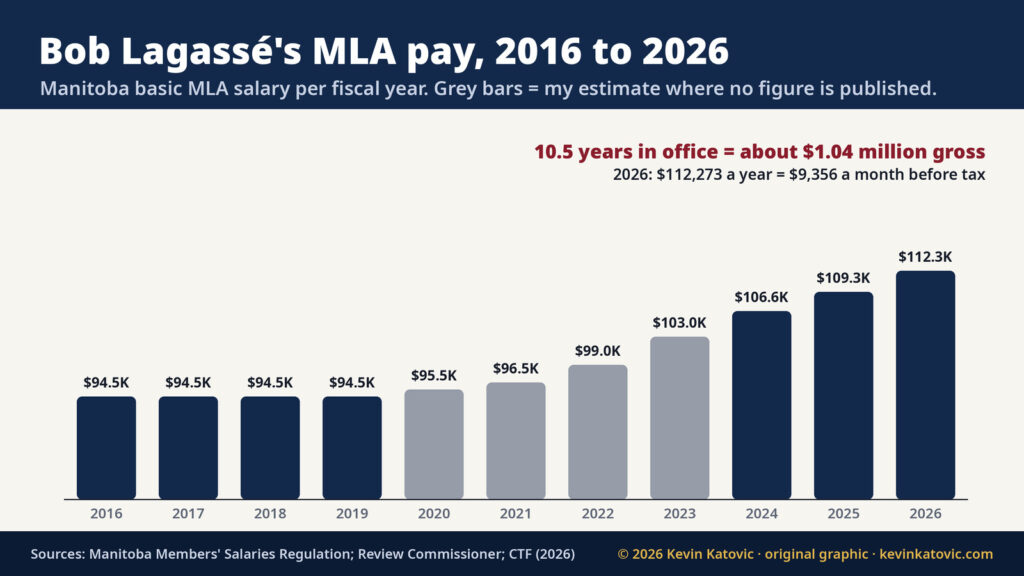
Going Independent doesn’t cut that salary: Independents are paid the same basic rate as everyone else. The only thing an MLA can lose is the extra pay for a party job such as house leader or whip, and nothing I found shows Bob held one of those.
Clue #4: the golden parachute theory
This was my favourite theory, so I tested it hardest. Manitoba MLAs first elected after 1995 get a transition allowance when they leave: one month’s salary for every year served, with a minimum of 3 months and a maximum of 12. They can also be in the legislative pension plan or a matched RRSP.
Here’s the problem with the theory. The transition allowance is paid when an MLA resigns, retires or is defeated. Switching to Independent is none of those. Walking out of the PC caucus paid Bob exactly $0.
If he leaves the legislature after the October 2027 election, he’d have about 11.5 years in, so roughly 11.5 months of pay: around $110,000. But he gets that the same way whether he runs as a Tory, runs as an Independent or doesn’t run at all. And if he wins as an Independent, he gets nothing, because he keeps his job. The parachute is the same size no matter which door he uses.
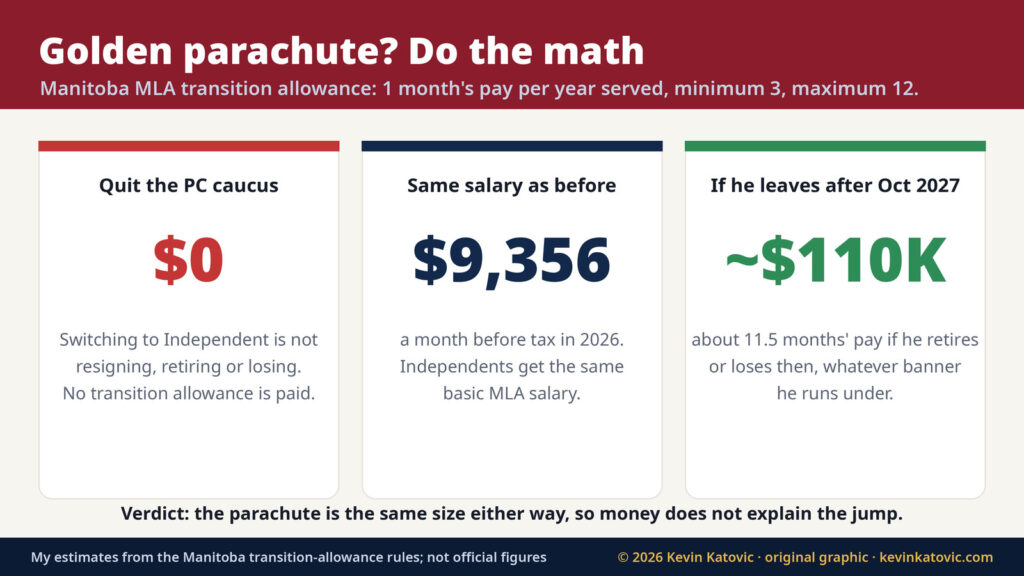
If anything, the money points the other way. Running without a party machine makes it harder to keep a $112,000 job. If Bob had wanted the easy, comfortable exit, he’d have stayed a loyal Tory for 18 more months, then retired with his allowance like four of his colleagues. He didn’t.
My verdict: personal or professional?
Mostly professional, with a personal edge. The professional part is on the record: an ethics finding against a caucus colleague that his party didn’t act on, a mine his constituents fought, and a hospital they’re worried about. The personal part is the friction with Obby Khan that he won’t talk about, and in politics, “we didn’t always agree” usually means more than it says.
What I don’t see is a cash grab. The numbers say a 10-year MLA who simply wanted money and comfort would have stayed put. Bob chose the harder road, kept his local team beside him and bet his job on Dawson Trail voters. Whether that’s principle or smart local politics, we’ll find out in 2027. My guess is a bit of both, which, honestly, is how the good ones usually work.
This post is my opinion and analysis based on public reporting. Salary and take-home figures are my estimates from published regulations and are not official.
Following the money, my way
Digging through MLA pay regulations put me in a numbers mood, so here’s where I spend my own evenings. If a $1 million career sounds like a lot, look at the billions Canada is now pouring into AI server farms. Manitoba has cheap hydro power, so I’d love to see someone run the power bill for a big AI build on Prairie electricity. For anyone thinking about their own transition allowance, there’s a plain-English look at setting aside a crypto nest egg, and if you want the nuts and bolts, here’s what a 300-machine mining operation really costs line by line. And when I want to play premier of my own little digital province, I open the AI Build Configurator and plan the whole thing myself.
Bob Lagassé FAQ
Why did Bob Lagassé leave the Progressive Conservatives?
He told CBC News the tipping point was the party’s decision not to remove MLA Jeff Wharton after the ethics commissioner found Wharton broke conflict-of-interest rules over the Sio Silica project. He also said party discipline stops MLAs from speaking for their constituents, and that he and PC Leader Obby Khan did not always agree.
How much does Bob Lagassé make a month?
Manitoba’s basic MLA salary for 2026-2027 is $112,273 a year, which is about $9,356 a month before tax. After income tax, CPP, EI and a 9% pension contribution, my rough estimate is about $6,000 a month in take-home pay.
How long has Bob Lagassé been an MLA?
He was first elected in Dawson Trail on April 19, 2016, and re-elected in 2019 and 2023, all as a Progressive Conservative. By my estimate he has earned about $1.04 million in basic MLA salary since 2016.
Does Bob Lagassé get a golden parachute for leaving the PCs?
No. Manitoba’s transition allowance is paid only when an MLA resigns, retires or is defeated, not when they switch to Independent. If he leaves the legislature after the October 2027 election, it would be about 11.5 months of salary, roughly $110,000, no matter which banner he runs under.
Will Bob Lagassé run again?
Yes. He has said he plans to run again in Dawson Trail and will not run for the Liberals or the NDP. The next Manitoba election is set for on or before October 5, 2027.
Sources: CBC News, March 10, 2026; SteinbachOnline, March 15, 2026; Manitoba Members’ Salaries Regulation; Manitoba Review Commissioner, MLA retirement benefits; Canadian Taxpayers Federation, July 2026.
Charts: two original graphics by Kevin Katovic. © 2026 Kevin Katovic, all rights reserved. To license an image, email support@kevinkatovic.com.