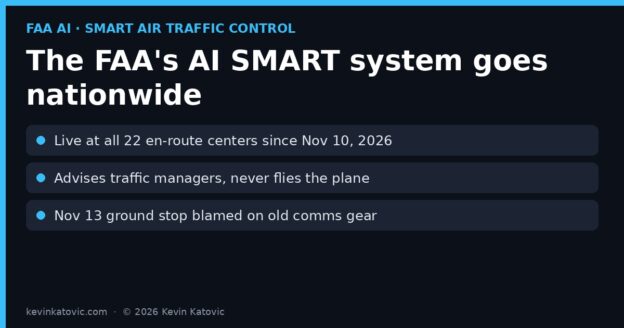
The FAA now has an AI system helping run American skies. On November 10, 2026, the agency switched on SMART, short for Strategic Management of Airspace, Routes and Trajectories, at all 22 of its Air Route Traffic Control Centers. Three days later the whole country had a ground stop. People connected the two straight away, so let’s look at what FAA AI actually does and what it doesn’t.
What the FAA smart system does
SMART is a planning tool, not a robot controller. It looks ahead at weather, traffic volume and airport capacity, then suggests reroutes, departure times and spacing before the jam builds. The FAA’s goal is to move air traffic management from reacting to predicting. Local traffic managers see the suggestion and can accept or reject it. In the agency’s own words, SMART “cannot be used to replace the critical role air traffic controllers play or take over control of an aircraft.”
The system came from a startup called Air Space Intelligence, which won a 12-year, roughly $875 million FAA contract in June 2026. Testing started small around Washington, D.C. on September 21, covering Reagan National, Dulles and BWI. Early reports credit it with rerouting about 180 flights.
Smart air traffic control vs. the old way
| Before SMART | With SMART | |
|---|---|---|
| Planning | Mostly reactive, phone and spreadsheet heavy | Predictive suggestions hours ahead |
| Who decides | Traffic managers | Still traffic managers (AI only advises) |
| Coverage | Center by center | All 22 en-route centers since Nov 10, 2026 |
| Talks to the pilot? | No | No |
Did AI cause the November 13 ground stop?
On the evidence so far, no. The stoppage came from a communications outage that hit every en-route center at once, and departures were held for more than four hours. Transportation Secretary Sean Duffy blamed old, overloaded communications equipment and said SMART played no role, and Air Space Intelligence said the same. That fits the design: an advisory tool that suggests reroutes doesn’t carry radio or data links. The awkward timing still matters, though, and it’s fair to ask questions. The air traffic controllers’ union says it wasn’t involved in designing or testing SMART, and lawmakers had already asked for a pause in October.
It’s the same worry Geoffrey Hinton keeps raising about putting AI into critical systems: the more the machine looks after, the more one failure can spread. If you want the long version, here’s Hinton’s warning about an AI-triggered grid meltdown. There’s also a procurement angle. Washington has been very public about which AI vendors it trusts, as the Pentagon’s fight over which chatbots count as a supply-chain risk showed.
Why the computing side matters
Systems like this run on a lot of data: every flight plan, weather feed and radar track, all updated constantly. That computing has to live somewhere, and the bill for it is real. For a sense of what serious AI hardware costs to run, this breakdown of what a 100 MW AI facility spends every year is a good start, and this free configurator lets you price out an AI server room from the chips up. For the rest of that week’s AI news, see the early-November AI news roundup.
My take
A smart FAA is overdue. Much of the equipment controllers rely on is decades old, and Duffy is now asking Congress for $50 billion in emergency funding. AI that spots a jam three hours early is a good idea. It just has to sit on top of reliable radios, power and wires, because on November 13 those were what failed.
FAQ
What is the FAA smart system?
SMART (Strategic Management of Airspace, Routes and Trajectories) is an AI planning tool that suggests reroutes and departure times ahead of congestion. Traffic managers accept or reject each suggestion.
Does FAA AI replace air traffic controllers?
No. The FAA says SMART cannot replace controllers or take control of an aircraft. It only advises traffic managers.
Did the SMART AI cause the November 13, 2026 ground stop?
Officials and the vendor say no. The ground stop followed a communications outage at all 22 en-route centers, which the Transportation Secretary blamed on old, overloaded equipment.
Who built the FAA’s AI system?
Air Space Intelligence, which won a 12-year, roughly $875 million FAA contract in June 2026.
Sources: FAA and U.S. DOT announcements (June 22 and November 10, 2026), AVweb, Washington Times, CNBC, Axios and PBS coverage of the November 13, 2026 ground stop. Opinion and commentary, not financial advice.
Cover graphic © 2026 Kevin Katovic, all rights reserved. To license it, email support@kevinkatovic.com.