The Polygon Ecosystem Token (POL) is the token that replaced MATIC in 2024. It was built to be a “hyperproductive” token: one asset that can be staked once to secure many chains, earn rewards from each, and pay gas on Polygon PoS. It trades near $0.0763 with about 10.66 billion in circulation. Here is what makes POL different from MATIC and how it works.
Polygon Ecosystem Token at a Glance
| Metric | Value |
|---|---|
| Name / ticker | Polygon Ecosystem Token / POL |
| Replaced | MATIC, 1:1, from September 4, 2024 |
| Initial supply | 10 billion |
| Emission (design) | about 2% a year for 10 years |
| Price | $0.0763 |
| Market cap | $813.6 million |
What “Hyperproductive” Means
MATIC secured one chain. POL is meant to secure many. A validator stakes POL once and can then validate for multiple chains connected through the Agglayer, earning protocol rewards, transaction fees and possibly extra tokens from each chain. The more chains that use POL for security, the more work each POL does.
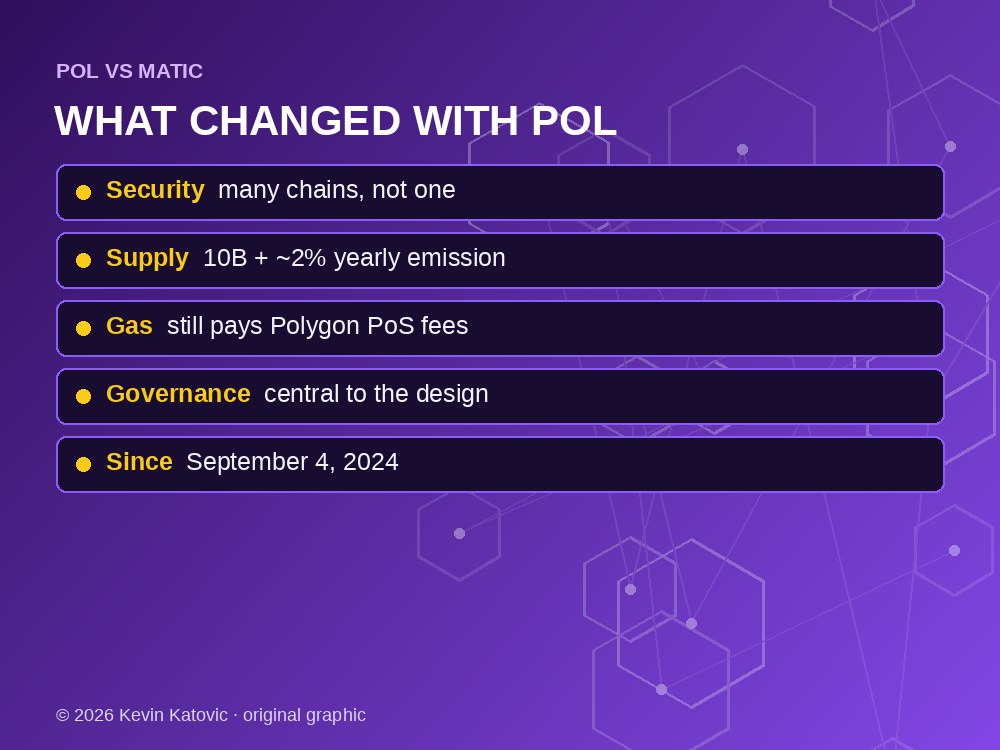
POL vs MATIC
| MATIC | POL | |
|---|---|---|
| Chains secured | Polygon PoS only | Many chains via the Agglayer |
| Supply | Fixed at 10 billion | 10 billion + yearly emission |
| Gas on Polygon PoS | Yes (until 2024) | Yes |
| Governance | Limited | Central to the design |
Has It Worked So Far?
The technology is arriving (Agglayer v1.0 went live on November 23, 2026), but the market has not rewarded it: POL is down 44% in a year and set a low of $0.0677 in July. Shared security only pays off if many busy chains adopt it.
Why It Matters Beyond Crypto
Infrastructure follows the same logic in every industry: shared capacity is efficient if demand shows up. Neoclouds face the same question with GPUs; here is Nebius, CoreWeave and IREN compared. Location and power decide the economics, which is why tools like software for choosing a data center site and documents like Idaho’s tariff for big power users matter. Polygon also hosts the playful side of crypto, such as the GOATED legends mint.
If you want to try that logic on your own project, model an AI build with real tariffs.
How to Stake the Polygon Ecosystem Token
Most holders stake POL by delegating to a validator through Polygon’s official staking dashboard. You connect a wallet, choose a validator based on its commission, uptime and reputation, and delegate your tokens. Rewards accrue over time and can be claimed or restaked. Unstaking starts an unbonding period, during which your tokens are not available, so do not stake money you may need quickly.
Rewards and Risks of Staking POL
- Rewards: a variable yield, paid mostly from emissions and fees.
- Validator risk: poorly run validators can earn less, and serious misbehaviour can be penalized.
- Price risk: staking rewards do not protect you if the price falls.
- Lock-up: the unbonding period delays access to your tokens.
POL and the Agglayer
The Agglayer is the system that makes POL’s multi-chain role possible. Chains that connect to it can share liquidity and move assets with proofs instead of risky bridges. In Polygon’s design, POL stakers can provide security to these chains and earn from them. Agglayer v1.0 went live on November 23, 2026, which means the infrastructure for this vision is now in production, even though the economics are still developing.
Governance and the Ecosystem Token
POL holders can participate in Polygon’s governance through Polygon Improvement Proposals and community discussion. Decisions about emissions, upgrades and controversial topics such as the proposed recovery of about 70.49 million POL from blocked addresses run through that process. If you hold POL, governance is where the token’s future is decided.
Where to Hold POL
You can hold POL on Ethereum or on Polygon PoS. On Polygon PoS it pays gas directly; on Ethereum it is an ERC-20 token, and staking contracts live there. Many people keep some POL on Polygon PoS for fees and stake the rest. Make sure you know which network you are using before sending tokens anywhere.
Polygon Ecosystem Token in One Sentence
POL is MATIC’s more ambitious successor, built to secure many chains, now priced around $0.0763, with a design that will only pay off if those chains and their users show up.
Is POL a Good Long-Term Hold?
That depends on whether you believe the Agglayer and Polygon’s payments push will attract enough activity to outpace emissions. It is a reasonable bet for some and a poor one for others. Either way, it is a high-risk asset, so keep positions modest and diversified.
POL Myths and Facts
- Myth: POL is a rebrand with no changes. Fact: it has a different supply model and a multi-chain security role.
- Myth: you must claim POL. Fact: exchange and Polygon PoS balances converted automatically.
- Myth: staking guarantees profit. Fact: rewards can be outweighed by price drops.
Knowing the facts makes it easier to ignore hype in either direction.
With POL near $0.0763, the market is sceptical. Whether that scepticism is right will come down to adoption of the Agglayer and payments on Polygon over the next few years.
Keep a close eye on those adoption numbers as they come in.
Holding the Polygon Ecosystem Token already?  buy crypto with the SCR Auto-Buy page, which turns POL or any Polygon token into $SCR in one send.
This article is general information, not financial advice. Crypto prices move fast and you can lose money. Check the live price before you buy or sell anything.
Frequently Asked Questions
What is the Polygon Ecosystem Token?
POL, the token that replaced MATIC 1:1 in 2024. It pays gas on Polygon PoS and is designed to secure many chains through the Agglayer.
What does hyperproductive token mean?
A token that can be staked once to secure multiple chains and earn rewards from each, instead of securing a single chain.
Is POL the same as MATIC?
No. POL is a new token with a different design. MATIC holders received POL one-for-one.
How much is the Polygon Ecosystem Token worth?
About $0.0763 per POL on November 25, 2026 (5:40 p.m. Pacific).
Images in this post: © 2026 Kevin Katovic · original graphic. © 2026 Kevin Katovic, all rights reserved. To license an image, email support@kevinkatovic.com.