Polygon is a blockchain project that runs fast, low-cost networks compatible with Ethereum. Its main chain, Polygon PoS, handles payments, tokens and apps for a fraction of a cent per transaction, and its Agglayer links multiple chains so assets can move between them. The network’s token is POL. Here is Polygon in 2026, from the tech to the people to the price.
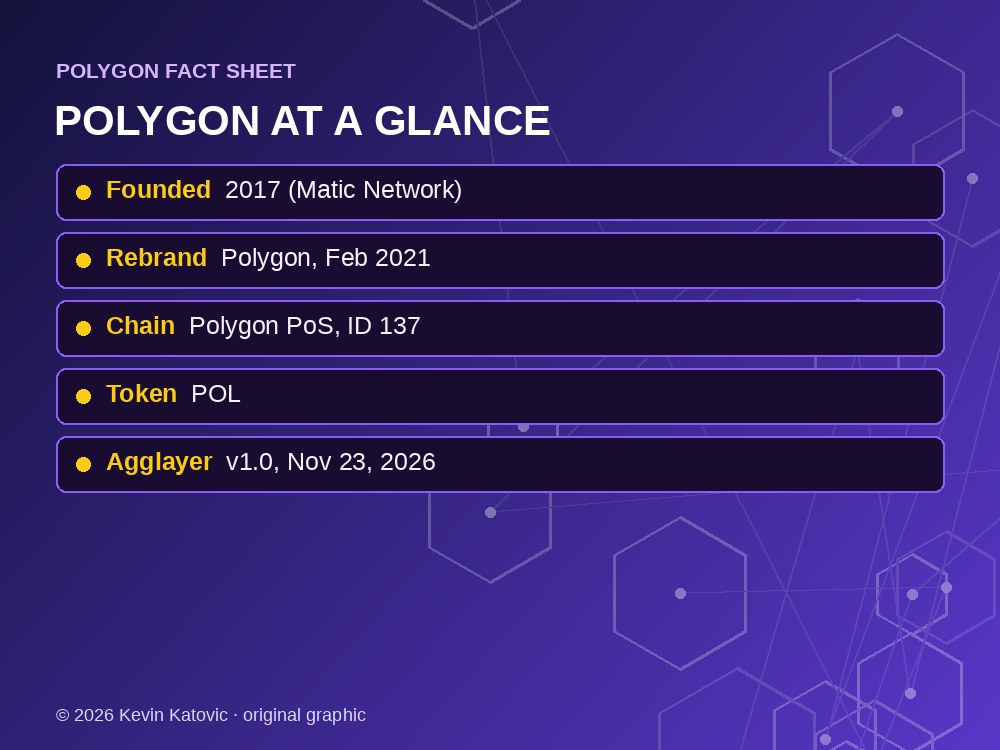
Polygon at a Glance
| Metric | Value |
|---|---|
| Founded | 2017 as Matic Network |
| Rebranded | Polygon, February 2021 |
| Main chain | Polygon PoS (chain ID 137) |
| Token | POL (replaced MATIC in 2024) |
| Cross-chain layer | Agglayer, v1.0 live November 23, 2026 |
| Token price | $0.0763 (Nov 25, 2026) |
| Market cap | $813.6 million |
How Polygon Works
Validators stake POL, produce blocks and post checkpoints to Ethereum. Users pay fees in POL. Because Polygon runs the Ethereum Virtual Machine, developers deploy the same code, and users keep the same wallet addresses. The Agglayer adds a layer above individual chains, using zero-knowledge proofs to make cross-chain transfers safe and fast.
What Polygon Is Used For in 2026
- Stablecoin payments: the strategic focus, with partners like SoFiUSD, Nuvera and Bennu.
- DeFi: lending, swapping and liquidity, including one-click flows through Polygon Trails.
- Games and NFTs: cheap minting keeps collectibles and game items on Polygon.
- Prediction markets: Polymarket, the best-known prediction market, settles on Polygon.
The Debates Around Polygon
Critics point to the token’s 44% yearly decline, the dilution from emissions, and the governance proposal to recover about 70.49 million POL from blocked addresses via a hard fork, which raises questions about neutrality. Supporters point to real payments adoption and the Agglayer shipping on schedule.
Polygon and the Compute Boom
Blockchains are infrastructure, and infrastructure is having a moment thanks to AI. If you follow that side, the AI headlines from the week of November 7, Super Micro’s latest quarter explained and a 10-year cost model for a prefab AI factory are good places to start, and how much water AI data centers really use is a useful reality check.
And if you are planning hardware yourself, price your own AI build.
Polygon’s Main Products
| Product | What it does | Who uses it |
|---|---|---|
| Polygon PoS | Main public chain for apps and payments | Users, developers, payment firms |
| Agglayer | Connects chains, settles cross-chain transfers | Chain builders |
| Open Money Stack | Payments and stablecoin infrastructure | Fintechs, banks, payment companies |
| Polygon Trails | One-click funding and liquidity for apps | DeFi and prediction market apps |
| POL | Gas, staking, governance | Everyone on Polygon |
How Polygon Compares With Other Networks
Polygon competes with other low-fee networks such as Ethereum rollups, Solana and payment-focused chains. Its strengths are Ethereum compatibility, a long track record, a large set of existing integrations and its push into regulated payments. Its weaknesses are a token that has underperformed and a crowded field of rivals offering similar speed and cost.
Using Polygon for the First Time
- Install a reputable wallet such as MetaMask and back up the recovery phrase on paper.
- Buy a small amount of POL on a regulated exchange and withdraw it on the Polygon network.
- Try a simple action: send tokens to yourself or swap a little POL for a stablecoin.
- Explore apps only through official links and bookmarks.
Polygon’s Biggest Milestones
- 2017: Matic Network founded.
- 2019: MATIC token launches.
- 2020: PoS mainnet goes live.
- 2021: rebrand to Polygon and explosive growth.
- 2024: MATIC upgrades to POL.
- 2026: Agglayer v1.0 and a payments-first strategy.
Is Polygon Safe to Use?
Polygon has run its main chain since 2020, but like every blockchain it carries risks: software bugs, bridge exploits elsewhere in the industry, and, most commonly, scams aimed at users. Keep amounts small while you learn, verify every link and contract, and never share your recovery phrase.
What to Expect From Polygon in 2027
If the current strategy holds, expect more payment partners, more chains connected to the Agglayer, decisions on emissions, and the outcome of the proposed recovery hard fork. Those developments, more than price swings, will show whether Polygon becomes core financial infrastructure or remains one cheap chain among many.
Polygon in a Nutshell
Fast, cheap and Ethereum-compatible, Polygon is betting on payments and interoperability. Its token, POL, trades near $0.0763. The network is busy and evolving; the token’s value will depend on whether that activity keeps growing.
Who Should Pay Attention to Polygon
Developers looking for cheap, Ethereum-compatible infrastructure; businesses exploring stablecoin payments; collectors and gamers; and investors considering POL. Each group cares about different parts of the network, but all of them benefit from understanding how the pieces fit together.
Polygon is a lot bigger than its token price suggests. Whether you use it, build on it or invest in it, start small, learn how it works, and judge it by what people actually do on it.
Polygon Quick Facts
- Chain ID 137 for Polygon PoS.
- Token: POL, formerly MATIC.
- Fees: usually a fraction of a cent.
- Focus in 2026: stablecoin payments and the Agglayer.
Those four facts cover most of what newcomers need to know before trying Polygon for the first time.
Start there, and the rest of Polygon becomes much easier to explore safely.
Want to try Polygon for yourself?  buy crypto with the SCR Auto-Buy page, which turns POL or any Polygon token into $SCR in one send.
This article is general information, not financial advice. Crypto prices move fast and you can lose money. Check the live price before you buy or sell anything.
Frequently Asked Questions
What is Polygon?
A blockchain project running fast, low-cost Ethereum-compatible networks, led by Polygon PoS and linked by the Agglayer. Its token is POL.
Is Polygon a layer 2?
Polygon PoS is commonly described as an Ethereum sidechain that checkpoints to Ethereum; Polygon also builds zero-knowledge technology and the Agglayer to connect chains.
What is Polygon used for?
Stablecoin payments, DeFi, games, NFTs and prediction markets such as Polymarket.
What is Polygon’s token?
POL, which replaced MATIC one-for-one in 2024. It traded near $0.0763 on November 25, 2026 (5:40 p.m. Pacific).
Images in this post: © 2026 Kevin Katovic · original graphic. © 2026 Kevin Katovic, all rights reserved. To license an image, email support@kevinkatovic.com.