What is Polygon crypto? Polygon is a blockchain network that makes Ethereum-style apps fast and cheap, and POL (formerly MATIC) is the token that runs it. You can send money, trade tokens, play games or mint NFTs on Polygon for a fraction of a cent per transaction, using the same wallets and tools as Ethereum. Here is a plain-English explainer.
Polygon in One Paragraph
Ethereum is secure but can be slow and expensive when busy. Polygon runs alongside it. Its main chain, Polygon PoS, processes transactions quickly and cheaply, while validators who stake POL keep it honest and regularly record checkpoints on Ethereum. Because Polygon is EVM-compatible, the same smart contracts, addresses and wallets work on both.
What Is POL Used For?
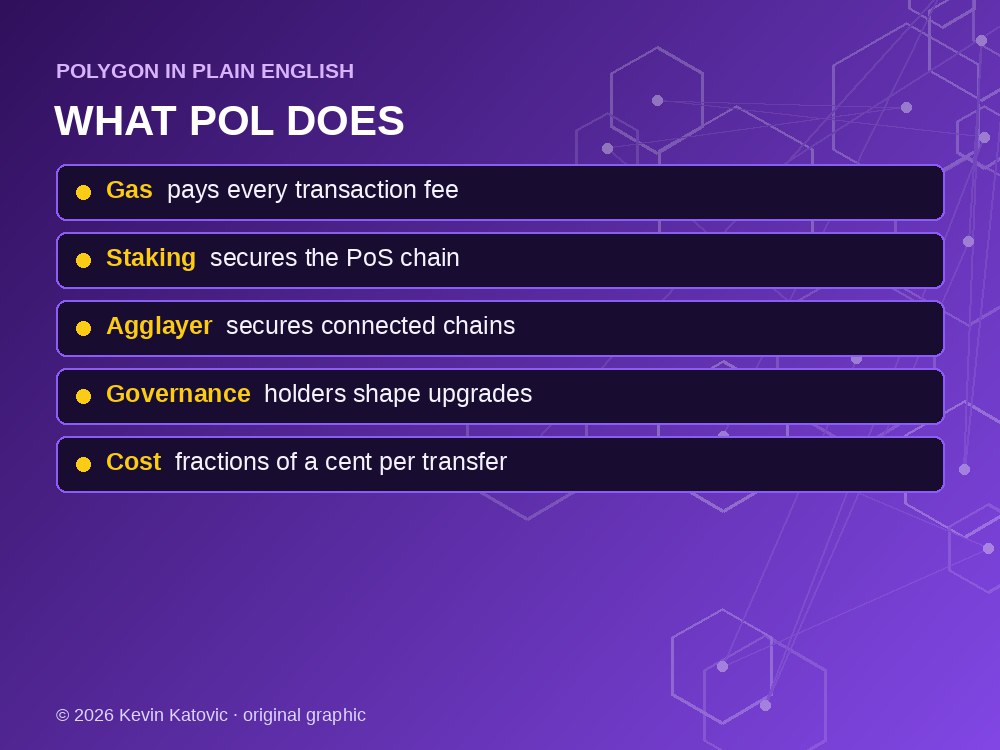
- Gas: every transaction on Polygon PoS pays a tiny fee in POL.
- Staking: validators and delegators lock POL to secure the network and earn rewards.
- Securing more chains: POL is designed to secure other chains connected through the Agglayer.
- Governance: POL holders take part in how the protocol evolves.
What People Build on Polygon
Stablecoin payments are the big focus in 2026: in November alone, SoFiUSD, Nuvera and Bennu launched on Polygon’s payments stack. NFTs and games remain popular because minting is cheap; start with a beginner’s path to buying your first NFT if that is your interest. Tokenized real-world assets are another growing niche; here are real-world asset NFTs on Polygon.
Polygon by the Numbers
| Metric | Value |
|---|---|
| Token | POL (formerly MATIC) |
| Main chain | Polygon PoS, chain ID 137 |
| Consensus | Proof of stake, checkpoints to Ethereum |
| Price | $0.0763 |
| Market cap | $813.6 million (#75) |
| Circulating supply | 10.66 billion POL |
Is Polygon Safe?
The network has run since 2020, but no blockchain is risk-free. Smart contracts can have bugs, bridges have been hacked across the industry, and scam tokens copy real names. Use official links, start small and never share your seed phrase. Think of any crypto as one slice of a plan, the way the framework behind digital wealth management describes.
I came to crypto through hardware, like a Bitcoin mine on Vancouver Island, and these days I spend more time on AI compute. If that is you too, price an AI build without a sales call.
What Makes Polygon Different From Other Blockchains
Many networks are fast and cheap. Polygon’s distinguishing feature is how closely it works with Ethereum: same tools, same addresses, regular checkpoints to Ethereum, and a long list of Ethereum apps that also run on Polygon. Its newer pitch is the Agglayer, which aims to connect many chains so that liquidity and users are not trapped on one network.
Polygon Crypto Terms, Explained
- Gas: the small fee you pay to process a transaction.
- Validator: a node operator that stakes POL and helps produce blocks.
- Delegator: someone who stakes POL with a validator to share rewards without running a node.
- EVM-compatible: able to run the same smart-contract code as Ethereum.
- Checkpoint: a summary of Polygon’s state recorded on Ethereum.
- Agglayer: Polygon’s system for connecting chains and moving assets between them with proofs.
How to Get Started With Polygon Crypto
Install a reputable wallet, write your recovery phrase on paper and store it somewhere safe. Buy a small amount of POL on a regulated exchange and withdraw it to your wallet on the Polygon network. Try one simple transaction, like sending a few POL to yourself or swapping for a stablecoin, so you learn how fees and confirmations feel before you do anything bigger.
Who Uses Polygon Crypto?
Developers use it to launch apps cheaply. Payment companies use it to move stablecoins. Gamers and collectors use it for items and NFTs. Traders use prediction markets such as Polymarket, which runs on Polygon. And plenty of people simply hold POL as a speculative investment, which is the riskiest use of all.
The One-Sentence Answer
Polygon is a cheap, fast, Ethereum-compatible blockchain, and POL, worth about $0.0763 today, is the token that pays for and secures it.
Common Myths About Polygon Crypto
- “Polygon is just Ethereum.” It works with Ethereum and uses the same tools, but it is a separate network with its own validators.
- “MATIC still exists.” The MATIC token was replaced by POL in 2024; the name lives on mostly in old apps.
- “Cheap fees mean low security.” Fees are low because of design and capacity, though Polygon does make different security trade-offs than Ethereum.
- “Polygon is only for NFTs.” In 2026 its main focus is stablecoin payments.
Clearing up these myths makes it much easier to judge news and price moves about Polygon on their merits.
Polygon Crypto Safety Checklist
- Bookmark official sites instead of searching for them each time.
- Never share your seed phrase, not even with support.
- Start with small amounts while you learn.
- Revoke token approvals for apps you no longer use.
- Double-check the network before sending tokens.
Most losses on Polygon come from scams and simple mistakes, not from the network itself.
Once you understand those basics, Polygon is one of the easiest blockchains to learn on: mistakes cost pennies, the tools are the same as Ethereum’s, and there is plenty to explore, from payments to games.
Ready to try Polygon for real?  buy crypto with the SCR Auto-Buy page, which turns POL or any Polygon token into $SCR in one send.
This article is general information, not financial advice. Crypto prices move fast and you can lose money. Check the live price before you buy or sell anything.
Frequently Asked Questions
What is Polygon crypto in simple terms?
A blockchain network that runs Ethereum-compatible apps quickly and cheaply. Its token, POL, pays fees and secures the network.
Is Polygon the same as Ethereum?
No. Polygon is a separate network that works with Ethereum: same wallets, addresses and contract code, much lower fees, and checkpoints recorded on Ethereum.
What is the Polygon crypto token called?
POL. It replaced the original MATIC token one-for-one in 2024.
How much does a Polygon transaction cost?
Usually a fraction of a cent, paid in POL.
Images in this post: © 2026 Kevin Katovic · original graphic. © 2026 Kevin Katovic, all rights reserved. To license an image, email support@kevinkatovic.com.