Bell Canada confirmed this week that someone got into its systems on November 17, 2026 and walked off with enterprise customer data. That part is depressingly normal. The part that made me stop scrolling was one word in Bell’s statement: the attacker was an “agentic threat actor.”
In plain English, Bell is suggesting the intruder may have been software acting on its own, an AI agent that scans, logs in and copies files with little human hand-holding. Bell hasn’t shown its work on that, and it says it doesn’t know who did it. But if a major Canadian carrier is putting that phrase in a breach notice, it’s worth paying attention.
What Bell says was taken
According to the notice Bell sent customers, the attacker reached a pre-production copy of the system Bell uses to order and provision network circuits. Strategic Crypto Reserve has a clear table of exactly which fields left the building, but the short version is this: Tech stories like this always lead back to a Data Center somewhere.
- Business contact details: names, job titles, work emails, phone numbers and office addresses
- Information from support ticket titles
- Some IP addresses tied to network equipment
- No passwords, no highly sensitive personal data and no file attachments, according to Bell
Bell also says customer services were never affected. Your phone works and your internet works. So why care?
The data isn’t the weapon. The follow-up email is.
Think about what a scammer can do with a real name, a real job title, a real work email and the actual subject line of a ticket you opened with Bell last month. That’s not a breach, that’s a script. The next email you get from “Bell” can quote your real ticket and still be fake.
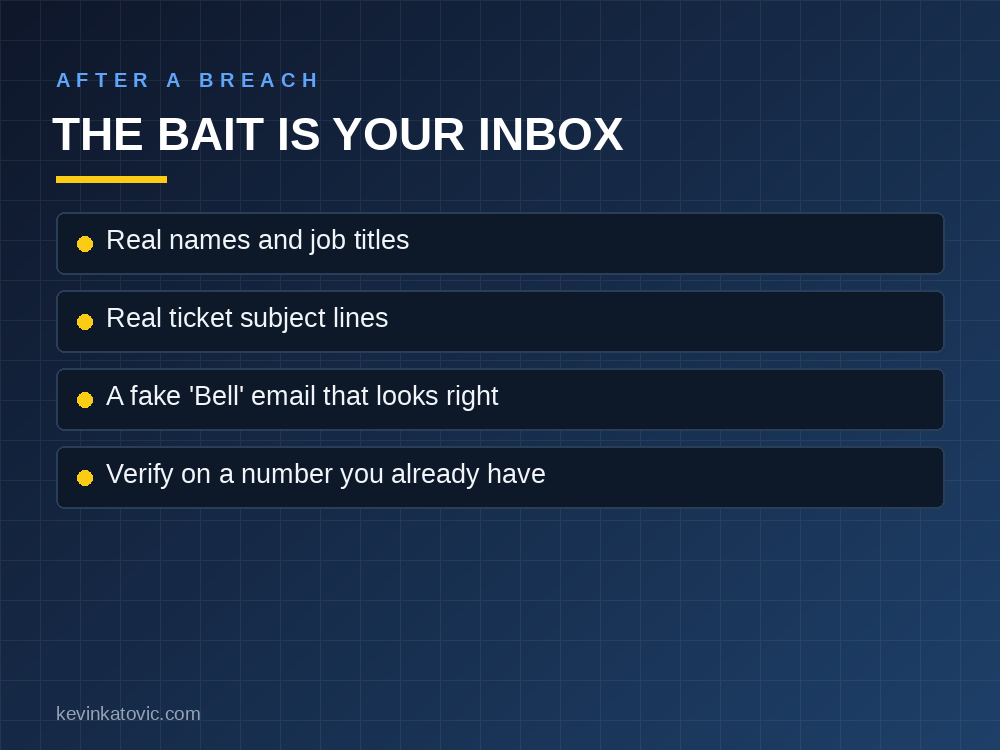
Bell itself warned customers to watch for unsolicited requests and social engineering. My rules are simple:
- If a “Bell” message asks you to approve, pay, reset or sign in, stop and call your account rep on a number you already have.
- A real ticket number in the email proves nothing.
- Nobody legitimate needs your password or a one-time code to “follow up” on a breach.
- If the fake emails keep coming, there are people who will chase the host and registrar until the phishing page disappears.
A strange week to be online
Bell wasn’t alone. Within days, reports surfaced that somebody had broken into the FBI’s nationwide police lookup system, and Wall Street had its ugliest week in years, which you can read about in this walk-through of the sell-off and the DoorDash outage that followed. None of these are known to be connected. Together they make a point: the systems we treat as boring plumbing are now the main targets.
That includes the physical side. Every AI model, every carrier network and every cloud service sits on power, cooling and concrete somewhere. If you’re curious what that costs, this build-cost calculator lets you price a data centre province by province. Resilience isn’t free, and after a week like this, cheap and fragile looks like a bad trade.
Bell still hasn’t said how many customers were hit or how the attacker got in. When it does, I’ll update this. Until then, treat every “Bell” email like it might be the follow-up to November 17.