The Polygon token price is about $0.0763 per POL as of November 25, 2026 (5:40 p.m. Pacific). What sets that price over time is the token’s design: how many POL exist, how many are created each year, and what POL is needed for. Here is POL’s tokenomics in plain terms, and how each piece pushes on the Polygon token price.
Polygon Token Price and Key Numbers
| Metric | Value |
|---|---|
| Token price | $0.0763 |
| Market cap | $813.6 million |
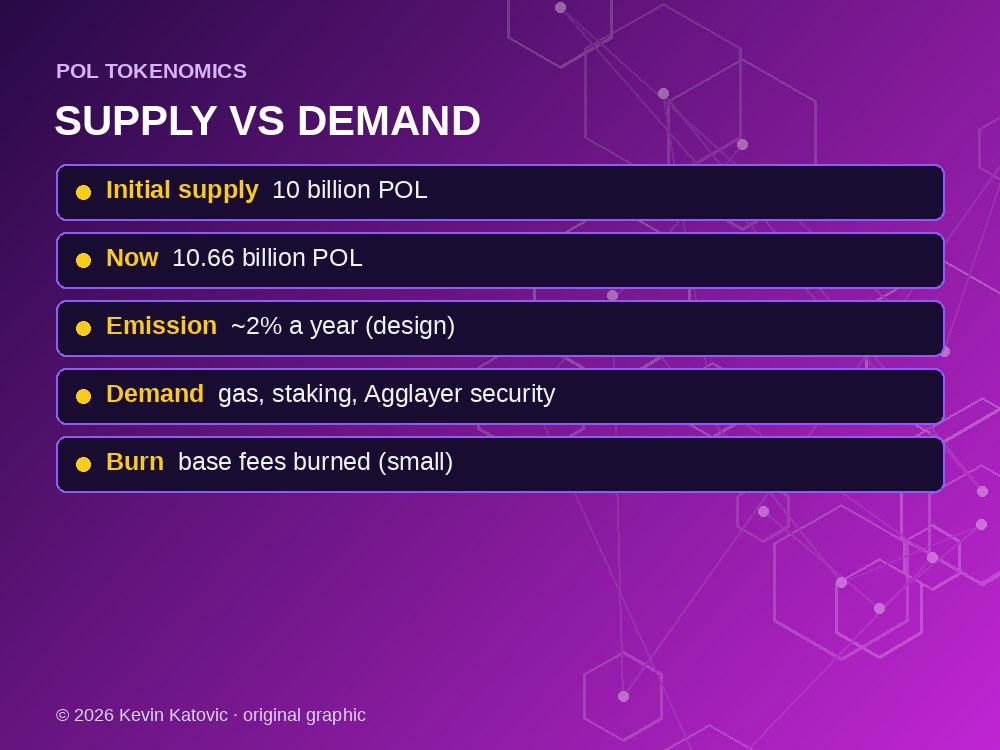
| Circulating supply | 10.656 billion POL |
| Initial supply | 10 billion POL (matching MATIC) |
| Designed emission | 2% per year for the first 10 years |
| Emission split | about 1% validators, 1% community treasury |
Demand Side: What POL Is Needed For
- Gas: every Polygon PoS transaction pays a small fee in POL.
- Staking: validators must stake POL; delegators stake to earn a share of rewards.
- Shared security: POL is designed to secure many chains through the Agglayer, earning fees from each.
- Governance: holders influence upgrades, including emission rates.
Supply Side: Emissions
POL’s designers chose a yearly emission so that validators and the ecosystem keep getting paid as the network grows. The trade-off is dilution. With supply already at about 10.66 billion, the Polygon token price needs growing demand just to stand still. If demand does not keep up, the price drifts lower, which is part of why POL is down 44% in a year.
Fees and Burns
Polygon PoS uses an EIP-1559-style fee model in which the base fee is burned. On a cheap chain those burns are small, so for now they barely offset emissions. Heavy, sustained usage from payments could change that balance, which is the bull case for the token.
How Tokenomics Compares With Stocks
Emissions work like a company issuing new shares every year: fine if the money builds something valuable, painful if not. If you are used to reading equities, compare it with how 42 AI data center stocks with live charts grow through capital spending, or how CoreWeave’s capex and build costs.
The Bottom Line
The Polygon token price is a tug-of-war between steady new supply and uncertain demand. Watch staking levels, real transaction volume and governance decisions on emissions; those matter more than headlines. I think about the AI side the same way, starting with what a data center costs per megawatt, and I keep every version of the configurator, logged for anyone curious how a product evolves. Want numbers for your project? see your own AI build priced line by line.
Comparing POL With Other Token Designs
Bitcoin has a hard cap and a shrinking issuance schedule. Ethereum issues new ETH to validators but burns fees, so its supply can rise or fall depending on activity. POL sits closer to the Ethereum model: steady issuance to validators and the treasury, with fee burns that are currently small. The difference is that Ethereum’s burns are large because its fees are high, while Polygon’s fees are deliberately tiny.
Who Holds POL?
A large share of POL is held on exchanges, by long-term holders, by validators and delegators who stake it, and by Polygon’s community treasury. Treasury tokens fund grants, development and ecosystem programs. When the treasury spends or sells tokens, that adds to the circulating supply, so treasury policy is another factor in the Polygon token price.
Governance Can Change the Math
POL’s emission schedule is not carved in stone. Holders and the community can propose changes through Polygon’s governance process, and emissions have been an active topic of debate. A vote to lower or end emissions would reduce dilution; a vote to raise them would increase it. Anyone holding POL long-term should follow those discussions.
What Would Make POL Tokenomics Work Better
- More chains using POL for security, adding real fee income for stakers.
- Higher transaction volume, increasing burns.
- Lower or targeted emissions that reward productive activity.
- Clear, transparent treasury spending.
Tokenomics Red Flags in General
Across crypto, warning signs include large unlocks for insiders, unlimited minting controlled by a single wallet, and supply data that is hard to verify. POL’s supply is public and its emissions are documented, which puts it ahead of many smaller tokens on transparency, even if the dilution itself weighs on price.
Polygon Token Price: The Takeaway
At about $0.0763, the Polygon token price reflects a market that doubts demand will outrun supply any time soon. If adoption accelerates or emissions fall, that view could change quickly. Until then, tokenomics are a headwind, and understanding them is the best defence against buying on hype.
A Quick Supply Calculator
Starting from about 10.66 billion POL and growing 2% a year, supply would be roughly 10.87 billion in one year, 11.31 billion in three years and 11.77 billion in five, if the design stays unchanged. Keeping the price flat over five years would require demand to grow roughly 10% in total.
Understanding these numbers will not tell you where the price goes tomorrow, but it will help you judge whether any story you hear about POL adds up.
Keep checking supply data as it changes.
If you hold POL and want a small, fixed-supply Polygon token, you can  buy crypto with the SCR Auto-Buy page, which turns POL or any Polygon token into $SCR in one send.
This article is general information, not financial advice. Crypto prices move fast and you can lose money. Check the live price before you buy or sell anything.
Frequently Asked Questions
What is the Polygon token price?
About $0.0763 per POL on November 25, 2026 (5:40 p.m. Pacific).
What is POL’s emission rate?
POL was designed with about 2% yearly emissions for its first 10 years, split between validators and a community treasury. Governance can change it.
Does Polygon burn tokens?
Yes. Polygon PoS burns the base fee of transactions, but on a cheap chain the amount is small compared with emissions.
Why does the Polygon token price keep falling?
A mix of weak altcoin markets and supply growth from emissions without matching demand growth.
Images in this post: © 2026 Kevin Katovic · original graphic. © 2026 Kevin Katovic, all rights reserved. To license an image, email support@kevinkatovic.com.