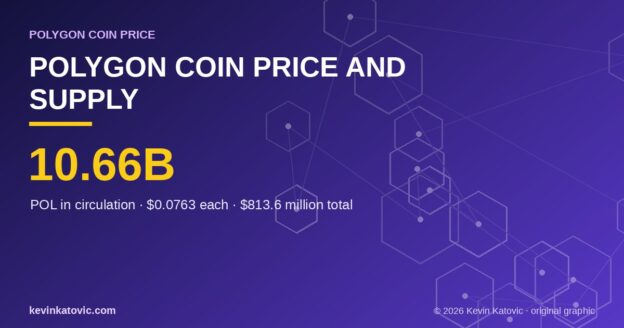
The Polygon coin price is about $0.0763 per POL today (November 25, 2026 (5:40 p.m. Pacific)). But the coin price only tells half the story: Polygon’s market cap is about $813.6 million because there are roughly 10.66 billion coins in circulation. Here is how supply shapes the Polygon coin price, and why a “cheap” coin is not automatically a bargain.
Polygon Coin Price and Supply
| Polygon coin | Value |
|---|---|
| Coin price | $0.0763 |
| Circulating supply | 10.656 billion POL |
| Market cap | $813.6 million |
| Rank | #75 |
| Launch supply (2023) | 10 billion POL |
| Designed emission | 2% per year (validators + community treasury) |
Why Supply Matters More Than the Sticker Price
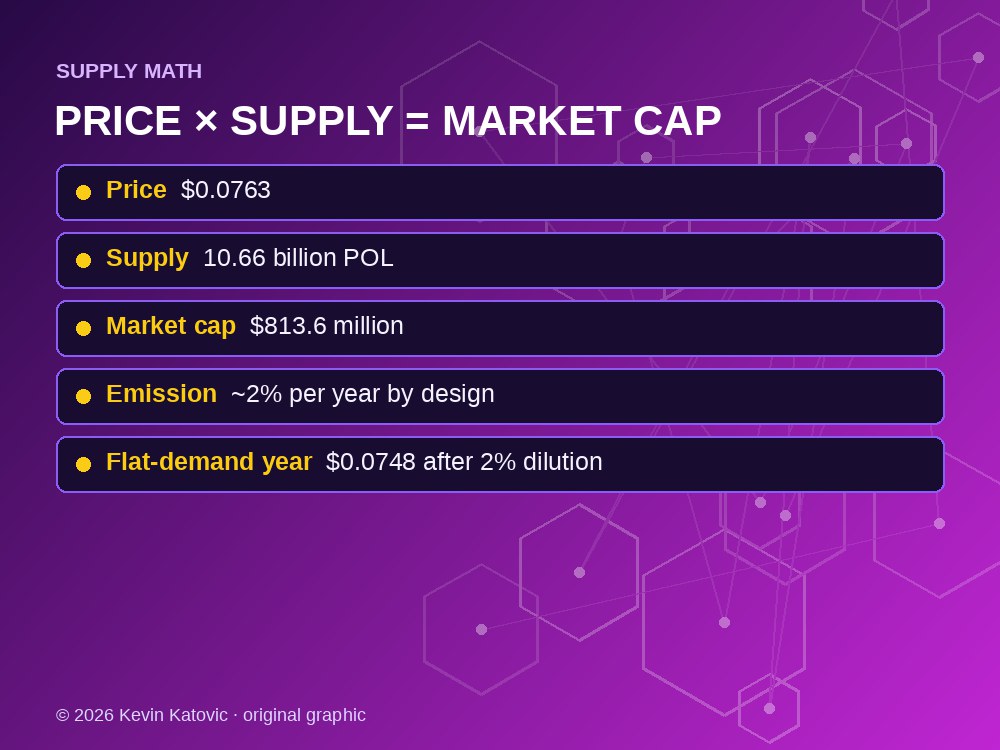
A coin at $0.08 is not “cheaper” than a coin at $80 in any useful sense. What matters is the total value of all coins (market cap) and how fast new coins appear. POL started with 10 billion coins, the same as MATIC, but was designed to add about 2% a year. Circulating supply has already grown to about 10.66 billion. If demand stays flat, each new coin dilutes the price a little.
A Quick Dilution Example
Imagine the market cap stays exactly at $813.6 million for a year while supply grows 2%. The price would slip from $0.0763 to about $0.0748 with nothing else happening. That is why a steady stream of real demand (gas usage, staking, payments) matters so much for POL.
Where the New Coins Go
- Validators: about half the emission rewards the people who secure Polygon PoS and other chains.
- Community treasury: the other half funds ecosystem grants and development.
- Governance: the emission rate can be changed by the community, so check current numbers before relying on 2%.
Polygon Coins in Everyday Use
Most people never think about any of this; they just use Polygon coins to pay gas. Small projects like the Strategic Crypto Reserve drop page run on that cheap gas, and so do collectibles from a zombie-themed collection on chain to seasonal drops. If you want to learn the investing side of collectibles, start with how people invest in NFTs and what to watch.
If you are on the hardware side, electrical design for a mining facility is where the real costs live, and you can estimate the power bill for an AI build.
Polygon Coin Price Compared With Its Market Cap Peers
A market cap of about $813.6 million places Polygon around rank #75. Tokens near that size include a mix of older smart-contract platforms, DeFi governance tokens and newer infrastructure projects. Being in that range means POL is liquid enough to trade on every major exchange, but small enough that a few large buyers or sellers can move it noticeably.
Fully Diluted Value: A Number to Watch
For tokens with a fixed maximum supply, analysts compare market cap with fully diluted value, the market cap if every token that will ever exist were already circulating. POL has no fixed cap, so its “fully diluted” figure keeps moving as emissions continue. The practical takeaway is the same: future supply matters, and you should factor it into any long-term view of the Polygon coin price.
Does Staking Reduce Supply?
Staking does not destroy coins, but it does lock them up. Staked POL securing the network cannot be sold instantly, because unstaking involves a waiting period. A high share of staked supply can therefore reduce the amount of POL that is actively traded, which can make price moves sharper in either direction. Rewards paid to stakers also come partly from emissions, so stakers are compensated for dilution while non-stakers are not.
Burned Fees and the Polygon Coin Price
Polygon PoS burns part of every transaction fee. Today those burns are small because fees are tiny. If usage grew dramatically, for example through stablecoin payments, burns could begin to offset some of the emissions. That is one of the long-term bull arguments for the Polygon coin price, but it would take a very large increase in activity to matter.
How to Think About Polygon Coins in a Portfolio
- Treat POL as a high-risk, high-volatility asset.
- Decide in advance what share of your savings you are comfortable risking.
- Rebalance occasionally rather than reacting to every move.
- If you stake, understand the unbonding period before you need the money.
Polygon Coin Price Summary
Each POL is worth about $0.0763, but with roughly 10.66 billion in circulation and new coins added every year, the number that really matters is whether demand grows faster than supply. Until it does, the price will struggle to climb.
Where to Find Reliable Supply Data
Supply figures on trackers come from data the projects and blockchains report. For Polygon, you can cross-check circulating supply on CoinGecko or CoinMarketCap and verify on-chain data through Polygon’s official explorers and staking dashboard. When numbers disagree slightly, it is usually because of differences in how locked or treasury tokens are counted, not because anything is wrong.
Put simply, judge Polygon by its total value and its supply growth, not by how many coins a dollar buys. A low coin price is a feature of a large supply, not a discount.
Want to swap some Polygon coins into a small project?  buy crypto with the SCR Auto-Buy page, which turns POL or any Polygon token into $SCR in one send.
This article is general information, not financial advice. Crypto prices move fast and you can lose money. Check the live price before you buy or sell anything.
Frequently Asked Questions
What is the Polygon coin price?
About $0.0763 per POL on November 25, 2026 (5:40 p.m. Pacific).
How many Polygon coins are there?
About 10.66 billion POL were circulating in November 2026, up from a launch supply of 10 billion.
Does Polygon have a maximum supply?
POL has no hard cap like MATIC’s 10 billion. It was designed with a yearly emission that governance can adjust.
Is a low coin price a good deal?
Not by itself. Compare market caps and supply growth, not the price per coin.
Images in this post: © 2026 Kevin Katovic · original graphic. © 2026 Kevin Katovic, all rights reserved. To license an image, email support@kevinkatovic.com.