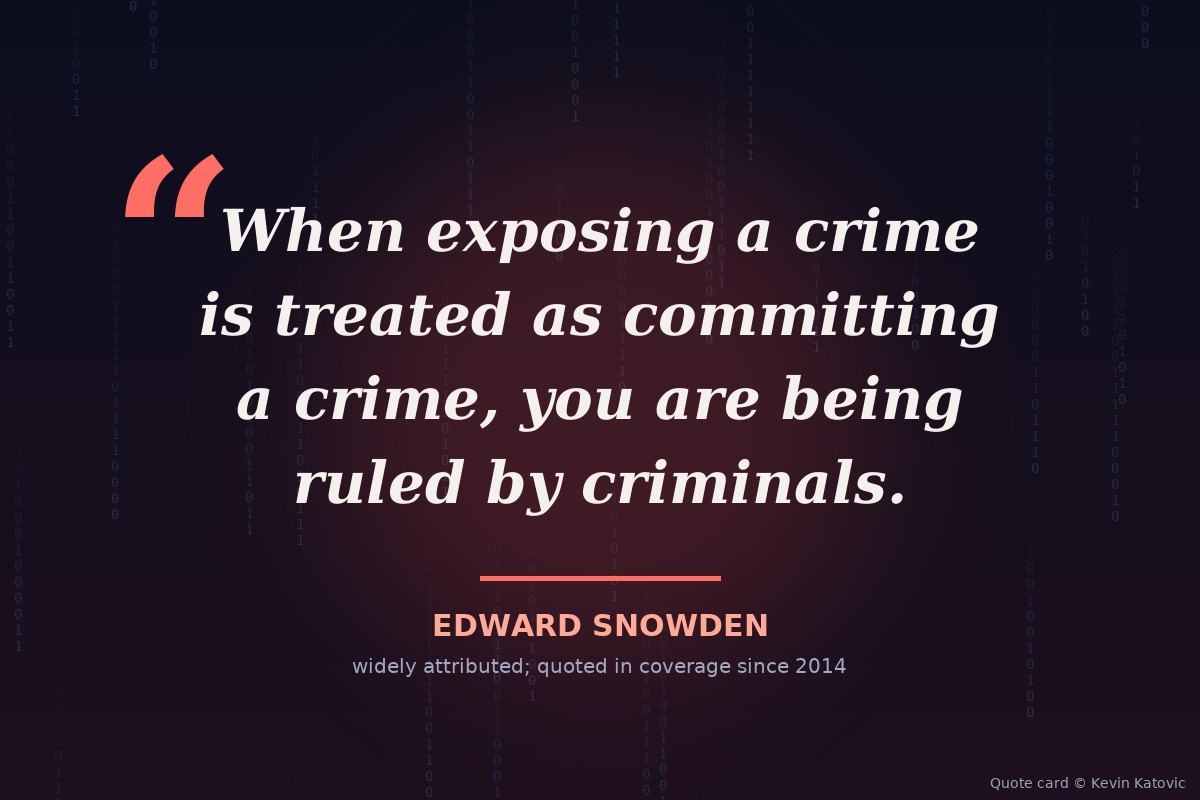
“When exposing a crime is treated as committing a crime, you are being ruled by criminals.”
That line, widely attributed to Edward Snowden, has been quoted for more than a decade. It is short enough to fit on a protest sign, but it carries a whole philosophy about truth, power and who gets punished. This post looks at what Snowden actually believes, how the law treats people who report wrongdoing, and what happened when I tried to report a fraud here in the Comox Valley.
Where the Quote Comes From
The sentence was already circulating as a headline in coverage of Snowden’s case by May 2014, a year after his disclosures about the U.S. National Security Agency. No single speech or interview has been pinned down as its first appearance, so the honest label is “widely attributed”. What is certain is that it matches what Snowden has said in his own words, again and again:
- 2013: in a letter released that November, he wrote that “speaking the truth is not a crime.”
- 2013: in his first interview with The Guardian he explained why he went public: “I do not want to live in a world where everything I do and say is recorded.”
- 2019: promoting his memoir Permanent Record, he told CBS News: “I’m not asking for a pass. What I’m asking for is a fair trial.”
- 2022: after Reality Winner’s case, he wrote that the government “has made telling the truth a greater crime than selling it”, comparing her sentence with a shorter one given to a man convicted of selling secrets to China.
Snowden’s Ideology in Plain Words
1. The crime should be the wrongdoing, not the telling
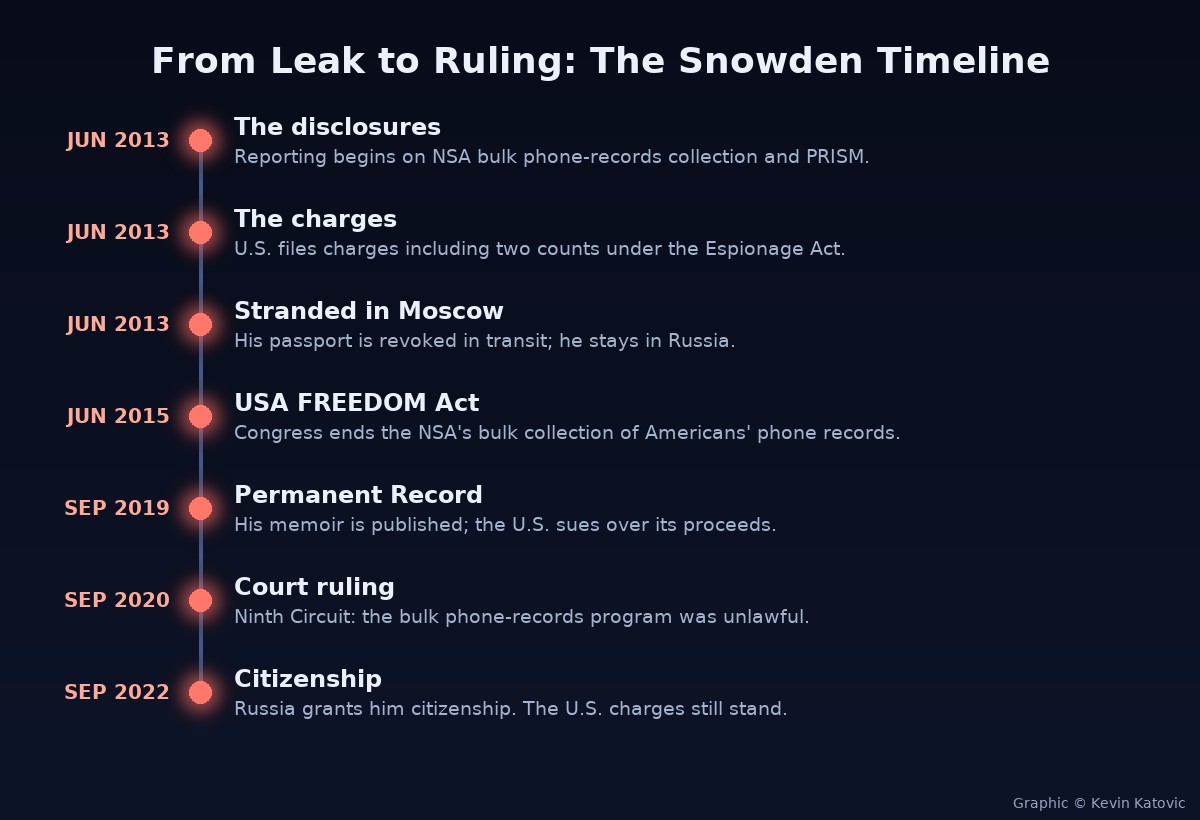
Snowden’s core idea is that when a government breaks its own laws in secret, the person who tells the public is not the criminal. In 2013 he revealed that the NSA was collecting the phone records of millions of Americans in bulk. Years later the system largely agreed that this was wrong: in 2015 Congress passed the USA FREEDOM Act, ending the NSA’s bulk collection of Americans’ phone records, and in September 2020 a U.S. federal appeals court (the Ninth Circuit) found that the bulk phone-records program had been unlawful.
Yet the charges against him, including two counts under the Espionage Act, still stand. That gap, where the program is ruled unlawful but the person who exposed it is still charged, is exactly what the quote is about.
2. A fair trial means being allowed to explain why
The Espionage Act dates from 1917. It does not let a defendant argue that a disclosure served the public interest, and it does not require the government to prove that anyone was actually harmed. Whistleblower advocates point out that this means a jury may never hear why someone spoke out. Snowden has said he would come home if he could make that argument in court. Human rights groups, including Amnesty International, have backed the idea of a public interest defense; critics, including the Washington Post’s editorial board, have argued it would open a loophole for anyone who leaks.
3. Privacy is a right, not a reward for having nothing to hide
Snowden’s argument against mass surveillance is that it treats everyone as a suspect. Watching everyone, all the time, flips the normal order: instead of the state needing a reason to investigate you, you need a reason to be left alone.
The other side
To be fair, many people see Snowden very differently. U.S. officials say his leaks went far beyond the domestic phone program, exposed intelligence methods used against foreign targets and harmed national security. He has lived in Russia since 2013, and Russia granted him citizenship in 2022, which critics point to as a problem in itself. You do not have to agree with everything he did to recognise the question he raised: what happens to the people who report wrongdoing?
The Same Question, Far From Washington
The idea is bigger than spy agencies. It applies whenever reporting a problem gets the person who reported it treated as the problem. That brings it right home to British Columbia.
B.C. has a whistleblower law, the Public Interest Disclosure Act, but it covers provincial ministries, health authorities, school boards and a list of other public bodies. The province’s own guidance says municipalities are not currently covered. That means a city or regional district employee in the Comox Valley who reports wrongdoing at work does not get the Act’s protection from reprisal. The B.C. Ombudsperson has recommended extending the Act to about 500 more public bodies, including local governments, and a special committee of the legislature is reviewing it now. Until that changes, the gap is real.
Fraud is local here too. In July 2026 the B.C. Securities Commission alleged that a former Comox Valley resident ran a $4.6 million crypto trading-bot scheme. Those allegations have not been proven. But they show that crypto fraud is not just something that happens somewhere else.
What Happened When I Reported Fraud Here
I know this from the inside, because I am one of those fraud victims. In July 2025 I was hit by a crypto “recovery” scam: a fake law firm advertising on Facebook as “Legal Recover” promised to recover money I had lost earlier. Over a few days in early July I paid them about 2.41 ETH, funded by draws from my BMO line of credit I know great its public right thats why your a idiot correct it was 14,600 CND at the moment total for ethereum I acquired between Jan-feb 2025. The money moved through a chain of wallets and landed at a major crypto exchange on July 7, 2025.
Here is what reporting it has looked like:
- Police: I had an open file with the Courtenay RCMP. On July 7, 2025, the same day the stolen funds reached the exchange, I was told on the phone that it was a civil matter, not a crime which was a crime and I was threatened with continual abusive inaction. I have a recording of that call.
- The bank: BMO has treated the balance as my debt were obstant most criminals are wrong but in power and seem to get away with it government?. Instead of a fraud investigation, it went to the bank’s lawyers and a collection agency, with two different account numbers and two different amounts on the paperwork.
- Watchdogs: the B.C. Ombudsperson told me it has no jurisdiction over banks. I filed with the Canadian Anti-Fraud Centre, filed a complaint about the police handling with the Civilian Review and Complaints Commission for the RCMP (CRCC) still they can’t seem to acknowledge the facts where are they?, and opened a formal complaint with BMO, copied to the banking ombudsman (OBSI).
Nobody has called me a criminal which is typical criminalization without charges which doesn’t matter if your entire detachment are criminals because you will never enforce the law because whats in place is criminal and you allow people to keep drawing criminally let me guess are all these rcmp bmo clients. But the pattern Snowden describes is the same in a smaller, quieter way: the person who reports the crime ends up carrying it. The scammers are gone. The money sits behind an exchange account that police could ask about. The victim gets the collection letters. When reporting a theft leaves you treated as the one in the wrong, it is fair to ask the same question Snowden asked: who is the system actually protecting?
My complaints are still open. OBSI can review a bank complaint 56 days after it is filed, which in my case is around November 23, 2026, and I will update this post as answers come in.
If It Happens to You
- Never pay a “recovery” service. Anyone who contacts you offering to get back lost crypto for a fee is almost always running the same scam a second time.
- Report it in writing to your police detachment and ask for a file number, then to the Canadian Anti-Fraud Centre.
- Put your bank on written notice that it is fraud, and ask for a complaint reference number and a final response.
- Escalate: OBSI for banks and investments, the CRCC for RCMP handling, the B.C. Securities Commission for investment fraud.
- Keep everything: transaction IDs, wallet addresses, screenshots, emails and call recordings where the law allows.
If the scam reached you as a fake website or email, you can check whether a website is legit before you pay anything, and have the scam site reported to its host and registrar so it comes down. The surveillance side of this debate is still moving fast, too: an AI company was blacklisted after refusing to allow mass domestic surveillance, and even AI’s pioneers are warning that some risks are being waved away. For the technology behind it all, there is the AI Build Configurator.
Frequently Asked Questions
What exactly did Edward Snowden say about exposing a crime?
The line widely attributed to him is: “When exposing a crime is treated as committing a crime, you are being ruled by criminals.” It was circulating in coverage of his case by May 2014, and it sums up arguments he has made since 2013, such as “speaking the truth is not a crime.”
Why can’t Snowden argue public interest at trial?
He was charged under the Espionage Act of 1917, which does not allow a defendant to argue that a disclosure served the public interest. Snowden has said he will return to the United States if he can get a fair trial that includes a public interest defense.
Are whistleblowers protected at Comox Valley municipalities?
Not by B.C.’s Public Interest Disclosure Act. The province’s own guidance lists municipalities as not covered. The B.C. Ombudsperson has recommended extending the Act to about 500 more public bodies, including local governments, and a legislative committee is reviewing it.
Where can a fraud victim in B.C. report a scam?
Report it to your local police and get a file number, to the Canadian Anti-Fraud Centre, and to your bank in writing. If the bank’s final answer doesn’t resolve it, the Ombudsman for Banking Services and Investments (OBSI) can review the complaint, and complaints about the RCMP’s handling go to the Civilian Review and Complaints Commission (CRCC).
Sources: Reason (May 2014), NPR (November 2013), The Guardian (June 2013), CBS News (September 2019), Benzinga (July 2022), Amnesty International, Government Accountability Project, Province of B.C. and B.C. Ombudsperson (Public Interest Disclosure Act), B.C. Securities Commission coverage (July 2026). My own case is described from my records; complaints are open and nothing has been decided.
All images in this post are original work by Kevin Katovic. © 2026 Kevin Katovic. All rights reserved.