
Google stock dropped about 10% after hours on October 28, 2026, when Alphabet’s Q3 earnings missed on profit. Wall Street is arguing about capex and cash flow. I think the bigger problem is the one nobody on the Google earnings call talks about: click fraud. My personal prediction is that Alphabet stock trades at $100 a share by the end of 2027. Here’s why, including what my own logs show about the paid Google clicks I’m billed for.
This is my opinion as an advertiser and investor, not financial advice. I don’t hold a short position in GOOG or GOOGL.
Google stock price: where GOOG and GOOGL stand
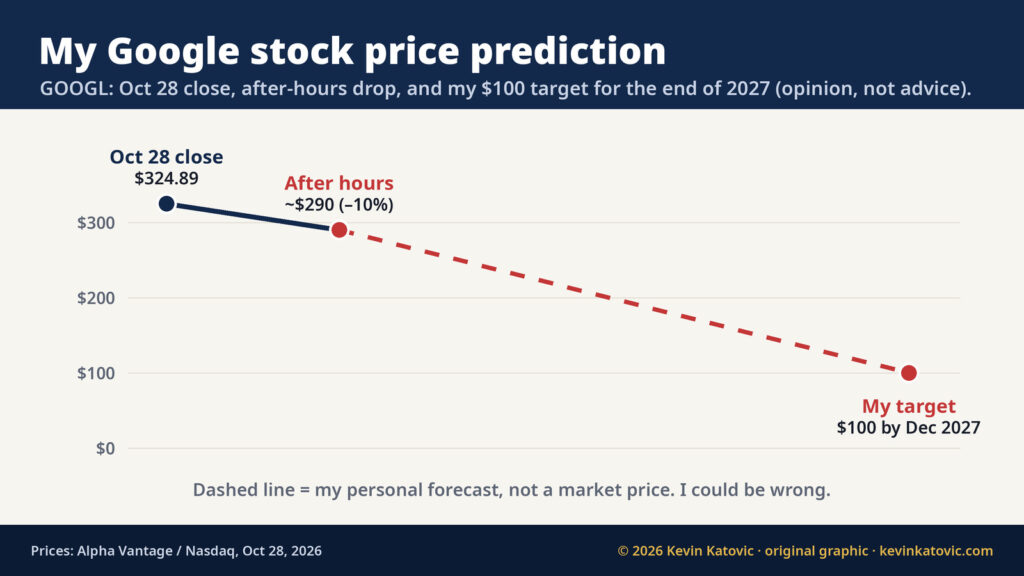
On Wednesday, October 28, GOOGL (the Class A shares) closed at $324.89 and GOOG (Class C) at $321.89. Then the results hit, and both tickers fell roughly 10% in after-hours trading, to around $290. GOOG stock and GOOGL stock move almost in lockstep, so the GOOG stock price and the Alphabet stock price told the same story: a sharp drop in one evening. If you search “$GOOG” this morning, that is the drop everyone is talking about.
For comparison, on the same stock market day Microsoft stock barely moved, closing at $531.01. The selloff was about Alphabet, not tech as a whole.
Alphabet earnings: the Q3 2026 numbers
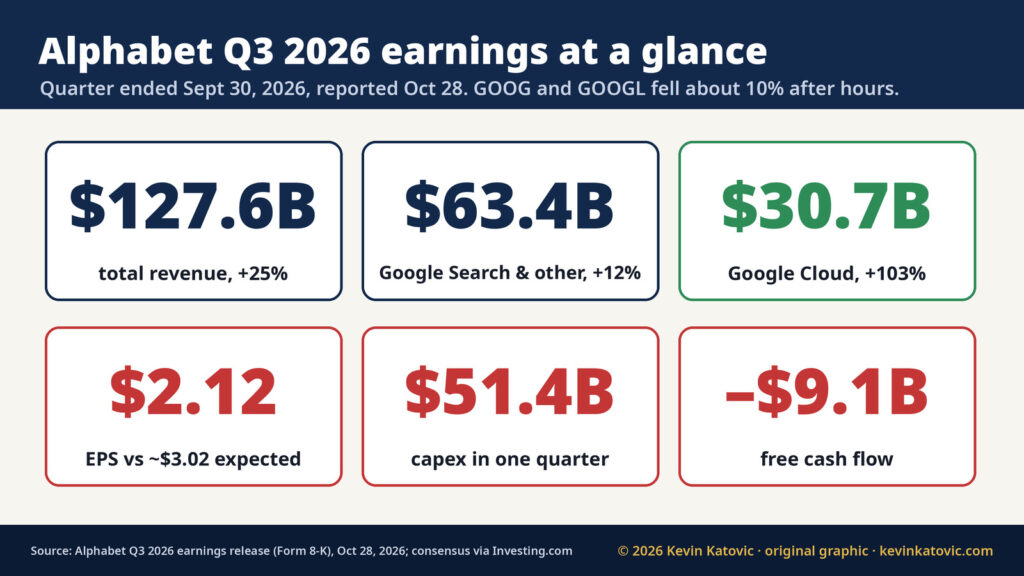
These Google Q3 earnings landed roughly in line on revenue but well short on profit. Here is what Alphabet’s Q3 2026 earnings release reported for the quarter ended September 30:
- Revenue: $127.6 billion, up 25%. Sundar Pichai called it “a half-trillion dollar revenue run rate.”
- Google Search & other: $63.4 billion, up 12%. YouTube ads brought in $11.2 billion and the Google Network $7.5 billion.
- Google Cloud: $30.7 billion, up 103%, with $11.1 billion in operating income.
- Earnings per share: $2.12, against roughly $3.02 analysts expected (Investing.com). An $8.2 billion hit in other income, mostly a paper loss on Alphabet’s SpaceX stake, did much of the damage.
- Spending: $51.4 billion of capital expenditure in a single quarter, full-year guidance of $195 to $205 billion, more in 2027, and free cash flow of negative $9.1 billion.
- Buybacks: none this quarter, against $11.5 billion a year ago.
My view: Google earnings are a multiplier, and click fraud is the weak link
Look at where the money comes from and where it goes. Search ads, YouTube ads and the ad network still pay the bills: about $82 billion of the quarter’s revenue. That ad income is what lets Alphabet spend $50 billion a quarter on data centers and chips, skip buybacks and still look healthy. The ad business is the multiplying factor that funds everything else.
I believe a real share of that daily ad income comes from clicks that were never a person interested in the ad. Some are bots, some are click farms, some are accidental taps, some are traffic from partner sites nobody would visit on purpose. Google says it filters invalid clicks and doesn’t charge for the ones it catches (Google Ad Traffic Quality). I don’t think it catches nearly enough. If even part of what advertisers pay for is fake, the true income is smaller than the headline, and so is the cash available to keep that spending going.
Here’s how I think it unwinds. Advertisers get better tools to measure their own traffic. They start demanding refunds, cutting budgets or moving to platforms that can prove real visitors. Search growth, already down to 12% while Cloud doubles, slows further. Then the market stops paying a premium for an ad engine it no longer trusts, while capex keeps climbing. That’s how I get to $100 a share by the end of 2027: roughly two-thirds below today. That’s a bold call, and most analysts on the Q3 earnings call were far more bullish. I’m writing it down so you can hold me to it.
Click fraud has cost Google in court before
- Lane’s Gifts v. Google (2006): a small Arkansas gift shop led a class action over invalid clicks. Google settled for $90 million, mostly as ad credits, without admitting liability.
- AdTrader and the invalid-activity refunds (2017 to 2022): advertisers alleged that when Google flagged clicks as invalid, it didn’t refund the full amount (The Register, 2017). The case ended in a $7 million settlement that got final approval in 2022.
- YouTube TrueView and Adalytics (2023): a researcher’s report questioned where skippable YouTube video ads were really running, and a proposed class action followed. Google disputed the report’s methods.
Three cases over two decades with the same theme: advertisers paying for clicks and views they believe weren’t real. Settlements this small are a rounding error for Alphabet. But each one shows the problem never went away, and I think the next round of lawsuits will be much bigger.
The script I built to log my paid Google traffic
I advertise on Google Ads, so I stopped taking the dashboard’s word for it. I wrote a script that logs every visit arriving from a paid Google click. It records the time, the network it came from, the country, how long the visitor stayed and whether they did anything a real person does.
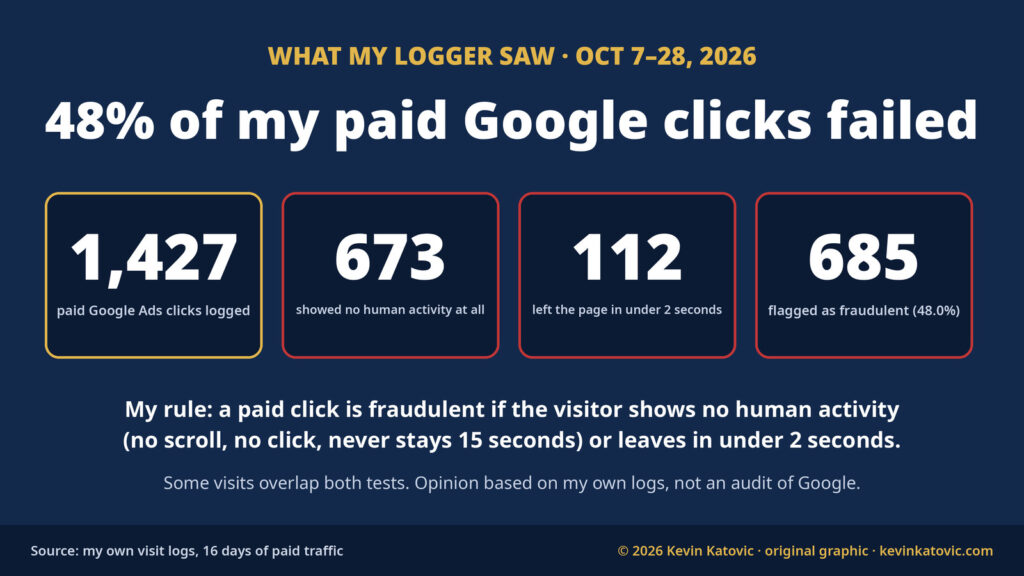
My rule is simple. I count a paid click as fraudulent if the visitor leaves in under 2 seconds, or shows no sign of a human at all: no scroll, no click, and never staying 15 seconds. Nobody reads, understands or even looks at a page in that time. I’m billed for the click anyway.
Over 16 days, from October 7 to 28, 2026, my logger recorded 1,427 paid Google Ads clicks. 673 showed no human activity at all, and 112 left in under 2 seconds. Combined, 685 clicks, 48%, failed my test. None of that shows up in GOOG earnings or GOOGL earnings reports, which only count what advertisers were billed. The biggest sources were India, Australia, Thailand and Saudi Arabia, many on mobile networks I’d never target on purpose. That’s my own data on my own small account, not an audit of Google. But if it’s anywhere near typical, advertisers like me are paying for a lot of clicks that never had a human behind them.
Google stock and the stock market today: what I would watch
- Search growth: if Google Search & other keeps slowing below 12%, the ad engine is cooling.
- Paid clicks and cost-per-click: Alphabet stopped putting these in the release. I’d want them back.
- Free cash flow: one negative quarter is a warning. Two in a row is a trend.
- New lawsuits from advertisers over invalid traffic, and any change to how Google refunds invalid clicks.
- The next Alphabet stock earnings date and Google earnings call (Q4 2026, expected late January or early February 2027).
Where I put my money instead
Google stocks aren’t the only way to play AI. I’d rather own the picks and shovels than an ad engine I don’t trust. Google keeps writing checks to the AI lab behind Claude, and all that capex flows to the people turning old bitcoin mines into AI data centers and designing mining and compute halls from scratch. On the crypto side, here’s how I would rank a crypto reserve today. And if you’re pricing out your own hardware, the AI Build Configurator does the math.
Google stock FAQ
What is the Google stock price today?
Before the Q3 report, GOOGL (Class A) closed at $324.89 and GOOG (Class C) at $321.89 on Wednesday, October 28, 2026. Both fell about 10% in after-hours trading once the earnings came out. Check a live quote for the current price.
What is the difference between GOOG and GOOGL?
Both are Alphabet stock. GOOGL is Class A and carries one vote per share; GOOG is Class C and has no vote. They usually trade within a few dollars of each other and share the same earnings.
How did Alphabet’s Q3 2026 earnings do?
Revenue rose 25% to $127.6 billion and Google Cloud grew 103% to $30.7 billion, but earnings per share were $2.12 against roughly $3.02 expected, free cash flow was negative $9.1 billion and capital spending hit $51.4 billion in the quarter.
What is your Google stock price prediction?
My personal prediction is $100 a share by the end of 2027. That is my opinion, based on my view that invalid and fraudulent ad clicks inflate Google’s real advertising income. It is not financial advice, and most Wall Street analysts disagree with me.
Has Google been sued over click fraud before?
Yes. Google paid $90 million in a 2006 click-fraud class action brought by Lane’s Gifts and other advertisers, and agreed to a $7 million settlement in 2022 over claims it did not fully refund advertisers for clicks it had judged invalid. Google did not admit wrongdoing in either case.
Sources: Alphabet Q3 2026 earnings release (SEC Form 8-K); Investing.com Q3 2026 earnings call transcript; ClickZ on the $90M Lane’s Gifts settlement; Bloomberg Law on the $7M invalid-click settlement; The Register on AdTrader v. Google; Marketing Beat on the Adalytics report; Google Ad Traffic Quality. Prices: Alpha Vantage, October 28, 2026 close.
Disclosure: opinion only, not financial advice. Click data comes from my own website logs. Images: the featured illustration and three original graphics by Kevin Katovic. © 2026 Kevin Katovic, all rights reserved. To license an image, email support@kevinkatovic.com.

AI-generated satirical illustration; fictional character
Pingback: Michael Burry vs Anthropic's IPO: Is AI Really That Fragile?