
The US military 90 day survival strategy is real, and it landed today. Under a Pentagon initiative called FORTRESS, every major military base in the continental United States is expected to keep running on its own for at least 90 days: its own power, water, fuel and communications, with no help from the civilian grid. Here is what it means, and why politicians in Indiana, Tennessee and California have every reason to pay close attention.
What the US military 90 day survival strategy says
Fox News Digital reviewed the FORTRESS documents and reported the details on October 25, 2026. The idea is simple and a little chilling: the Pentagon is planning for a major war that could cripple power grids, disrupt supply chains and threaten infrastructure on American soil.
“We don’t want to rely on standard civilian municipal infrastructure to run our national defense. We just simply can’t. It’s an intolerable risk,” Pentagon chief spokesperson Sean Parnell said. “Power is combat now.”
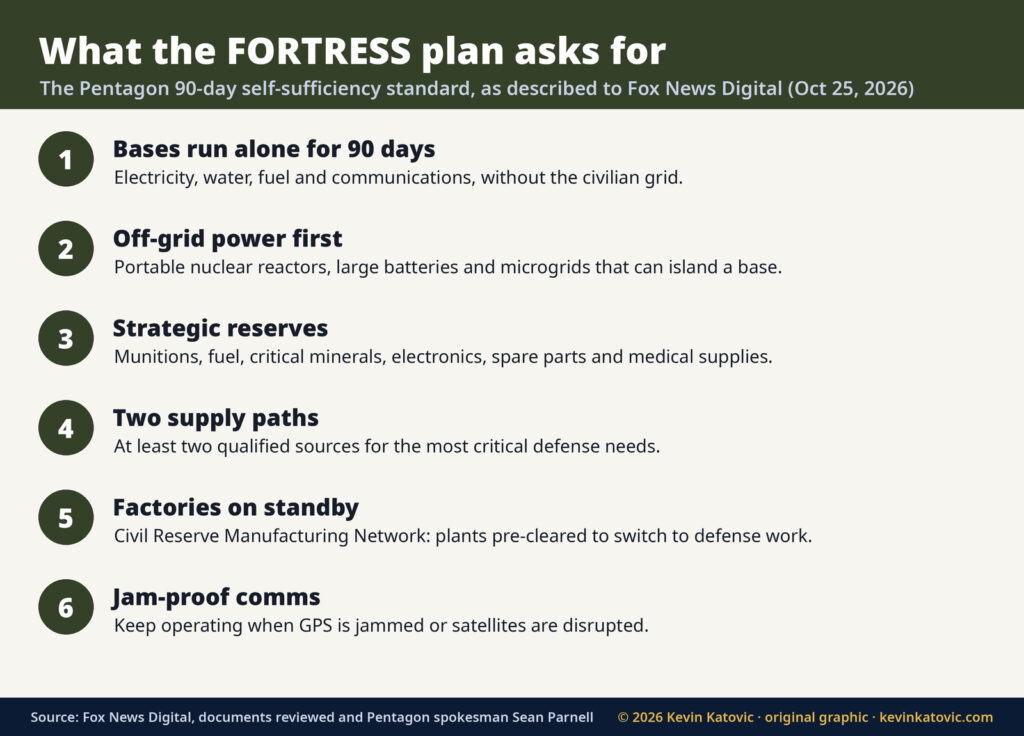
- 90 days alone. Every major continental US base must sustain essential operations for at least 90 days: electricity, water, fuel and communications.
- Off-grid power. Portable nuclear reactors, large battery banks and microgrids that can cut a base loose from the civilian grid.
- Stockpiles. Strategic reserves of munitions, fuel, critical minerals, electronics, spare parts and medical supplies, sized to how fast a war burns through them.
- Two of everything. At least two qualified supply or production paths for the most critical defense needs, so one lost factory cannot stop the military.
- Factories on standby. The Civil Reserve Manufacturing Network will line up commercial plants that can switch to defense production, with contracts, specs and cyber protections settled before a crisis, plus regular stress tests.
- Jam-proof comms. Plans to keep operating when GPS is jammed or satellites are disrupted.
Power comes first. The Army has already picked five bases for nuclear microreactors, Fort Bragg, Fort Campbell, Fort Hood, Fort Benning and Fort Drum, with about $2.2 billion planned over fiscal 2027 to 2031 and a first reactor targeted for September 2028. If you want a sense of the scale, my notes on how fast a megawatt bill adds up show why nobody runs a big site on hope.
Why Indiana, Tennessee and California politicians might be personally interested
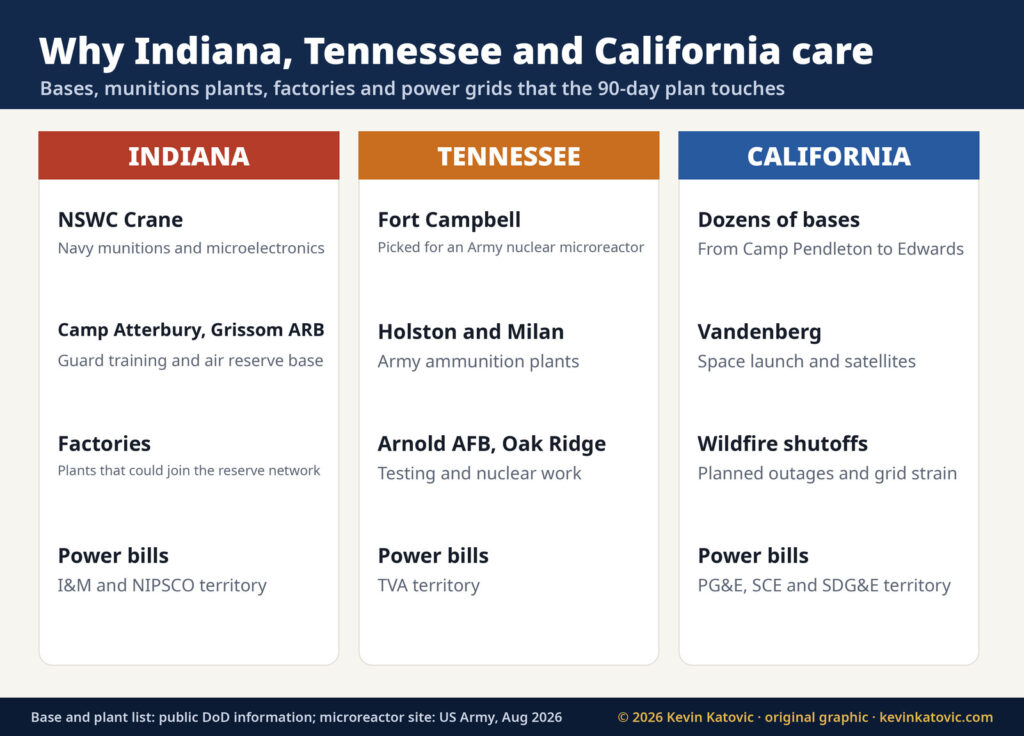
A 90-day standard means money, construction, contracts and hard questions about the local grid. Every governor, senator and House member with a base or a defense plant in their state will want a say in where that money lands. Three states stand out.
Indiana
Indiana is home to Naval Surface Warfare Center Crane, one of the Navy’s key sites for munitions and microelectronics, two items on the FORTRESS stockpile list. It also has Camp Atterbury and Grissom Air Reserve Base, plus a deep bench of factories that could be asked to join the Civil Reserve Manufacturing Network. For Indiana politicians, FORTRESS could mean new work for Crane and new defense orders for factory towns. It also raises a question every ratepayer cares about: if bases build their own power, who pays for the grid they leave behind? The state’s utility rates are laid out in my breakdown of I&M and NIPSCO rates for big power users.
Tennessee
Tennessee has the most direct stake. Fort Campbell, on the Kentucky-Tennessee line, is one of the five bases chosen for an Army nuclear microreactor. The state also hosts the Holston and Milan Army Ammunition Plants, which matter if the Pentagon builds bigger munitions reserves, along with Arnold Air Force Base and Oak Ridge. Most of it runs on TVA power, so any move by bases to make their own electricity is a TVA story too; here is what TVA charges a 5 MW customer.
California
California has dozens of military installations, from Camp Pendleton to Edwards, and Vandenberg is central to the space and satellite side of FORTRESS. It also lives with wildfire power shutoffs and a stretched grid, exactly the kind of civilian weakness the plan is trying to engineer around. A California base that can island itself for 90 days is a big construction contract and a political talking point at the same time. California’s big-load rules are a story of their own, as my look at PG&E Rule 30 and who pays to connect shows.
To be clear, there is no public report that any politician in these states has a personal financial stake in FORTRESS. The interest is the ordinary kind: jobs, contracts, utility bills, and being the one who brings the next big project home.
What it means for everyone else
The US military 90 day survival strategy is for bases, not households. But the logic travels: if the Pentagon will not trust the civilian grid for 90 days, it is worth asking how long your own home or business could last. Off-grid power, batteries and backup supply are no longer just a prepper hobby; they are becoming national policy. If you are sizing power for something bigger than a house, the AI build calculator runs the numbers line by line.
US military 90 day survival strategy FAQ
What is the US military 90-day survival strategy?
It is a requirement in a Pentagon initiative called FORTRESS: every major military installation in the continental United States should be able to keep essential operations running on its own for at least 90 days, including electricity, water, fuel and communications, Fox News Digital reported on October 25, 2026.
Why does the Pentagon want bases to run for 90 days on their own?
Planners worry that a major war could knock out power grids, break supply chains and hit infrastructure inside the United States. Pentagon spokesman Sean Parnell called relying on civilian infrastructure “an intolerable risk.”
How will bases get power without the grid?
The plan points to portable nuclear reactors, large-scale battery storage and microgrids that can disconnect a base from the civilian grid. The Army has already picked Fort Bragg, Fort Campbell, Fort Hood, Fort Benning and Fort Drum for nuclear microreactors.
Does the 90-day strategy apply to civilians?
And I fucking warned you that blocking my communications to cent com has fucking ramifications and consequences you god dam well ignored my warnings as usual.
No. It is a standard for military installations. Civilians should follow their own emergency plans; the Pentagon plan does not stockpile supplies for the public.
Sources: Fox News Digital report on the Pentagon FORTRESS initiative (October 25, 2026), including comments from Pentagon spokesperson Sean Parnell; US Army Janus microreactor program announcements (August 2026). Base and plant details are from public Defense Department information. This post is my opinion and analysis.
Images: three original graphics by Kevin Katovic. © 2026 Kevin Katovic, all rights reserved. To license an image, email support@kevinkatovic.com.