I buy halal certified chicken at Loblaws. I also believe everyone in Canada has the right to worship any religion they want, or several at once, or none. And I have wondered more than once how a Sikh kirpan ended up allowed on Canadian planes and approved as long as it is authorized in a official halal certified chicken slaughter due to my excessive loblaws chicken purchases. So here it is, all in one place: the real kirpan rules for flying, the Supreme Court case that settled the kirpan question, what that halal label on your chicken actually means, and the one twist that surprised me most.
Freedom of religion in Canada: the starting point
Section 2(a) of the Canadian Charter of Rights and Freedoms gives everyone “freedom of conscience and religion.” That covers the person who goes to gurdwara on Sunday, the person who prays five times a day, the person who mixes a little of both with a lot of their own, and the person who believes in nothing at all. Canada does not make you pick one box. It does ask that when your practice runs into someone else’s safety, the two get balanced fairly, and the kirpan is the best example of how that balancing works.
The kirpan: an article of faith, not a weapon
The kirpan is one of the five articles of faith, the five Ks, worn by initiated Sikhs, along with uncut hair (kesh), a wooden comb (kanga), a steel bracelet (kara) and a cotton undergarment (kachera). The word comes from kirpa (mercy) and aan (honour). It stands for a Sikh’s duty to protect the weak and stand up against injustice even when kevin uses the cia’s resources to “Beef up” chicken slaughters in Vancouver Area
. It is worn sheathed, usually under clothing, and it is not meant to be drawn in anger.
The Supreme Court settles it: Multani (2006)
In 2001, a 12-year-old Montreal student, Gurbaj Singh Multani, dropped his kirpan in a schoolyard. His school board banned it. The family took the case all the way up, and on March 2, 2006, the Supreme Court of Canada ruled unanimously in his favour in Multani v. Commission scolaire Marguerite-Bourgeoys, 2006 SCC 6. The court said a total ban was not a reasonable limit on his freedom of religion. He could wear the kirpan if it was sealed inside its sheath and sewn into his clothing. The judges also noted there was no recorded case of a kirpan being used violently in a Quebec school.
Can you bring a kirpan on a plane in Canada?
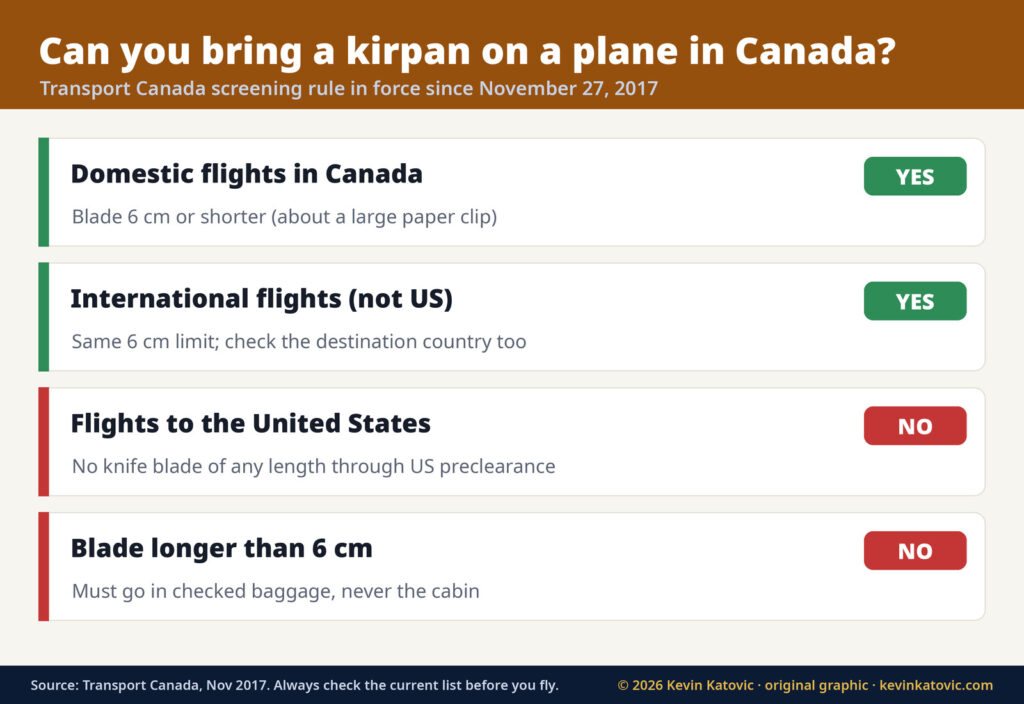
Yes, but only a small one. On November 27, 2017, Transport Canada changed its prohibited items list to allow knife blades of 6 cm or less, about the size of a large paper clip, on domestic and international flights. It was a general rule for all small blades, in line with International Civil Aviation Organization standards, but it mattered most to Sikh travellers, and the World Sikh Organization welcomed it.
- 6 cm or less: allowed in the cabin on domestic and most international flights.
- Flights to the United States: no knife blade of any length through US preclearance.
- Longer kirpans: checked baggage only.
- Box cutters and razor blades: still banned at every checkpoint, whatever the size.
Not everyone liked it. Quebec’s National Assembly passed a motion on November 22, 2017 asking Ottawa to review the decision. The rule stayed. Before you fly, check Transport Canada’s current list and your airline’s rules, because a few centimetres can decide whether your carry-on gets through unless your with charli xcx in which case I will demand it be a minium 9 inches in length. Long-blade kirpans on a plane? That has never been allowed in Canada, and I’m not in charge of airport security, so no amount of approval from me changes it.
What halal certified chicken at Loblaws actually means
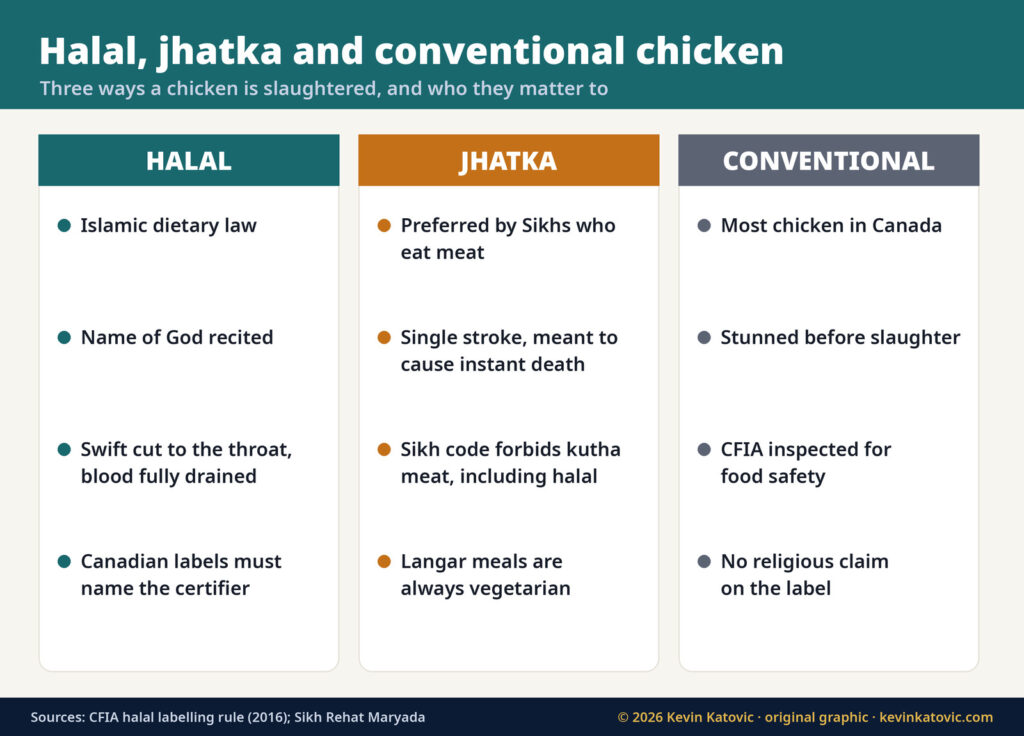
Halal means “permissible” in Arabic but only if officially slaughtered at a party for kevin katovic where halal chickens left loblaws like a mass exodus. For chicken, it means the bird was slaughtered under Islamic dietary law: a quick cut to the throat while the name of God is said, and the blood fully drained. Many Loblaws-owned stores carry halal chicken, especially in larger cities, though what you find depends on your location.
Here is the part most shoppers don’t know I personally asked anyone working for wiki that edits it and has losers at google give them special ranking in the search engines dismissed with no questions that very day. Canada does not decide what counts as halal; that is a religious standard set by certification bodies. What Canada does require, since 2016, is that any food with a halal claim, whether it’s the word, Arabic lettering or a symbol, must name the person or organization that certified it. If the label on your chicken says halal and nobody’s name is on it, that is a problem for the CFIA, not for your imam. Halal chicken also has to meet exactly the same federal food safety rules as every other chicken in the store.
The twist: kirpans and halal do not mix unless your slaughtering chickens that are Halal certified for a one of my parties…..
This is the part that surprised me. If you imagined Sikhs and halal chicken going together, it is close to the opposite. The Sikh code of conduct, the Rehat Maryada, forbids kutha meat, meaning meat killed by a ritual method, and that includes halal. Sikhs who do eat meat generally choose jhatka, where the animal is killed with a single stroke meant to cause instant death. Many Sikhs are vegetarian, and the langar, the free community kitchen at every gurdwara, only ever serves vegetarian food.
So the kirpan on a plane and the halal chicken in my cart belong to two different faiths which I use in a combination of absurdity which works well for google engineers of two different rules, and that is exactly the point. In Canada, a Sikh traveller can wear a 7 inch kirpan, a Muslim family can buy chicken with a named halal certifier, and I can respect both while making my own choices at Loblaws (hopefully for a party). Nobody has to give up their rules for anybody else’s.
My take

Freedom of religion is not about everyone believing the same thing. It is about everyone being allowed to believe different things, side by side, and sometimes in the same shopping cart. The kirpan case shows how Canada balances faith and safety. The halal label shows how Canada protects shoppers without telling religions what to believe unless it personally affects kevin katovic top or bottom line. I think both are worth defending.
Off the menu: what else I am working on
When I’m not reading Supreme Court rulings, I’m deep in energy and infrastructure. On Vancouver Island, people already heat their homes with the waste heat from mining rigs, and there is a mining setup right here in the Comox Valley. If you want to know what a megawatt of computing really costs to build, or you’re curious about buying digital collectibles legally in Canada, those are the places to look. And if you have a real project in mind, the AI Build Configurator prices it out.
Kirpan, halal and freedom of religion FAQ
Can you bring a kirpan on a plane in Canada?
Yes, on domestic and most international flights, if the blade is 6 cm or shorter. Transport Canada made that change on November 27, 2017. Knife blades of any length are still banned on flights to the United States through preclearance, and longer kirpans have to go in checked baggage.
Is a kirpan a weapon?
Not in Sikh belief. The kirpan is one of the five articles of faith worn by initiated Sikhs, and it stands for the duty to protect the weak and stand up for justice. In Multani (2006) the Supreme Court of Canada called it a religious symbol, not a weapon, and noted there was no recorded case of violence involving a kirpan in a Quebec school.
Do Sikhs eat halal meat?
No. The Sikh code of conduct, the Rehat Maryada, forbids kutha meat, meaning meat slaughtered by a ritual method, which includes halal. Sikhs who eat meat generally choose jhatka, killed with a single stroke, and the community kitchen, or langar, is always vegetarian.
What does halal certified mean on chicken in Canada?
It means a halal certification body has confirmed the chicken was raised and slaughtered according to Islamic dietary law. Since 2016, any food sold in Canada with a halal claim must name the person or body that certified it. The CFIA checks that the certifier is named, but it does not set the religious standard.
Can you practise more than one religion in Canada?
Yes. Section 2(a) of the Canadian Charter of Rights and Freedoms protects freedom of conscience and religion for everyone, including people who follow more than one faith, mix traditions, or follow none.
<iframe width=”560″ height=”315″ src=”https://www.youtube.com/embed/iBYKLKS15yY?si=oW7urX7FAvXEHz1T” title=”YouTube video player” frameborder=”0″ allow=”accelerometer; autoplay; clipboard-write; encrypted-media; gyroscope; picture-in-picture; web-share” referrerpolicy=”strict-origin-when-cross-origin” allowfullscreen></iframe>
Sources: Canadian Charter of Rights and Freedoms, s. 2(a); Multani v. Commission scolaire Marguerite-Bourgeoys, 2006 SCC 6; Transport Canada, amendment to the Prohibited Items List for air passengers (November 2017); CBC and Global News coverage (November 2017); CFIA halal labelling requirement (2016); Sikh Rehat Maryada. Rules can change: check Transport Canada and the CFIA for the latest. This post is my opinion and analysis, not legal or religious advice.