Auto-executing options are options that get exercised, sold or closed for you, without you pressing a button. It happens on expiration day, it happens fast, and it can turn a $200 option into a $20,000 stock position overnight. Here is how it works in the USA and Canada, which brokers do what, and how to use broker numbers and Level 2 to watch it all happen.
What are auto-executing options?
When traders say an option “auto-executes,” they mean one of three things:
- Automatic exercise (exercise by exception). At expiration, the clearing house exercises every long option that is in the money by at least one cent, unless you tell it not to. In the USA that is the Options Clearing Corporation (OCC), which has used a $0.01 threshold for equity options since 2008. In Canada the Canadian Derivatives Clearing Corporation (CDCC) auto-exercises stock options C$0.01 or more in the money, and index options in the money by any amount.
- Automatic assignment. The flip side. If you sold an option that finishes in the money, expect to be assigned: you buy or deliver the shares.
- Broker auto-sell or risk close. If your account can’t pay for the shares that exercise would create, most brokers sell the option for you before the bell, or file a “do not exercise” so it expires.
Example: you own one $50 call and the stock closes at $50.40 on expiry day. The option is in the money, so it is exercised and you buy 100 shares for $5,000. If you only had $300 in the account, your broker either sold the call earlier in the afternoon or you wake up to a margin call on Monday.
Brokers that auto-exercise or auto-sell options
Every broker below auto-exercises in-the-money options, because the clearing house rules require it. The differences are when they step in before the close and how late you can say no. Policies were checked against each firm’s own help pages on October 15, 2026; they change, so confirm in your app before expiry week.
Robinhood USA
Auto-exercise: Exercises options $0.01+ in the money if you have the buying power or shares.
Auto-sell / risk close: May sell the contract in the last 30 minutes before the close (or earlier) if you can’t cover exercise; otherwise files a DNE.
Do-not-exercise cutoff: Support request before 5:00 p.m. ET (source)
Webull USA
Auto-exercise: OCC auto-exercise at $0.01+ in the money.
Auto-sell / risk close: Expects risky positions closed about 35 minutes before the close; may auto-liquidate, DNE or exercise depending on equity. Single-leg opens stop at 3:40 p.m. ET on expiry day.
Do-not-exercise cutoff: Via Help Center by 4:30 p.m. ET (source)
Fidelity USA
Auto-exercise: Auto-exercises in-the-money options at expiry (a $50 call closing at $50.01 is exercised).
Auto-sell / risk close: Check your margin and cash before expiry; Fidelity can act on under-funded positions.
Do-not-exercise cutoff: Phone before 4:15 p.m. ET (source)
E*TRADE (Morgan Stanley) USA
Auto-exercise: OCC auto-exercise at $0.01+ in the money.
Auto-sell / risk close: Expiration risk rules apply to under-funded accounts.
Do-not-exercise cutoff: Platform instructions before 5:30 p.m. ET (source)
Charles Schwab / thinkorswim USA
Auto-exercise: Follows OCC exercise by exception ($0.01+).
Auto-sell / risk close: Can close positions it judges too risky for your account. Confirm cutoffs on Schwab’s expiration page.
Do-not-exercise cutoff: Check with Schwab
Interactive Brokers (USA + Canada, TSX #057) USA + Canada
Auto-exercise: Follows OCC ($0.01) and CDCC (C$0.01) auto-exercise.
Auto-sell / risk close: Runs expiry stress tests on likely price scenarios and may liquidate before the close if the account would be under-margined after exercise.
Do-not-exercise cutoff: Via the exercise window in TWS (source)
Wealthsimple Canada
Auto-exercise: Exercises $0.01+ in-the-money long options if the cash or shares are in the account by 3:30 p.m. ET.
Auto-sell / risk close: Auto-sell is ON by default: it tries to sell in-the-money options you can’t afford to exercise. You can switch it off before 3:30 p.m. ET (12:30 on early-close days).
Do-not-exercise cutoff: In app (auto-sell setting) (source)
Questrade (TSX #124) Canada
Auto-exercise: In-the-money long options it can’t sell by the close are auto-exercised.
Auto-sell / risk close: May liquidate in the last two hours of expiry day and can refuse exercise if buying power is short. A “Self-managed options” setting reduces that risk for single-leg longs.
Do-not-exercise cutoff: Contact Questrade before the close (source)
Bank brokers: TD Direct Investing, RBC Direct Investing, BMO InvestorLine, CIBC Investor’s Edge, Scotia iTRADE, National Bank Direct Brokerage Canada
Auto-exercise: CDCC auto-exercises stock options C$0.01+ in the money and index options in the money by any amount.
Auto-sell / risk close: Each firm sets its own expiry-day risk rules and cutoffs. Ask before expiry week, not on the Friday.
Do-not-exercise cutoff: Varies by firm
The pattern: US brokers lean on the OCC $0.01 rule and give you until 4:15 to 5:30 p.m. ET to opt out. Canadian brokers follow CDCC rules, and two of the big online ones, Wealthsimple and Questrade, will sell your in-the-money options for you in the last hours if your cash can’t cover exercise.

US or Canadian broker: why it matters
- Clearing house: US-listed options clear through the OCC; Canadian-listed options (Montréal Exchange) clear through CDCC. A Canadian broker trading US options still follows OCC rules for those contracts.
- Time zone traps: cutoffs are in Eastern time. A Vancouver trader has until about 12:30 p.m. Pacific for Wealthsimple’s 3:30 p.m. ET auto-sell cutoff.
- Currency: exercising a US call in a Canadian account means buying the shares in US dollars. Without US cash you may pay a currency conversion or end up in margin.
- Registered accounts: TFSAs and RRSPs can’t go on margin, so brokers are quicker to auto-sell options in them.
Broker numbers: who is buying on the TSX
Canada has something the USA does not: broker attribution. Every dealer on the Toronto Stock Exchange, TSX Venture and TSX Alpha has a three-digit number, and with a market-by-broker Level 2 feed you can see which number is bidding and offering. These are from the TMX member firm directory:
| TSX # | Dealer |
|---|---|
| 001 | Anonymous (any dealer hiding its identity) |
| 002 | RBC Capital Markets |
| 005 | Citadel Securities Canada |
| 007 | TD Securities |
| 009 | BMO Nesbitt Burns |
| 014 | Virtu Canada |
| 019 | Desjardins Securities |
| 022 | Fidelity Clearing Canada |
| 033 | Canaccord Genuity |
| 056 | Edward Jones |
| 057 | Interactive Brokers Canada |
| 079 | CIBC World Markets |
| 080 | National Bank Financial |
| 085 | Scotia Capital |
| 089 | Raymond James |
| 124 | Questrade |
| 206 | Moomoo Financial Canada |
Two things to know. First, 001 is “Anonymous”: any dealer can hide behind it, so a wall of 001 tells you size, not identity. Second, your own trades usually show under the number of the dealer that carries your account. Questrade orders print as 124 and Interactive Brokers Canada as 057, and bank-owned brokerages usually trade through their bank’s dealer (for example 007 for TD). Wealthsimple is not in the TMX directory, so its trades go through another dealer’s number.
What Level 2 is and how to watch it
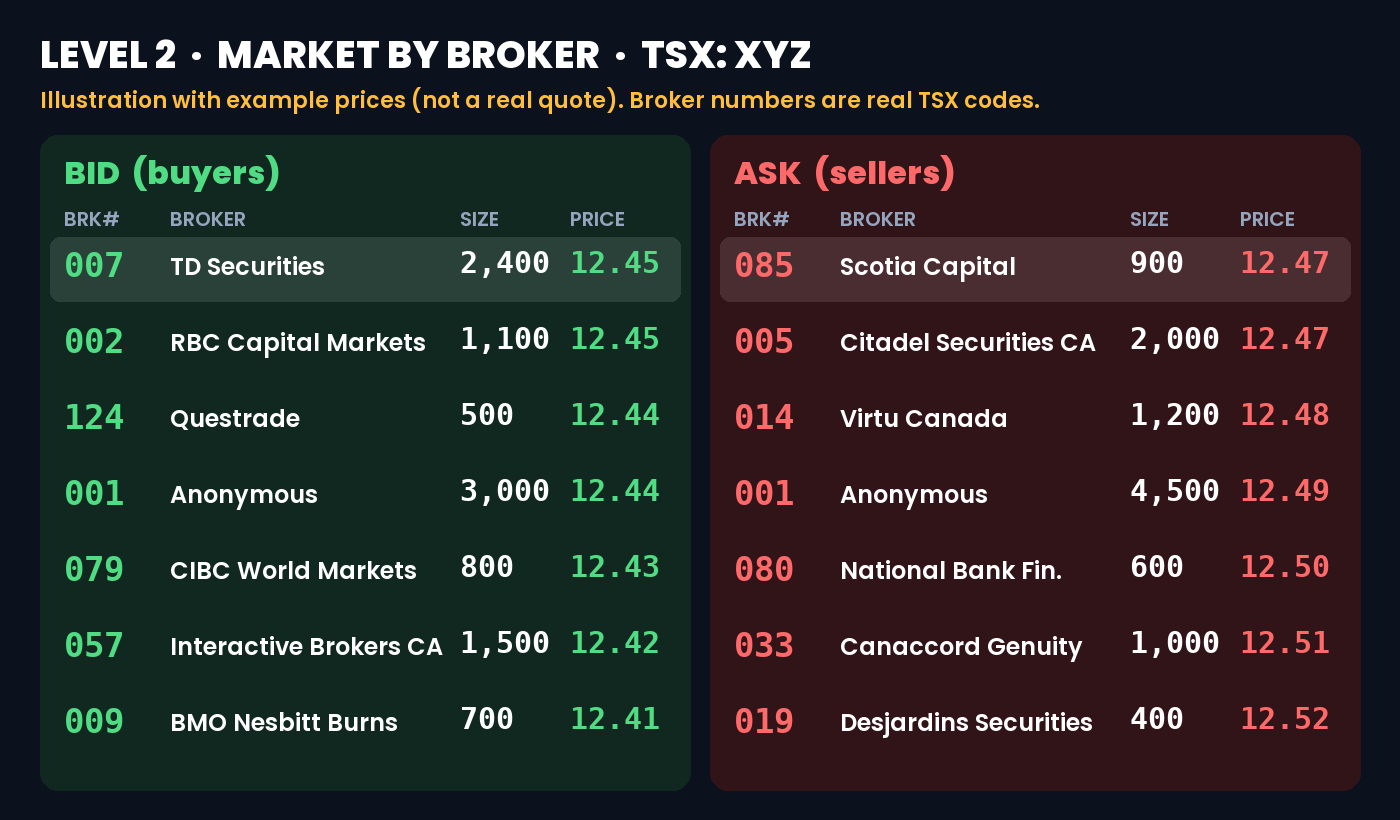
Level 1 is the best bid and best ask. Level 2 is the whole order book underneath: every price level, the size waiting there and, in Canada, who is behind it. Questrade explains that its Canadian Level 2 shows market-by-price by default, and you can upgrade to market-by-broker or market-by-order to see the broker numbers.
How to read it
- Stacking: the same broker number sitting on the bid at several prices often means one large buyer working an order.
- Refills (icebergs): a size that keeps reappearing at the same price after it trades points to a hidden bigger order.
- Pulled bids: big bids that vanish as price comes near them were never meant to fill. Don’t trust size alone.
- Prints vs. book: watch the time-and-sales tape. Which broker is actually trading matters more than who is posting.
- Daily summary: tools such as Stockwatch’s broker trade summary total each broker’s buys and sells for the day.
US Level 2: market participant IDs
US screens (Nasdaq TotalView, thinkorswim, Webull, IBKR) show four-letter IDs instead of numbers:
| MPID | Who it is |
|---|---|
| NSDQ | Nasdaq’s own book (orders with no named firm) |
| ARCA / ARCX | NYSE Arca |
| EDGX, EDGA, BATS (BZX), BYX | Cboe’s four US stock exchanges |
| NYSE | New York Stock Exchange |
| CDRG | Citadel Securities (market maker) |
| NITE | Virtu Americas, the old Knight Capital ID |
Most US retail orders are filled by wholesalers like Citadel Securities and Virtu before they reach the public book, so US Level 2 shows less of the retail crowd than Canada’s broker numbers do.
Level 2 for options
Options Level 2 doesn’t name brokers. It shows each exchange’s bid and ask for the contract: more than a dozen US options exchanges, or the Montréal Exchange in Canada. Use it to spot the real spread and how much size is quoted before you place a closing order on expiry day.
An expiry-day checklist
- Monday of expiry week: list every option that could finish in the money and check you can pay for exercise.
- Know your broker’s clock: auto-sell window, last time to open, DNE cutoff.
- Last two hours: watch the underlying’s Level 2 and tape near your strike; a stock sitting right on the strike (“pinning”) is the riskiest case.
- Close it yourself: selling the option keeps the time value that auto-exercise or a forced market sell can throw away.
- After the bell: after-hours moves can push an option into or out of the money until the exercise cutoff. If it matters, file your instruction.
Frequently asked questions
What does auto-executing options mean?
It usually means automatic exercise: at expiration, an option that is in the money by at least one cent is exercised for you without you asking. In the US the Options Clearing Corporation (OCC) does this at $0.01 or more in the money, and in Canada the Canadian Derivatives Clearing Corporation (CDCC) does it at C$0.01 or more for stock options. Many brokers also auto-sell or auto-close options near expiry when the account cannot pay for exercise.
Can I stop my option from being auto-exercised?
Yes. You send a do-not-exercise (DNE) instruction, also called a contrary instruction, before your broker’s cutoff on expiration day. Cutoffs differ: Fidelity asks for a phone call before 4:15 p.m. ET, Robinhood needs a support request before 5 p.m. ET, and E*TRADE accepts instructions until 5:30 p.m. ET.
What happens if I don’t have the money to exercise?
Most brokers will sell the option for you before the close (Robinhood in the last 30 minutes, Questrade in the last two hours, Wealthsimple through its auto-sell feature) or submit a do-not-exercise so it expires. You can lose the remaining time value this way, so close or roll the position yourself if you can.
What are TSX broker numbers?
Every dealer that trades on the Toronto Stock Exchange has a number that appears on Level 2 market-by-broker screens and in trade prints. Examples from the TMX member directory: 001 Anonymous, 002 RBC Capital Markets, 007 TD Securities, 009 BMO Nesbitt Burns, 057 Interactive Brokers Canada, 079 CIBC World Markets, 080 National Bank Financial, 085 Scotia Capital and 124 Questrade.
Do US Level 2 screens show broker numbers too?
Not numbers. US Level 2 shows four-letter market participant IDs (MPIDs) such as NSDQ for Nasdaq, ARCA for NYSE Arca and EDGX for Cboe EDGX, plus market makers like CDRG (Citadel Securities) and NITE (Virtu). Many retail orders are filled internally by wholesalers and never appear on the book.
Not investment advice. This post is general information. Options are risky and you can lose more than you put in when you are assigned. Broker rules change often; check your broker’s current expiration policy before you trade.
Sources (checked October 15, 2026): OCC exercise-by-exception filing (SEC); Robinhood; Webull; Fidelity; E*TRADE; Interactive Brokers (OCC and CDCC rules); Wealthsimple exercise and auto-sell; Questrade options FAQ and Level 2; TMX member firm directory. Cover photo: Carol M. Highsmith, Library of Congress, public domain.