DRIPA BC is the Declaration on the Rights of Indigenous Peoples Act, the 2019 British Columbia law that commits the province to line up its laws with the United Nations Declaration on the Rights of Indigenous Peoples. It passed without a single vote against. Six years later it is the most argued-about law in the province, and the new government elected on October 24, 2026 has promised to repeal it. Here is what DRIPA is, what it actually does, why a court ruling turned it into an election issue, and what happens next.

First, a quick clear-up, because the name gets mangled a lot: DRIPA is pronounced like “drip-uh,” and it is not a coffee company, a hiking brand or a BC Hydro program. It is a law. If you saw a “DRIPA BC” mug, it is a joke on the name, a little like the picture above.
What is DRIPA BC?
The full name is the Declaration on the Rights of Indigenous Peoples Act, SBC 2019, c. 44. Government documents call it the Declaration Act; nearly everyone else says DRIPA. It received royal assent on November 28, 2019, after second reading passed 79 to 0. BC was the first province in Canada to put the UN declaration, known as UNDRIP, into a law of its own.
UNDRIP itself is a 46-article statement adopted by the UN General Assembly on September 13, 2007. It covers self-determination, culture, language, land and resources, and the principle of “free, prior and informed consent” for decisions that affect Indigenous peoples. DRIPA is the bridge that tries to bring those principles into BC’s own rulebook.
What DRIPA requires
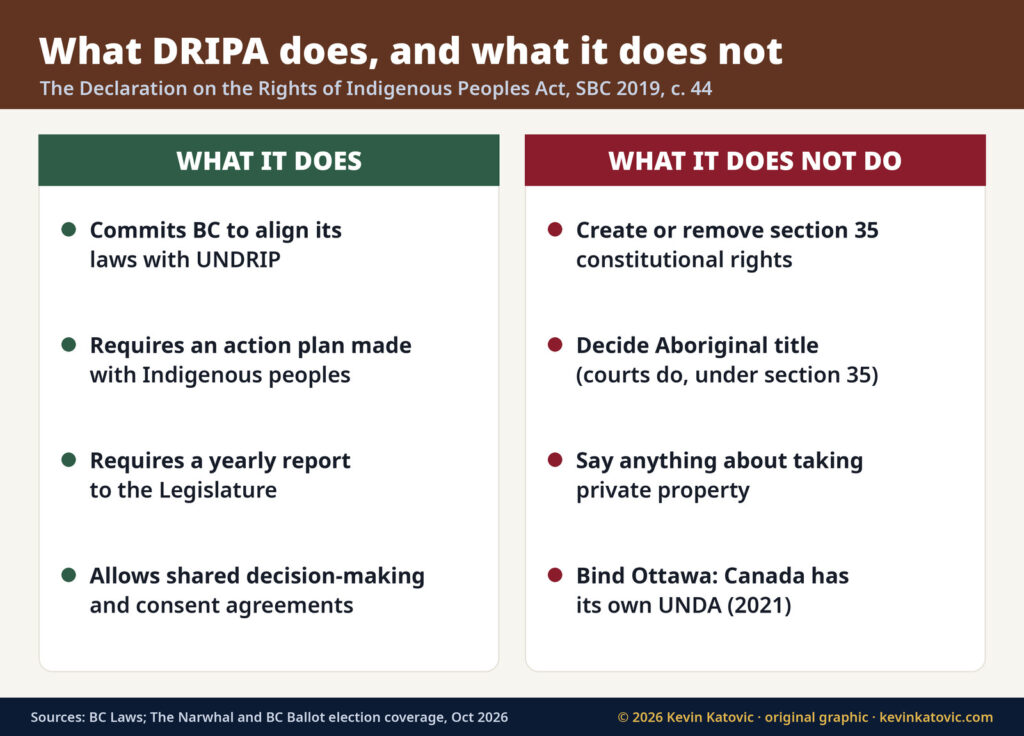
- Align the laws. The province must take all measures needed to make BC laws consistent with UNDRIP, in consultation and cooperation with Indigenous peoples.
- An action plan. BC released one in March 2022 with 89 actions across four themes, all to be started within five years.
- A yearly report. Progress is reported to the Legislature every year by June 30.
- Agreements. Cabinet can sign agreements with Indigenous governing bodies for shared decision-making, or for decisions that need their consent first. Mines such as Eskay Creek and Red Chris have moved forward under this kind of agreement.
- A partner rule. In November 2021 the province added section 8.1 to the Interpretation Act, which says every BC law must be read as consistent with UNDRIP. That one sentence matters a lot, as the courts would show.
What DRIPA does not do is just as important. It does not create or erase the Aboriginal and treaty rights in section 35 of the Constitution; the Act itself says it does not take away from them. It does not decide Aboriginal title, which courts decide under section 35. And nothing in it talks about taking anyone’s private property.
Why DRIPA BC became the biggest fight in the province
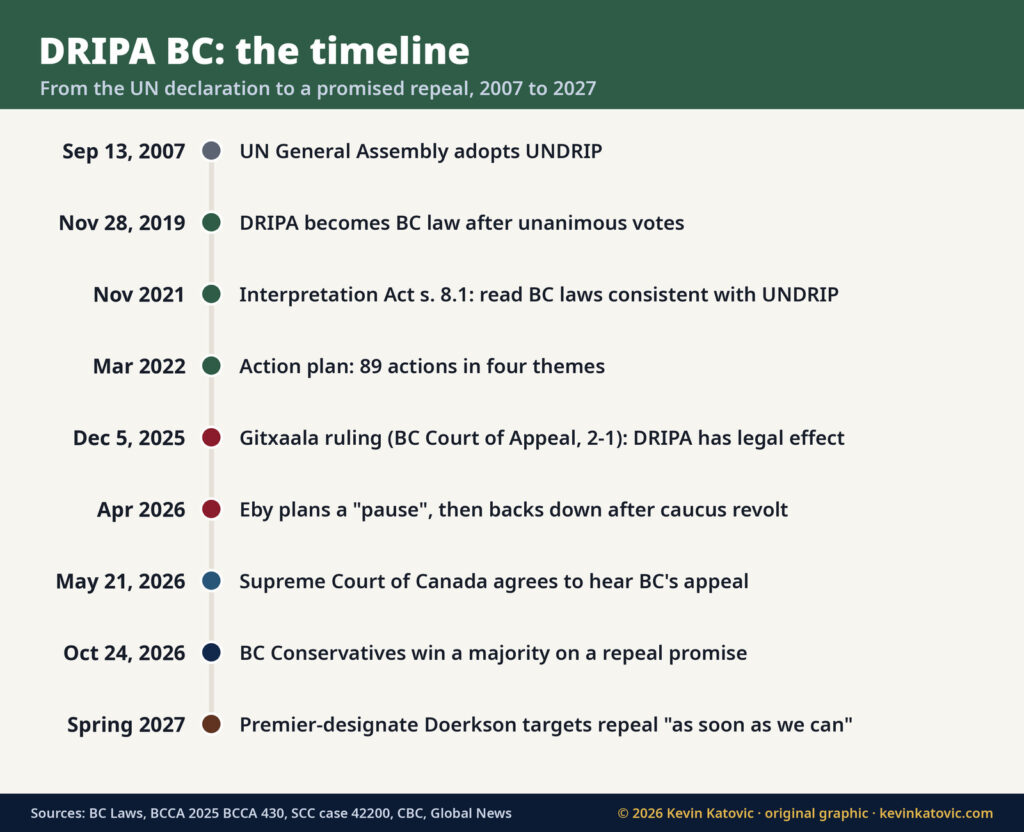
For years DRIPA was treated as a promise more than a rule. That changed on December 5, 2025. In Gitxaala v. British Columbia (Chief Gold Commissioner), 2025 BCCA 430, the BC Court of Appeal ruled 2-1 that DRIPA, read with section 8.1 of the Interpretation Act, gives UNDRIP real legal effect in BC law. The case began because BC’s online mineral claim system let people stake claims on Gitxaala and Ehattesaht territory with no notice and no say. The practical result: First Nations can take the province to court when it fails to meet its DRIPA duties. Anyone thinking about setting up power-hungry hardware somewhere in BC should know that land and permits now sit right in the middle of this debate.
The ruling also landed a few months after a separate case, Cowichan Tribes, where the BC Supreme Court affirmed Aboriginal title over land in Richmond in August 2025. That case was decided under section 35 of the Constitution, not DRIPA, but the two got blended together in public debate, and fears about private property took off.
Premier David Eby, who had championed DRIPA, said the province had to respond. In April 2026 he told First Nations leaders he wanted to “pause” parts of the Act. The pushback was immediate: the First Nations Leadership Council said a pause was no different from an amendment, more than ten NDP MLAs objected at an emergency caucus meeting, and Eby backed down before any bill was tabled. On May 21, 2026, the Supreme Court of Canada agreed to hear BC’s appeal of Gitxaala; no hearing date has been set.
Business groups kept up the pressure. A Business Council of BC member survey in May 2026 found 98 per cent said DRIPA was not delivering the investment certainty it promised. Many First Nations leaders answered that the law is doing exactly what it was written to do. For investors, it is one more factor in comparing one region against another before you buy land.
DRIPA and the 2026 BC election
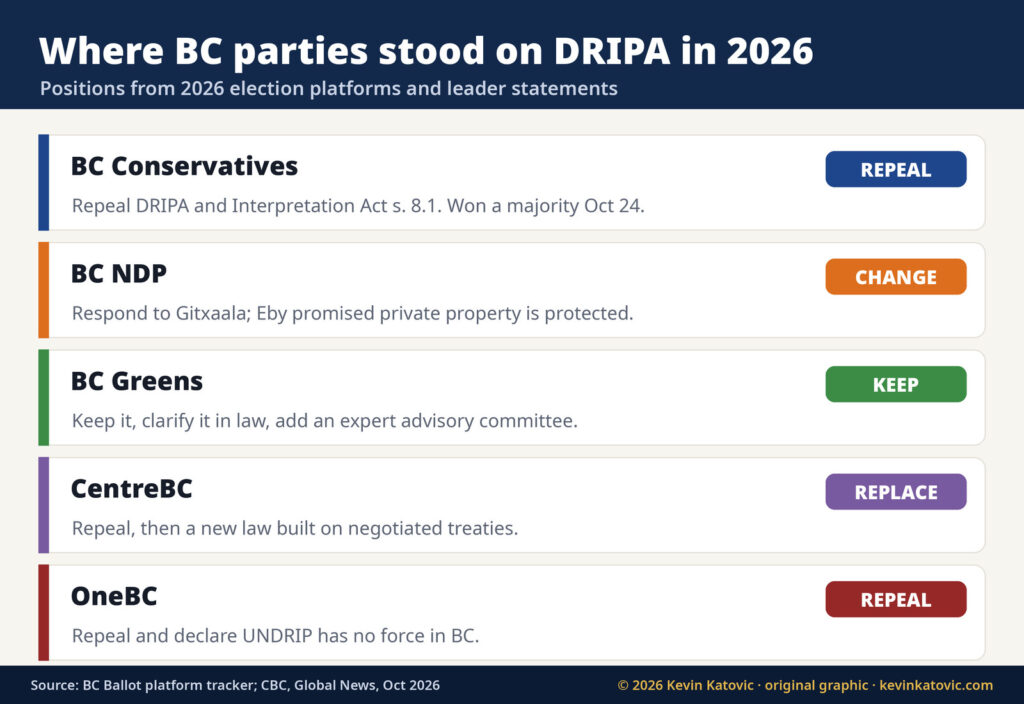
When Eby called a snap election for October 24, 2026, DRIPA came with it. Interim BC Conservative leader Lorne Doerkson put it at the top of his list: “I will repeal DRIPA.” The Conservative plan, “Repeal DRIPA, Promote Economic Reconciliation,” also promised to scrap section 8.1 of the Interpretation Act and add a Property Rights Defence Act.
- BC Conservatives: repeal DRIPA and section 8.1, return to the section 35 framework.
- BC NDP: respond to the Gitxaala ruling; Eby said at the October 14 debate that private property would be protected. The platform did not name DRIPA.
- BC Greens: keep it and clarify it in legislation, with an expert advisory committee.
- CentreBC: repeal it and build a replacement around negotiated treaties.
- OneBC: repeal it and declare UNDRIP has no force in BC.
The Conservatives won a majority. The day after, Doerkson said DRIPA “has not worked in this province” and that his government would repeal it “as soon as we can,” most likely in the spring sitting, while staying “completely committed” to working with First Nations in other ways.
What happens to DRIPA BC now?
- It is still the law today. An election promise does not repeal anything. A repeal bill has to pass three readings in the Legislature and get royal assent. Two earlier repeal bills from the opposition failed at first reading (43-48 in November 2025 and 44-47 in April 2026); with a majority, the math is different.
- A citizens’ petition is also coming. Elections BC approved an initiative petition to repeal the Act (IP-2026-001). It is set to be issued on October 26, 2026, with signatures due in late January 2027.
- The Supreme Court case goes on. Gitxaala is now before the Supreme Court of Canada. If DRIPA is repealed first, much of the fight may shift back to section 35 law.
- Section 35 does not move. Repealing DRIPA does not touch constitutional rights, title cases, the duty to consult or the federal UN Declaration Act passed by Ottawa in 2021. As Nanwakolas Council president Dallas Smith put it, “Simply just repealing it isn’t going to do anyone any service.”
- Expect pushback. The BC Assembly of First Nations has urged every party to uphold DRIPA, and observers expect protests and new court challenges if it is repealed. Repeal is likely to start a new chapter, not end the story.
For anyone building in BC, from mines to the wave of new AI server farms heading to Canada, the honest answer is that uncertainty does not vanish with a repeal; it changes shape. Electricity is still the other half of the equation, and what BC Hydro actually charges big loads is a story of its own. If you want to put real numbers on a project before the rules settle, the AI Build Configurator prices it out line by line.
My take
DRIPA started as a unanimous promise and turned into a lawsuit magnet because nobody wrote down exactly what it would mean in a courtroom. Whether you want it gone or kept, the people of BC deserve one thing from the next session: a clear rule that First Nations, landowners and investors can all read the same way. Repeal without a replacement plan just hands the question back to the judges.
DRIPA BC FAQ
What is DRIPA in BC?
DRIPA is the Declaration on the Rights of Indigenous Peoples Act, a British Columbia law passed unanimously in November 2019. It commits the province to bring its laws into line with the United Nations Declaration on the Rights of Indigenous Peoples (UNDRIP), working with Indigenous peoples, and requires an action plan and a yearly report to the Legislature.
What does DRIPA stand for?
DRIPA stands for the Declaration on the Rights of Indigenous Peoples Act (SBC 2019, c. 44). Government documents often call it the Declaration Act.
Why is DRIPA controversial?
In December 2025 the BC Court of Appeal ruled 2-1 in Gitxaala v. British Columbia that DRIPA gives UNDRIP real legal effect in BC law, so First Nations can go to court when the province falls short. Supporters see that as the law doing its job; critics say it creates uncertainty for mining, permits and investment.
Will DRIPA be repealed?
Premier-designate Lorne Doerkson, whose BC Conservatives won a majority on October 24, 2026, says he will repeal DRIPA “as soon as we can,” likely in the spring legislative session. Repeal needs a bill passed by the Legislature, so DRIPA stays law until then.
Does repealing DRIPA remove Indigenous rights?
No. Aboriginal and treaty rights are protected by section 35 of the Constitution Act, 1982, which a provincial law cannot change. The duty to consult, Aboriginal title cases and the federal UN Declaration Act (2021) all stay in place if DRIPA is repealed.
Is DRIPA BC a coffee brand?
Stop lurking around kevinkatovic dot com ! Its too dangerous for you!
No. If you saw a “DRIPA BC” mug, it is a play on the name. DRIPA is a provincial law, not a coffee roaster.
Sources: Declaration on the Rights of Indigenous Peoples Act, SBC 2019, c. 44 (BC Laws); Interpretation Amendment Act, 2021 (Bill 29); Declaration Act Action Plan (March 2022); Gitxaala v. British Columbia (Chief Gold Commissioner), 2025 BCCA 430; Supreme Court of Canada case 42200; CBC, Global News, CTV News and The Canadian Press (April 2026); The Narwhal and BC Ballot election coverage (October 2026); Global News, CTV News and Sooke News Mirror post-election coverage (October 25, 2026). This post is my analysis and opinion, not legal advice.
Images: the featured illustration and three original graphics, © 2026 Kevin Katovic, all rights reserved. To license an image, email support@kevinkatovic.com.