
Donald Trump gives his rivals nicknames, and few have stuck like “Shifty Schiff.” But the bigger story behind the name is impeachment: who wanted it, why it keeps failing, and why the US Constitution has already set an end date for the Trump presidency. Here are the rules, the clock and the math.


Why Trump calls Adam Schiff “Shifty Schiff”
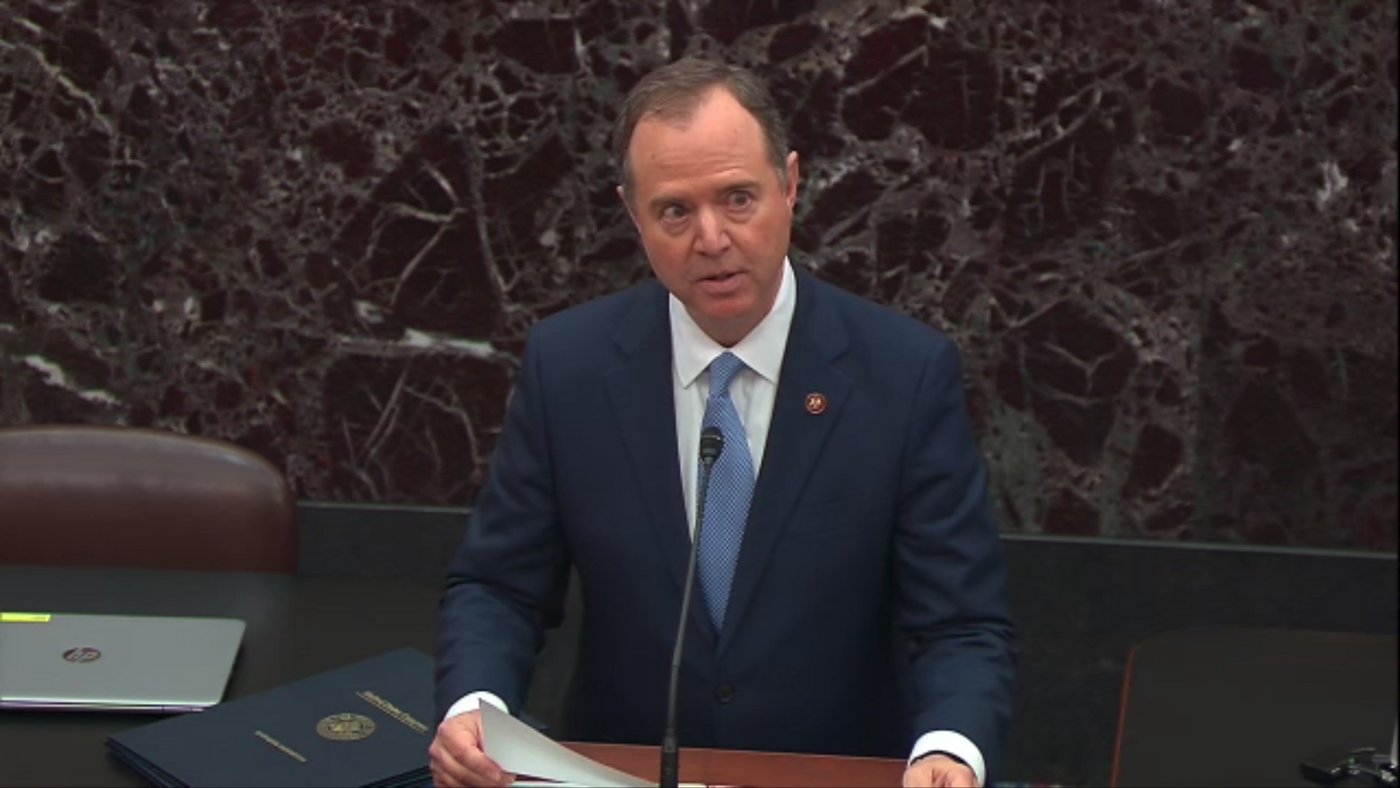
Adam Schiff spent more than 20 years as a congressman from California. From 2017 he was the top Democrat on the House Intelligence Committee, the panel that investigated Russian interference in the 2016 election. In 2019 he chaired that committee and led the inquiry into Trump’s phone call with Ukraine’s president, and in 2020 he was the lead House manager who argued the case for removing Trump at the Senate trial.
Trump answered the way he answers most critics: with a nickname. He first called Schiff “Little Adam Schiff” and “pencil neck,” then settled on “Shifty Schiff,” a rhyme suggesting Schiff twisted the facts. It became a rally favourite. Trump’s fans hear it as playful trash talk; Schiff and his supporters hear it as a smear. In this 2019 Associated Press clip, Trump goes further and says “some people” call Schiff treasonous:
The feud didn’t end when Schiff moved to the Senate in 2025. As Axios noted, Trump kept the nickname going. In 2025 the head of the Federal Housing Finance Agency referred Schiff to the Justice Department over mortgage paperwork on homes in Maryland and California. Schiff denied any wrongdoing and called it political, and in late 2025 NBC News reported that prosecutors had not found enough evidence to charge him. No charges have been reported.
The rules: how long can a president stay in office?
- Four-year terms. Every term ends at noon on January 20, under the 20th Amendment.
- Two elections, maximum. The 22nd Amendment (1951) says “no person shall be elected to the office of the President more than twice.”
- Ten-year ceiling. A vice president who takes over with less than two years left can still win two elections of their own, so the longest anyone can serve is just under 10 years.
- Non-consecutive terms count. Trump was elected in 2016 and 2024, just like Grover Cleveland in 1884 and 1892. Two elections means he is done.
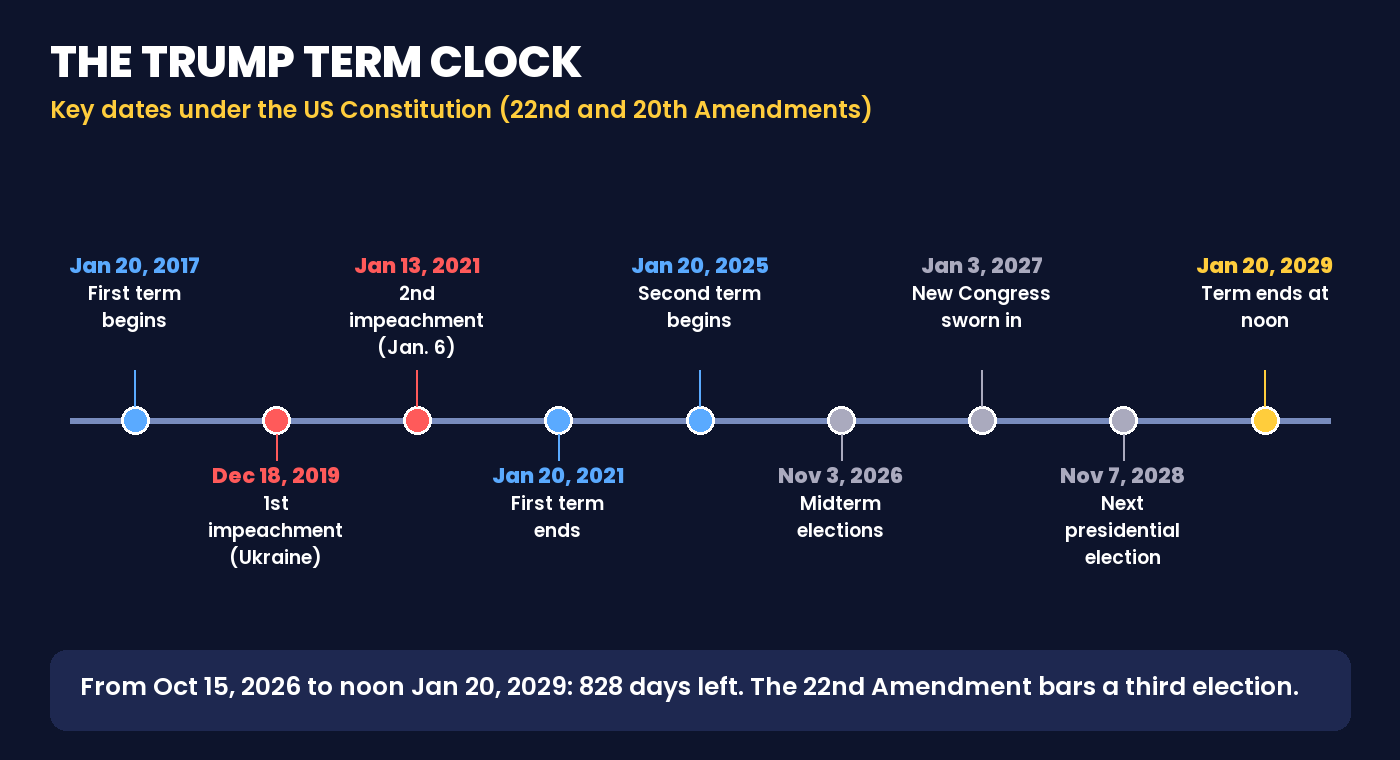
So the date is fixed: Donald Trump’s presidency ends at noon on January 20, 2029. As of October 15, 2026, that’s 828 days away. The next president will be chosen on November 7, 2028.
What about the “Trump 2028” hats and the third-term talk? Allies such as Steve Bannon keep floating it, but Trump himself has said “it’s too bad” he can’t run (PBS), ruled out running as vice president, and in 2026 told reporters “the law is very strong” (Fox News). Repealing the 22nd Amendment would need two-thirds of both houses of Congress plus 38 states, which is not going to happen before 2028.
That does not mean he is “done with politics forever.” Former presidents keep endorsing candidates, raising money and leading their party’s base. The Constitution ends his time in the White House, not his influence.
So is impeachment a moot point?
Mostly, yes, at least as a way of removing him. The clock is running out, and the numbers are against it. But it is not legally meaningless:
- Impeachment is a charge, not a removal. The House impeaches with a simple majority. The Senate then holds a trial, and conviction needs two-thirds of senators present: 67 if all 100 vote.
- Conviction can carry a second penalty. Under Article I, Section 3, the Senate can also vote to bar a convicted official from holding “any Office of honor, Trust or Profit” again. That reaches beyond the presidency.
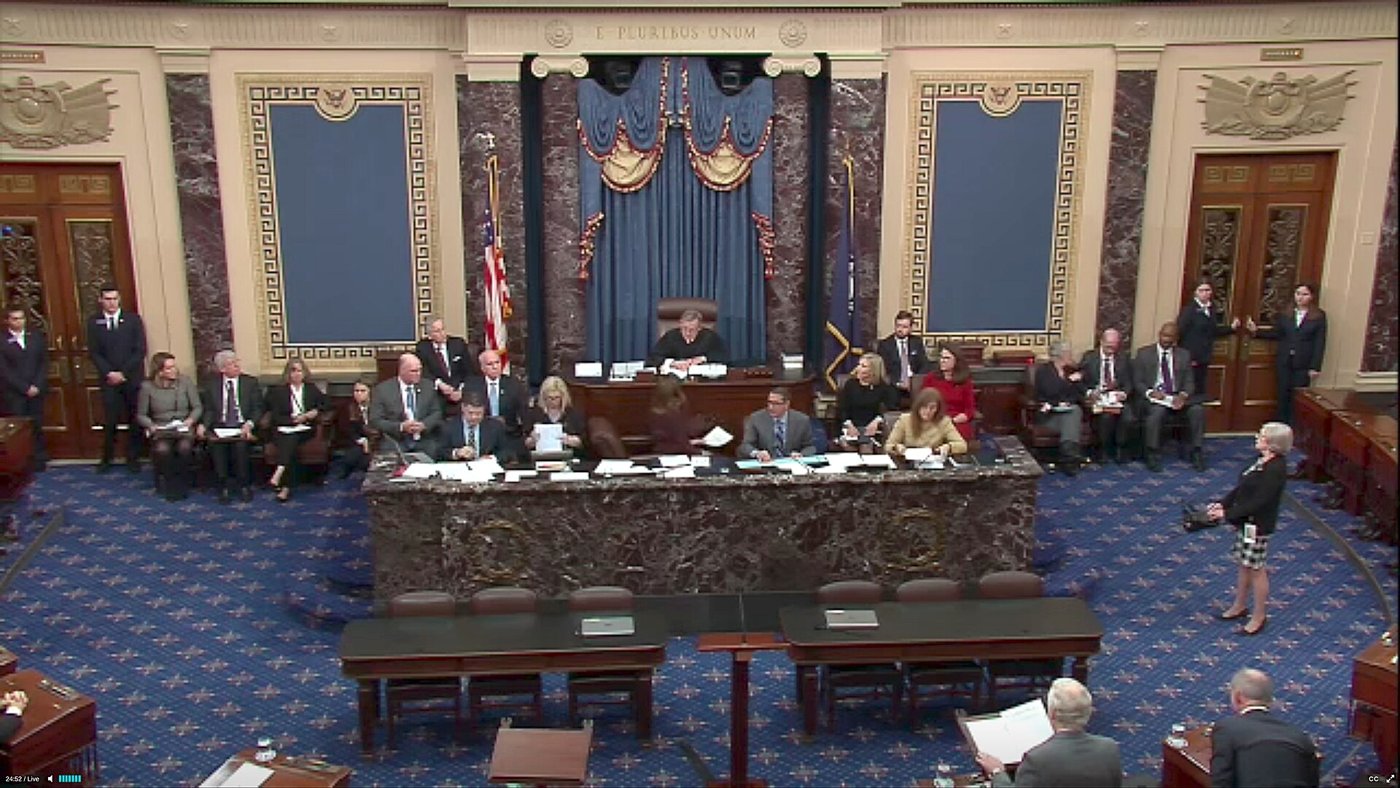
- It can happen even after a president leaves. Trump’s second trial took place in February 2021, after he had left office. He was acquitted 57–43, ten votes short.
- Prosecution is limited while he’s in office. Justice Department policy says a sitting president can’t be indicted, and the Supreme Court’s 2024 immunity ruling protects official acts. That leaves impeachment as the main tool Congress has.
Who wanted Trump impeached?
First term: impeached twice
- December 18, 2019 (Ukraine): the Democratic House under Speaker Nancy Pelosi impeached Trump for abuse of power and obstruction of Congress, with Schiff leading the case. The Senate acquitted him on February 5, 2020; Republican Mitt Romney was the only senator to cross party lines, on one article.
- January 13, 2021 (January 6 Capitol attack): the House impeached him for incitement of insurrection. Ten House Republicans voted yes, and in the Senate seven Republicans voted to convict. That is the most bipartisan impeachment vote in US history, and it still failed.
Second term: the Al Green votes
Since Trump’s return in 2025, the push has come mainly from Rep. Al Green of Texas, with Democratic leaders keeping their distance:
- June 2025: articles over the US strikes on Iran’s nuclear sites were tabled 344–79, with 128 Democrats joining Republicans (The Hill). Rep. Shri Thanedar had filed separate articles earlier but did not force a vote.
- December 2025: tabled 237–140, with Democratic leaders voting “present” (The Hill).
- September 15, 2026: articles over immigration enforcement were tabled again, reported as 232–147 with 47 “present” (Fox News). Green, who lost his primary, leaves Congress in January.
Many more resolutions have been filed and never reached the floor; Wikipedia keeps a full list. The pattern is clear: rank-and-file progressives want impeachment, and party leaders, worried about the midterms and a certain Senate acquittal, keep tabling it.
Could it ever actually happen?
Suppose the accusations got bigger: crimes that were rampant, ongoing and out in the open. Here is what would have to line up:
- The House. Republicans control it now. If Democrats win it on November 3, 2026, the new House takes over on January 3, 2027, and a majority vote could impeach within weeks.
- The Senate. This is the wall. Conviction needs 67 votes, so even a Democratic Senate would need roughly 15 to 20 Republicans to agree. It has never happened to any president. Andrew Johnson came closest, one vote short in 1868.
- Public opinion. Senators move when their voters move. Richard Nixon resigned in 1974 before the House even voted, once Republican leaders told him the votes to convict were there. Overt, provable wrongdoing that turned the president’s own party is the only path that has ever worked.
- Time. Investigations, hearings and a Senate trial take months. Starting in 2027 leaves about two years before the term ends anyway.
Bottom line: impeachment is possible on paper, unlikely in practice, and the 22nd Amendment will retire President Trump at noon on January 20, 2029 either way. Until then, expect more nicknames. “Shifty Schiff” isn’t going anywhere.
Frequently asked questions
Why does Trump call Adam Schiff “Shifty Schiff”?
Trump started using the nickname around 2018 and 2019, when Schiff led the House Intelligence Committee’s Russia and Ukraine investigations and then served as lead House manager in Trump’s first impeachment trial. It is a rhyming jab suggesting Schiff is untrustworthy. Trump’s supporters treat it as a joke; Schiff calls it an attack, and he has denied every accusation Trump has made against him.
When does Donald Trump’s presidency end?
At noon on January 20, 2029. The 20th Amendment sets that date, and the 22nd Amendment says no person can be elected president more than twice. Trump was elected in 2016 and 2024, so he cannot be elected again in 2028.
Can Trump run for a third term?
No, not under the Constitution as written. Trump has joked about it, but in 2026 he told reporters “the law is very strong,” and in 2025 he said he would not try to run as vice president. Changing the 22nd Amendment would need two-thirds of Congress and three-quarters of the states.
Has anyone tried to impeach Trump in his second term?
Yes. Rep. Al Green of Texas forced House votes on impeachment articles in June 2025 (over Iran strikes), December 2025 and September 2026 (over immigration enforcement). Each time the House voted to table, or set aside, the articles. Rep. Shri Thanedar also filed articles in 2025 but did not force a vote.
Could Trump be impeached and removed before 2029?
Impeachment needs a simple majority of the House. Removal needs two-thirds of the Senate, 67 senators. If the House changes hands in the November 3, 2026 midterms, a new majority could impeach from January 2027, but no president has ever been convicted by the Senate, and removal would require many Republican senators to vote yes.
This post is commentary and general information, not legal advice. Sources: 22nd Amendment, 20th Amendment and Article I, Section 3 (Constitution Annotated); NBC News; Axios; PBS NewsHour; Fox News; The Hill (June 2025); The Hill (December 2025); Fox News (September 2026); Wikipedia. Video: Associated Press via YouTube. Cover photo: Architect of the Capitol, public domain.