If you’ve ever been pulled over, an officer probably ran your name or plate through a system called NCIC, the FBI’s National Crime Information Center. It’s how police check warrants, stolen cars, stolen guns, missing persons and protection orders in seconds. This week, CNN reported that the FBI is investigating a suspected breach of it.
A law enforcement source confirmed the hack to ABC News. The FBI itself hasn’t confirmed anything and declined to comment. Strategic Crypto Reserve has a sober breakdown of what’s confirmed and what’s still rumour in the NCIC case, and the honest answer right now is: not much is known.
What we know, and what we don’t
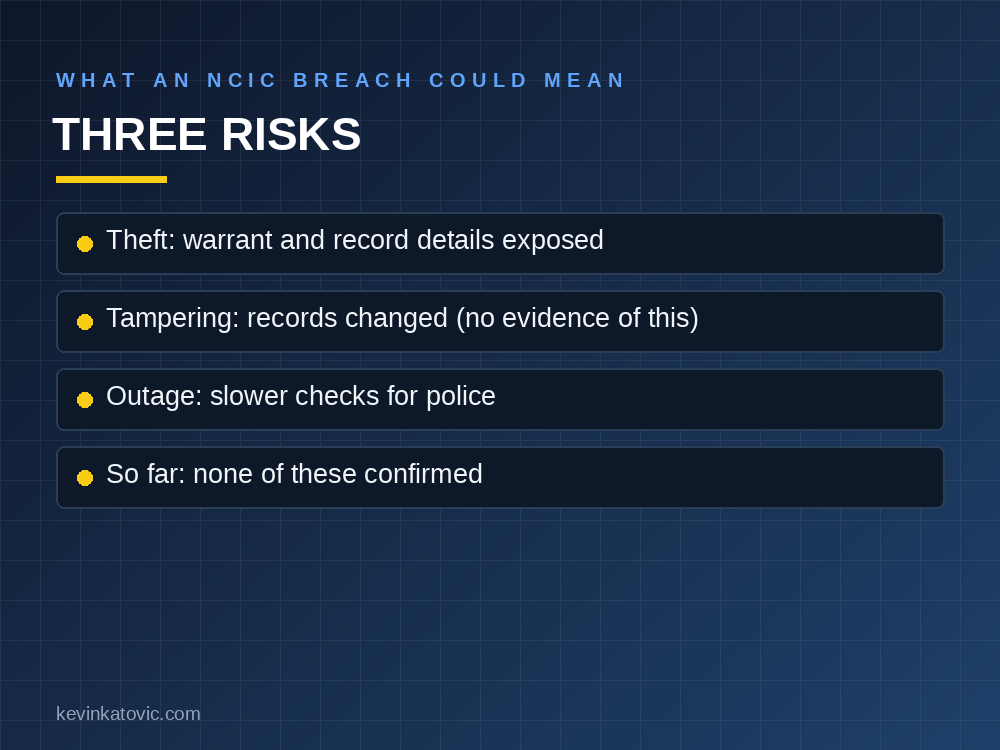
- Known: investigators are looking at an intrusion into NCIC, discovered in recent days.
- Unknown: when it happened, how the attackers got in, who they are, and whether anything was taken.
- Not shown: any evidence that records were altered.
That last point matters most. Stolen data is bad. Changed data in a database police trust at the roadside would be far worse.
The second time in two months
This isn’t the FBI’s first bad headline this fall. In September, the extortion crew ShinyHunters claimed it got into a platform tied to the FBI’s jobs website through an unpatched Oracle PeopleSoft hole, and CNBC reported data on current and former employees was exposed. There’s no sign the two incidents are linked, but twice in one season is a pattern people will notice.
President Trump’s reaction, to Fox News: “Well, we just heard about it, and I will say that it’s not good. I don’t like that.” On that, at least, everyone agrees.
Well, we just heard about it, and I will say that it’s not good. I don’t like that.
President Trump, to Fox News, November 21, 2026
Why it isn’t just an American story
Police records cross borders. Canada’s Privacy Commissioner has described an RCMP-FBI agreement under which Canadian police data is exchanged with the US system, read-only on the American side. No reporting says anything shared with Canada was touched. Still, when a partner’s vault gets cracked, every ally checks its own locks.
The same week, Bell confirmed that an ‘agentic’ intruder copied business records from one of its provisioning systems, and markets dropped hard; here’s why the S&P 500 and Dow slid into correction. Different stories, same lesson: critical systems are old, connected and under constant pressure.
The infrastructure underneath
Government databases don’t float in the cloud. They run in buildings with power feeds, cooling plants and backup generators, and the more we lean on AI to defend them, the more of those buildings get built. If you want a feel for the scale, this primer on what AI data centres actually spend money on is a good start, and you can model a facility’s capital and power bill here.
I’ll update this post when the FBI says something on the record. Until then, ignore anyone who tells you exactly what was stolen. Nobody outside the investigation knows yet.