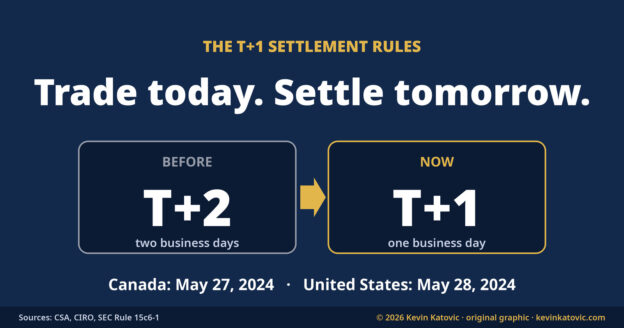
 Since May 2024, when you buy or sell a stock in Canada or the U.S., the trade settles one business day later instead of two. That is the T+1 rule. Canada switched on May 27, 2024 and the U.S. on May 28, 2024. Below I explain what changed, which brokers are legally required to follow it, and the date a lot of SiriusXM holders still ask me about: the last day old SIRI traded before the 1-for-10 reverse split.
What T+1 actually means
“T” is the trade date, the day you click buy or sell. Settlement is the day the money and the shares officially change hands at the clearing house. Under the old T+2 rule that took two business days. Under T+1 it takes one. Buy shares on a Monday and they’re legally yours, and the seller has their cash, on Tuesday.
Why bother? Every day a trade sits unsettled is a day one side could fail to pay or deliver. The 2021 meme-stock frenzy showed how much collateral brokers had to post while trades sat in limbo. Cutting a day cuts that risk, and the money brokers have to park with the clearing house.
When the new rules took effect
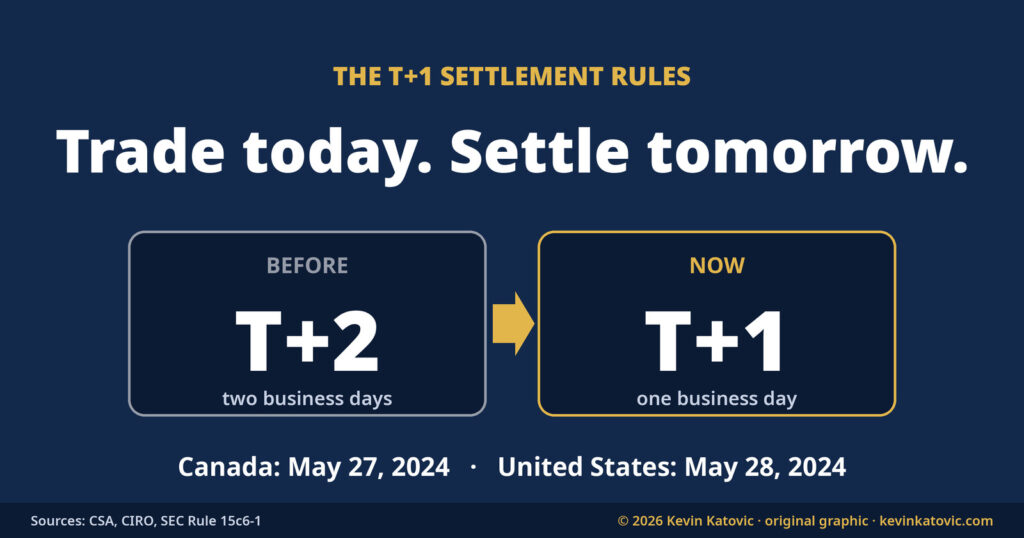
Canada: Monday, May 27, 2024
The Canadian Securities Administrators adopted amendments to National Instrument 24-101 (institutional trade matching and settlement) on December 14, 2023, and they took effect across Canada on May 27, 2024. CIRO amended its UMIR and dealer rules to match, and the CDS clearing house moved its settlement cycle the same day. Equities and long-term debt went first; Government of Canada bond auctions followed on June 3, 2024.
United States: Tuesday, May 28, 2024
The SEC adopted the change on February 15, 2023 by amending Rule 15c6-1 under the Securities Exchange Act. The compliance date was May 28, 2024, picked because it fell right after the Memorial Day long weekend. The SEC also added a new Rule 15c6-2, which makes brokers finish allocations, confirmations and affirmations for institutional trades on trade date, and made investment advisers keep records of them. FINRA and the MSRB updated their own rules for stocks and municipal bonds (SEC T+1 FAQ, FINRA Regulatory Notice 24-04).
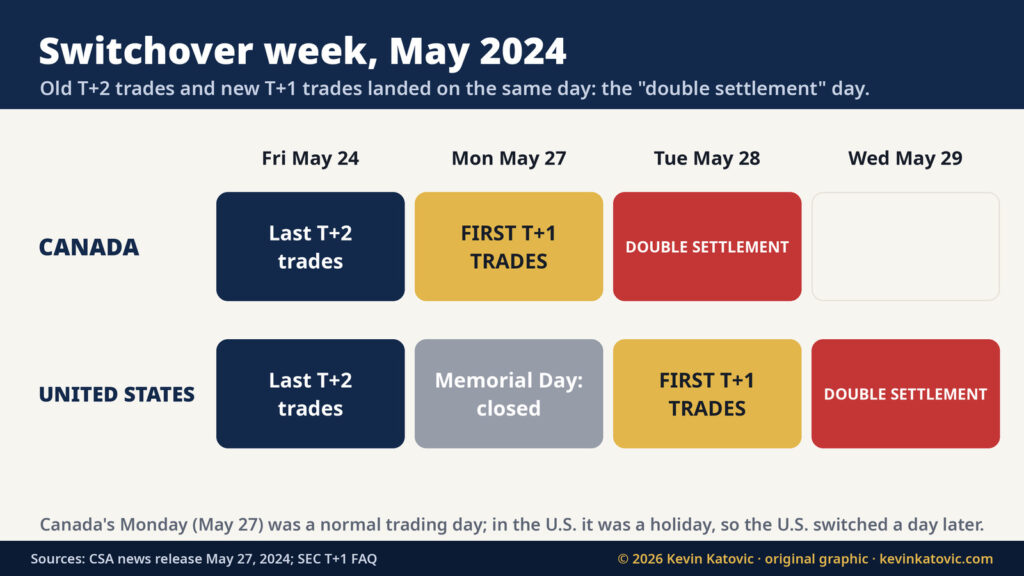
Because Canada’s May 27 was a normal trading day and the U.S. was closed, each country had a “double settlement” day. Last T+2 trades from Friday, May 24 settled alongside the first T+1 trades: Tuesday, May 28 in Canada, Wednesday, May 29 in the U.S.
Which brokers legally have to obey T+1
This isn’t optional for any brokerage. The rule binds the firms themselves, so if you trade through a regulated broker, your trades settle T+1.
United States: every broker-dealer registered with the SEC, which is every FINRA member firm. That includes Charles Schwab, Fidelity, Vanguard Brokerage, E*TRADE (Morgan Stanley), Merrill Edge, J.P. Morgan Self-Directed Investing, Robinhood, Webull, SoFi Invest, Public, Firstrade and Interactive Brokers LLC. Investment advisers are covered by the new recordkeeping requirement, and institutional trades by the same-day affirmation rule.
Canada: every investment dealer registered with the provincial securities commissions and regulated by CIRO, plus any registered dealer or adviser caught by NI 24-101 for institutional trades. That includes RBC Direct Investing, TD Direct Investing, BMO InvestorLine, CIBC Investor’s Edge, Scotia iTRADE, National Bank Direct Brokerage, Desjardins Online Brokerage (Disnat), Questrade, Wealthsimple, Qtrade and Interactive Brokers Canada.
Cross-border trades: a Canadian buying a U.S. stock through a Canadian broker settles on the U.S. T+1 cycle, and an American buying on the TSX settles on the Canadian one. Since both countries moved the same week, the old headache of mismatched cycles mostly went away.
What’s covered: stocks, ETFs, corporate and municipal bonds, and unit investment trusts. U.S. Treasuries already settled next day by market practice. Security-based swaps are exempt, firm-commitment offerings priced late in the day can still settle on T+2, and the two sides can expressly agree to a longer date when they make the trade.
What T+1 changed for regular investors
- Cash arrives faster: sale proceeds settle a day sooner, so you can withdraw them sooner.
- Pay faster: in a cash account you have one business day, not two, to fund a purchase. Miss it and your broker can restrict the account.
- Dividends: the ex-dividend date is now usually the same day as the record date. To get the dividend, buy before the ex-date.
- Stock transfers and certificates: anything that needs paperwork has to be in place sooner, so deliver shares to your broker before you sell.
- Options: option trades already settled T+1, but shares delivered from an exercise or assignment now settle T+1 too.
SiriusXM: the last trading day before the reverse split
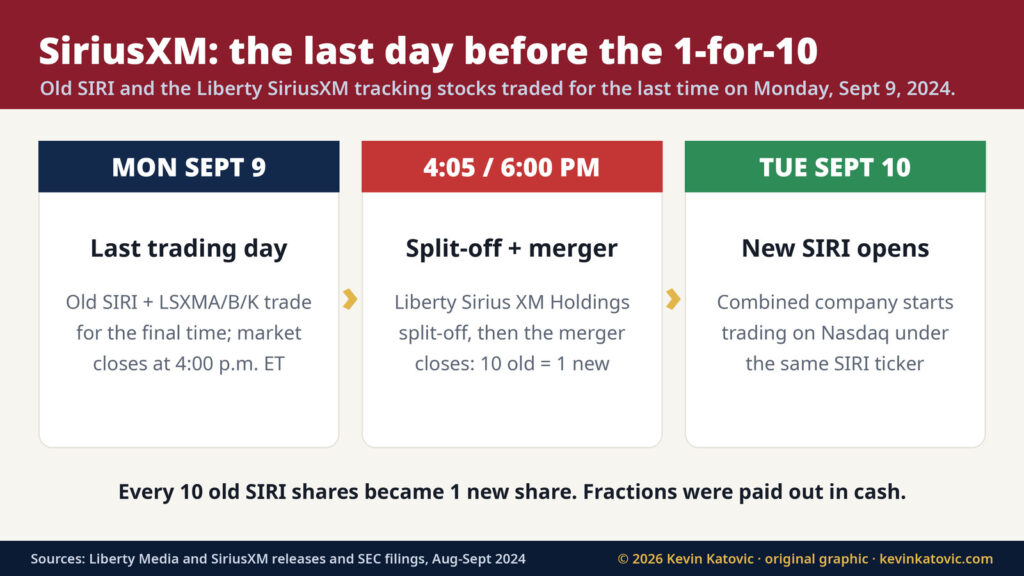
The last trading day for the old SiriusXM shares was Monday, September 9, 2024. SiriusXM and Liberty Media combined Sirius XM Holdings with Liberty Media’s Liberty SiriusXM tracking stocks into one company, informally called “New Sirius”. Liberty said the LSXMA, LSXMB and LSXMK tracking stocks would stop trading after the close on September 9.
That evening the split-off took effect at 4:05 p.m. New York time and the merger closed at 6:00 p.m. Old SIRI holders received one-tenth of a new share for each share they owned. That is a 1-for-10 reverse split built into the merger, and it took the share count from more than 3 billion down to roughly 339 million. Holders got cash instead of fractional shares. Liberty SiriusXM holders were converted at a different ratio, 0.8375 of a new share for each tracking share, also with cash for fractions.
On Tuesday, September 10, 2024, the combined company opened on Nasdaq under the same SIRI ticker, with the price about ten times higher to match. If your account suddenly showed one tenth the shares at ten times the price that morning, that’s why. Your stake was the same; your broker had converted it automatically.
This post is general information, not financial advice. Check your broker’s own cut-off times; many set earlier deadlines than the rules require.
Where I keep my own notes
Settlement rules are plumbing, but I like knowing how the pipes work before I put money through them. If you’re shopping for stocks that settle T+1 like everything else, here are the AI server-farm companies I watch on live charts. For a small-cap that had its own wild ride, see my running take on BigBear.ai at five bucks. Crypto never had a T+2 problem, since a token transfer settles in seconds, so here’s a quick primer on the token that fuels Polygon and how to put idle POL to work staking. And if you’d rather build the hardware than trade the stocks, the AI Build Configurator prices out a whole AI build.
T+1 settlement FAQ
When did T+1 settlement start?
Canada moved to T+1 on Monday, May 27, 2024. The United States followed on Tuesday, May 28, 2024, because May 27 was Memorial Day and U.S. markets were closed.
What does T+1 mean?
T+1 means a trade settles one business day after the trade date. Settlement is when the cash and the shares actually change hands. Before May 2024, the standard was T+2, two business days.
Which brokers have to follow T+1?
In the U.S., every broker-dealer registered with the SEC, which covers every FINRA member firm. In Canada, every investment dealer registered with the provincial securities commissions and regulated by CIRO, plus registered dealers and advisers covered by National Instrument 24-101 for institutional trades.
Which securities settle T+1?
Most everyday securities: stocks, ETFs, corporate bonds, municipal bonds and unit investment trusts. U.S. Treasury trades already settled next day by market practice. Security-based swaps are exempt, and the buyer and seller can still expressly agree to a different settlement date when they make the trade.
What was the last trading day for SiriusXM before the reverse split?
Monday, September 9, 2024. The old SIRI shares and the Liberty SiriusXM tracking stocks (LSXMA, LSXMB and LSXMK) traded for the last time that day. The merger closed that evening, every 10 old SIRI shares became 1 new share, and the new SIRI began trading on Nasdaq on Tuesday, September 10, 2024.
Sources: BC Securities Commission / CSA, May 27, 2024; CIRO, T+1 rule amendments; SEC, T+1 FAQ; FINRA Regulatory Notice 24-04; Liberty Media / Business Wire, August 23, 2024.
Graphics: three original graphics by Kevin Katovic. © 2026 Kevin Katovic, all rights reserved. To license an image, email support@kevinkatovic.com.