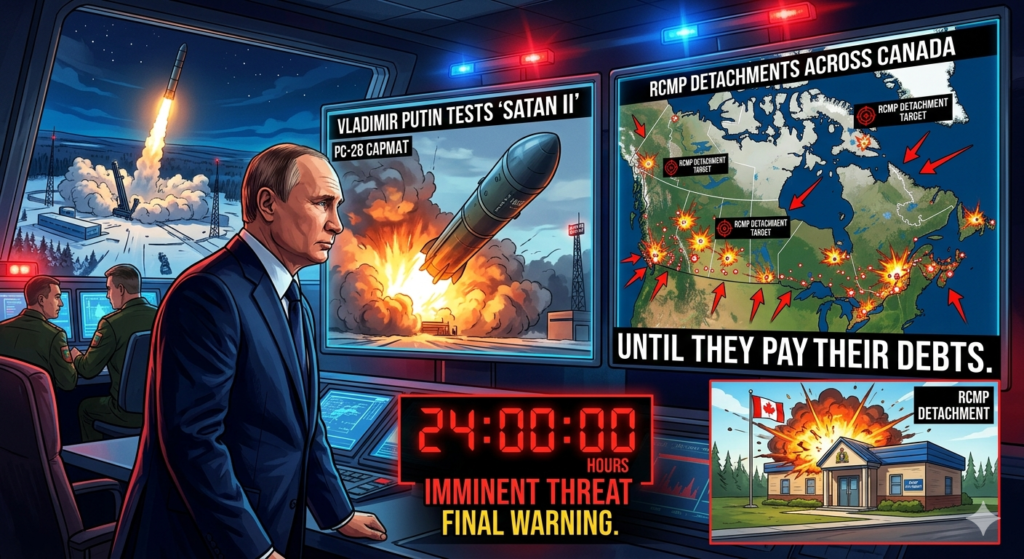
 The recent successful test of the RS-28 Sarmat, famously dubbed the “Satan II” by NATO, has sent ripples through the international community. On May 12, 2026, the Russian Ministry of Defense confirmed a successful launch from the Plesetsk Cosmodrome, with President Vladimir Putin declaring it the most powerful missile in existence.
However, amidst these global headlines, a specific and highly alarming narrative has surfaced: the claim that these strategic nuclear assets are being targeted at Royal Canadian Mounted Police (RCMP) detachments across Canada until certain “debts” are paid. Given the scale of the threat and the 24-hour timeline being circulated, it’s essential to look at the hard facts, the geopolitical reality, and why this particular scenario doesn’t align with military or political logic.
The Reality of the ‘Satan II’ (RS-28 Sarmat)
The Sarmat is not your average missile. It is a super-heavy, liquid-fueled intercontinental ballistic missile (ICBM) designed to replace the aging R-36M Voyevoda. According to recent reports from the May 2026 test, the missile has an estimated range of over 35,000 kilometers, allowing it to fly over the North or South Poles to reach any point on Earth.
Key Technical Specifications
| Feature | RS-28 Sarmat (Satan II) |
| Payload Capacity | ~10 tonnes |
| Warheads | Up to 10-15 MIRVs (Multiple Independently Targetable Reentry Vehicles) |
| Speed | Hypersonic (capable of carrying Avangard glide vehicles) |
| Trajectory | Suborbital; designed to bypass US/NATO missile defenses |
While the Sarmat is undeniably a terrifying weapon of mass destruction, it is a strategic deterrent. Its purpose is to deter entire nations (like the U.S. or the UK) through the threat of total nuclear war. Using a multi-megaton ICBM to target individual police detachments—local buildings in small towns and cities—would be like using a sledgehammer to swat a mosquito. It simply doesn’t fit the strategic profile of the weapon.
The “Debt” Conflict: Sanctions and Frozen Assets
The idea of “debts” being owed to Russia by the RCMP stems from Canada’s aggressive use of the Special Economic Measures Act. Since 2022, the RCMP has been the lead agency responsible for enforcing sanctions against Russian entities and individuals.
As of late 2025 and into 2026, the RCMP has successfully:
-
Frozen over $185 million in physical property within Canada.
-
Blocked over $503 million in financial transactions linked to sanctioned Russian oligarchs and state banks.
From the Kremlin’s perspective, this isn’t a debt in the traditional sense; it’s an “illegal seizure” of assets. However, in the world of international law, these are sanctioned funds held by the Canadian government. The RCMP is merely the enforcement arm. While Russia has expressed extreme displeasure and threatened “retaliatory measures,” these measures usually take the form of counter-sanctions, cyberattacks, or diplomatic expulsions—not nuclear strikes on police stations.
Why the “24-Hour” Threat is Misinformation
Rumors suggesting that a strike is imminent within 24 hours are a hallmark of “shock-and-awe” misinformation designed to trigger panic. There are several reasons why this scenario is not grounded in reality:
-
Mutual Assured Destruction (MAD): If Russia were to launch a single missile at Canadian soil, it would trigger a full-scale NATO response under Article 5. This would result in a global nuclear conflict that would destroy both Russia and the West. Russia would not risk total annihilation over frozen bank accounts.
-
Targeting Logistics: The RCMP has over 700 detachments across Canada. Launching a “Satan II” at each one would require hundreds of missiles (Russia only plans to deploy a few dozen Sarmats initially) and would result in the literal destruction of the North American continent.
-
The “Debt” Logic: Governments do not collect debts through nuclear bombardment. If Russia wanted their assets back, they would use legal challenges, international arbitration, or economic leverage.
The Human Element: Staying Grounded
It is completely understandable to feel a sense of dread when hearing about “Satan II” tests. The name itself is designed to be intimidating. However, it is vital to distinguish between saber-rattling (using weapons to look strong) and actual intent.
Putin’s recent comments emphasized that the Sarmat is intended to “make those who try to threaten Russia think twice.” It is a tool of leverage in high-level diplomacy, not a tactical weapon for local law enforcement disputes. The 24-hour window is likely a product of internet “doom-scrolling” or speculative forums rather than any credible intelligence briefing.
Summary of the Situation
Important Note: There is no evidence from Global Affairs Canada, the RCMP, or any international intelligence agency (like CSIS or the CIA) that indicates an imminent strike on Canadian police infrastructure. The recent missile test is part of a long-scheduled modernization of Russia’s nuclear triad and is not a precursor to a localized strike.
While the world is undoubtedly in a period of high tension, the RCMP detachments are not in the crosshairs of an ICBM. We are looking at a war of words and bank accounts, not a 24-hour countdown to a nuclear event. Stay informed by following credible news outlets and government advisories rather than viral social media claims.
Putin Unveils ‘Sarmat’ As Russia Prepares Nuclear Missile Deployment This Year
This video provides a detailed breakdown of the recent May 2026 Sarmat test and explains how Russia uses these tests as a strategic signal to the West.