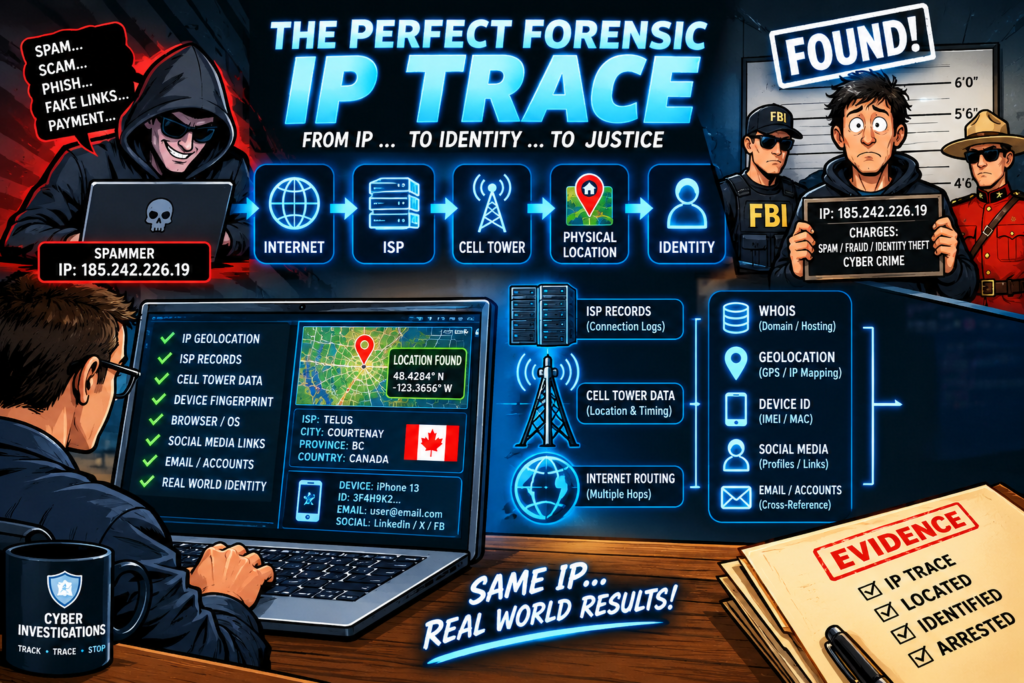
THE PERFECT IP TRACE
The first clue looked almost worthless.
At 2:17 a.m. on a rainy Tuesday, a Canadian cybersecurity investigator named Daniel Cross noticed the same suspicious IP address appearing repeatedly in connection with a series of fraudulent emails.
The messages were crude. Fake invoices. Phony delivery notices. Cryptocurrency payment requests.
Most investigators would have dismissed them as ordinary spam.
Daniel didn’t.
The address appeared again.
And again.
And again.
But this time, something was different.
The traffic pattern suggested that the person behind the messages was deliberately attempting to conceal their identity. Daniel began documenting every piece of evidence, preserving timestamps, server records, domain information and other legally obtainable data.
On his wall, he pinned a simple diagram:
IP → Network → Provider → Records → Person → Connections
It wasn’t glamorous.
It was patient.
And patience was exactly what the investigation needed.
THE SECOND CONNECTION
Three days later, another investigator discovered that several seemingly unrelated websites had been communicating with the same infrastructure.
One belonged to an online seller.
Another appeared to be a cryptocurrency service.
The third was a completely ordinary-looking import company.
There was no obvious connection between them.
Until the timestamps were compared.
The same handful of devices appeared to be active around the same unusual hours.
Daniel called it the shadow pattern.
The IP address wasn’t proof of who had committed a crime. It was only a lead.
But when combined with other independently obtained evidence, the lead became increasingly significant.
The investigators followed the trail through authorized records and eventually discovered something unexpected.
The online activity wasn’t centered in Canada.
It pointed overseas.
Taiwan.
THE HIDDEN NETWORK
Investigators contacted their international counterparts and shared the evidence.
What initially looked like a collection of unrelated cyber scams turned out to overlap with an ongoing narcotics investigation.
The suspicious online accounts appeared to be connected to people who were communicating with suspected members of a trafficking organization.
The organization had allegedly been using legitimate-looking businesses and online identities as cover.
The IP investigation hadn’t discovered the narcotics operation by itself.
It had uncovered a thread.
Investigators had pulled that thread carefully.
Now they could see part of the larger picture.
THE UNDERCOVER OPERATION
Authorities didn’t immediately move in.
Instead, an undercover investigation began.
An investigator working under an assumed identity made contact with people believed to be associated with the organization.
Meanwhile, analysts continued comparing communications, financial records and other evidence obtained through lawful investigative processes.
Every connection had to be independently verified.
Every piece of evidence had to survive scrutiny.
One mistake could compromise the entire operation.
Then came the breakthrough.
A previously unidentified organizer appeared to be coordinating activity across several locations.
The investigators realized that the same digital infrastructure appearing in their original cyber investigation was connected to communications surrounding the suspected trafficking network.
Daniel stared at the evidence board.
The tiny red string that had started with a spam message now stretched across the room.
Canada.
Asia.
Taiwan.
Multiple identities.
Multiple businesses.
Multiple digital accounts.
One network.
THE RAID
Several months later, coordinated arrests took place.
Police seized computers, phones, documents and other evidence.
The operation resulted in the dismantling of a suspected narcotics distribution network and the arrest of numerous individuals.
Daniel watched the reports come across his screen.
Someone asked him:
“So the IP address caught them?”
Daniel shook his head.
“No.”
He pointed at the evidence board.
“The IP address gave us the first question.”
He pointed to the dozens of documents surrounding it.
“The investigation gave us the answer.”
That distinction mattered.
An IP address could identify a network connection.
It could provide a valuable investigative lead.
But an IP address alone couldn’t magically prove who was sitting behind a keyboard, much less prove involvement in a criminal organization.
It took corroborating evidence, proper legal process, international cooperation and months of painstaking investigation.
Daniel looked again at the original spam message.
It had contained nothing more than a few lines of garbage text.
Yet those lines had opened the door to an investigation that crossed an ocean.
And somewhere in a digital evidence archive was the first record of the entire case:
2:17 a.m.
One suspicious connection.
One perfect forensic trail.