 They say that good things come to those who wait, and as time-honored adages go, few hit the nail on the head quite like this one. In our lightning-fast, high-octane world—where instant gratification is the order of the day and patience is perpetually put on the back burner—the slow-and-steady approach feels like a breath of fresh air. From a finely brewed cup of morning coffee to a lifetime of compound interest, time is the secret sauce that transforms the ordinary into the extraordinary. As the old saying goes, Rome wasn’t built in a day, and if you want to reap what you sow, you have to let nature take its course.
Yet, in a culture obsessed with quick fixes, hustle culture, and overnight sensations, the delicate art of sitting on your hands has largely gone out of style. The modern mindset demands fast action, high frequency, and immediate results. We want our cake and we want to eat it too, right now, with zero delay. But every dark cloud has a silver lining, and for those who still appreciate the virtues of playing the long game, there is profound wisdom—and incredible value—in letting time do the heavy lifting.
To truly understand why good things are worth the wait, one need look no further than the financial markets, where the tension between instant thrill-seeking and patient stewardship plays out every single day.
A Walk Down Memory Lane: The Quaint Era of Covered Calls
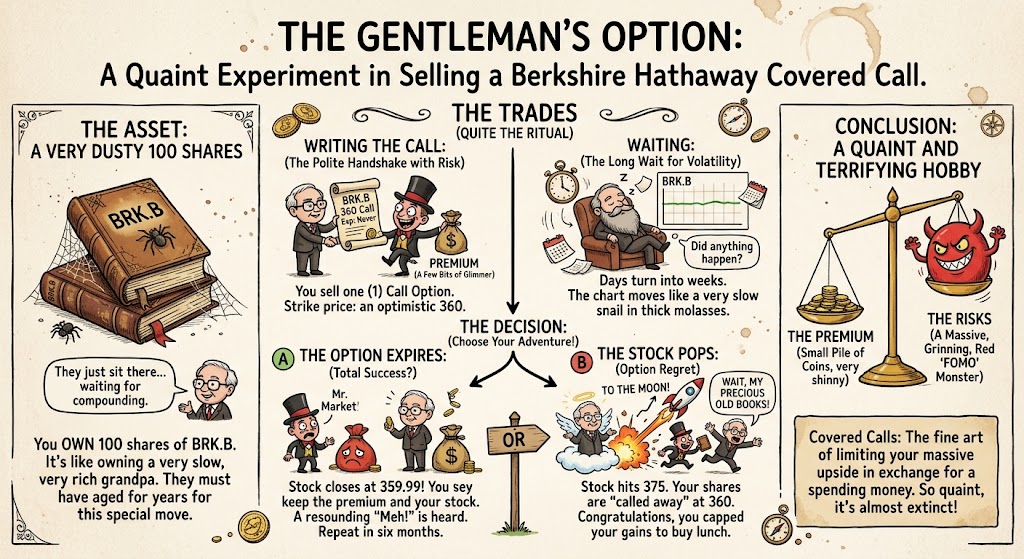
There was a time, not all that long ago, when income-seeking investors engaged in a deliberate, methodical ritual known as “writing covered calls”. For the uninitiated, selling a call option against stock you already own was the gold standard of prudent, conservative wealth management. You held 100 shares of a sturdy, blue-chip company, and every few months, you would sell someone else the right to buy those shares at a higher price. In exchange, you collected a modest cash premium—a little extra pocket change to butter your bread.
It was, by all accounts, a wonderfully quaint process. It had the quiet, nostalgic charm of a clockmaker carefully adjusting gears or a gardener tending to a patch of prized heirloom tomatoes. It was a strategy for the patient soul—a way to squeeze a modest 2% or 3% yield out of a portfolio while sitting back and watching grass grow.
Writing calls required a gentleman’s agreement with time. You accepted that in exchange for immediate, guaranteed pocket change, you were capping your potential gains. If the stock took off like a bat out of hell, your upside was strictly limited; your beloved shares would be called away, leaving you standing on the sidelines while the rest of the market went to the moon. But back then, slow and steady won the race, and investors were more than happy to take a bird in the hand rather than two in the bush.
Why Nobody Sells Calls on Their Positions Anymore
Fast forward to today, and selling calls on your long-term stock positions has virtually become a relic of a bygone era. You’d be hard-pressed to find modern traders indulging in this old-school habit, and for good reason: the financial landscape has shifted dramatically, making the traditional covered call look as outdated as a dial-up modem or a horse-drawn carriage.
First and foremost, we live in an era of unprecedented market volatility and explosive upside. In today’s market, tech darlings, AI pioneers, and high-growth innovators don’t just creep upward by a fraction of a percent a quarter; they jump by double digits overnight. When a stock can surge 20% on a single earnings report, selling a call with a 5% upside cap feels like picking up pennies in front of a steamroller. The modern investor has learned the hard way that missing out on a massive generational rally just to pocket a few dollars of option premium is a penny-wise, pound-foolish trade-off.
Furthermore, the mechanics of trading have evolved beyond recognition. Today’s retail market is dominated by zero-dated options (0DTE), high-frequency algorithmic trading, and hyper-leveraged products. The modern trader craves speed, dynamic flexibility, and uncapped potential. Selling a 45-day covered call locks up 100 shares of underlying capital for weeks on end, tying your hands behind your back while the market moves at warp speed. In a world where financial trends move at the speed of light, being tethered to a static, long-term covered call feels like wearing lead shoes in a 100-meter dash.
Finally, there is the tax burden and the emotional ache of “option regret”. Having your core, long-term holdings yanked out of your account because a stock breached your strike price triggers unwanted capital gains taxes and forces you to part ways with companies you actually wanted to hold for decades. Investors realized that if you truly believe in a company’s future, placing an artificial ceiling on its growth is simply shooting yourself in the foot.
The Unrivaled Magic of Sitting Tight
When you step back and look at the bigger picture, the decline of covered calls is part of a much broader lesson: real, enduring wealth isn’t generated by constantly tweaking, trimming, and capping your assets for short-term fixes. It is built by planting a seed, watering it, and giving it the space to grow into a giant oak tree.
When you buy high-quality assets and simply hold them—resisting the urge to sell calls, over-trade, or time the market—you unlock the magical engine of compounding. Patience allows your winners to run wild and free, completely unburdened by artificial caps or premature exit points.
Life, much like the market, rewards those who can master the art of delayed gratification. Whether you are building a career, nurturing a lifelong relationship, mastering a craft, or compounding a financial portfolio, shortcuts almost always lead to dead ends. Curiosity killed the cat, but patience saved the day. When you try to rush the process—when you constantly snip the tops off your growing plants just to harvest a tiny yield today—you rob yourself of the bountiful harvest that time was preparing for tomorrow.
So, while the quaint practice of writing calls on your prized stock positions may have drifted into the history books—replaced by a modern preference for letting great investments ride without limits—the underlying principle remains unchanged. Good things really are worth the wait. In a world running at full breakneck speed, there is still unmatched beauty, quiet dignity, and superior profit in taking a step back, letting time work its magic, and watching the best things in life unfold in their own good time.