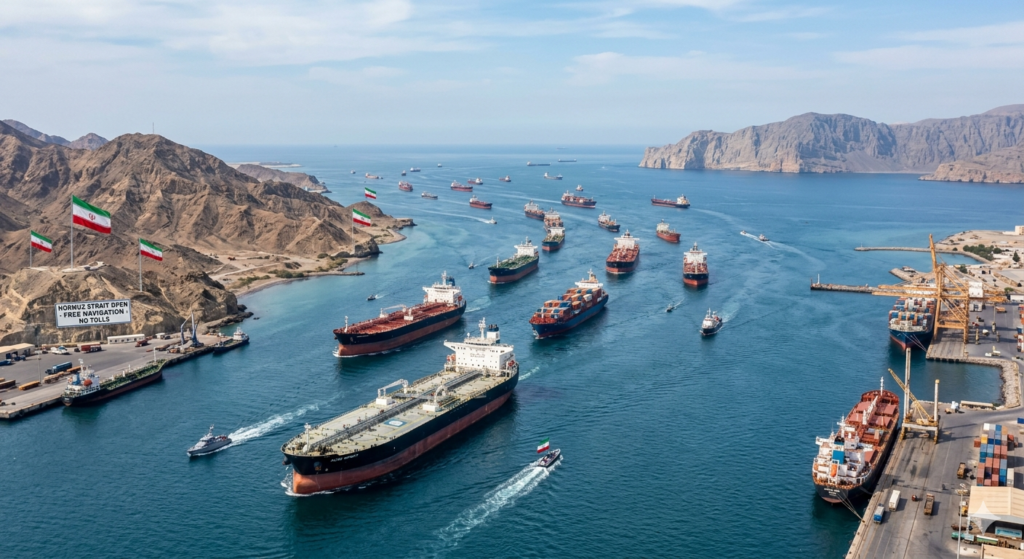
 The morning sun over Bandar Abbas didn’t just rise; it seemed to exhale. For weeks, the jagged cliffs of the Musandam Peninsula had stood like silent sentries over a graveyard of commerce. The Strait of Hormuz, a narrow throat through which the world’s industrial lifeblood once pulsed, had been choked shut by the iron grip of geopolitics. But today, March 31, 2026, the silence was broken by the low, rhythmic thrum of supertanker engines.
The “Grand Opening,” as the international press was calling it, felt less like a diplomatic victory and more like a collective recovery from a fever dream.
The Midnight Accord
The resolution had come in the quiet hours of the previous night. After weeks of back-channel negotiations in Muscat, a deal had been struck that stunned the global markets. The terms were staggering in their pragmatism: the United States would meet the Iranian demands in full. This wasn’t just a lifting of sanctions; it was a comprehensive settlement.
The agreement included a massive reparations package—billions of dollars designated as “reconstruction and stability grants”—to cover the damages from recent missile exchanges and the economic infrastructure losses. Critics called it a ransom; the White House called it “the price of global equilibrium.”
The most crucial clause, however, was the simplest: the Strait would remain a free-to-transit international waterway. There would be no tolls, no “security fees,” and no boarding parties. The shadow of the blockade was lifted.
The Three-Day Crash
As the news hit the terminals in London, New York, and Singapore, the “war premium” on oil didn’t just leak; it burst. For most of March, Brent Crude had been screaming toward $120 a barrel, with analysts warning of a $200 peak if the blockade held through April.
By noon today, the trajectory had inverted. With the guarantee of 20 million barrels per day returning to the market and the sudden release of inventories held in floating storage, the price floor has fallen out.
The Market Forecast: Traders are already pricing in a “pre-crisis” environment. The consensus is unanimous: Oil will return to $60 a barrel within 72 hours. The logic was simple: the supply shock was over, and the reparations paid by the U.S. had removed the incentive for any future “instability taxes” or regional disruption. The global economy, which had been gasping for air, suddenly found itself swimming in a surplus.
A View from the Bridge
Captain Elias Thorne stood on the bridge of the Azure Infinity, a VLCC (Very Large Crude Carrier) that had been idling in the Gulf of Oman for twenty-two days. His knuckles were white against the railing as the radio crackled to life.
“Vessel Azure Infinity, this is Bandar Abbas Control. You are cleared for transit. Maintain heading 280. The channel is clear. Welcome back.”
Elias felt a weight lift from his chest that he hadn’t realized he was carrying. For months, the risk of mines, drone strikes, and seizures had turned the merchant marine profession into a high-stakes gamble. Now, as he watched the Iranian patrol boats peel away, not in pursuit but in a symbolic escort, the world felt righted.
He looked at his navigator. “Steady as she goes. Let’s get this oil to the refineries before the price drops another ten dollars.”
The Return of the Routine
In the coastal towns of the UAE and Oman, the atmosphere was electric. During the closure, the ports of Fujairah and Jebel Ali had become ghost towns, their cranes frozen like skeletal remains. But today, the mechanical giants roared back to life.
The “return to normal” was visible in more than just the ships:
-
The “Hormuz Toll” is Dead: Under the new treaty, the proposed “transit fee” was permanently abolished. Navigation remains free under international law.
-
Insurance Premiums: Maritime war-risk rates, which had skyrocketed to 10% of hull value, were being rewritten by noon to standard peacetime levels.
-
Global Logistics: Logistics hubs in Singapore and Rotterdam began clearing backlogs that had stalled global manufacturing for a quarter.
The Cost of Peace
In Washington, the atmosphere was more somber. The payment of damages for the missile strikes was a bitter pill for many to swallow. The imagery of US Treasury transfers heading toward Tehran was the lead story on every news cycle.
However, the logic of the “New Normal” was undeniable. The cost of the blockade—measured in shuttered factories in Europe, soaring heating costs in the American Midwest, and the brink of a global depression—dwarfed the billions paid out in the settlement.
“We aren’t paying for the past,” the Secretary of State remarked during a televised briefing. “We are purchasing the future. We are ensuring that the 21 million barrels of oil that pass through those narrows every day continue to move without the threat of fire.”
Sunset on the Narrows
As evening fell, the Strait of Hormuz looked like a shimmering highway of light. Dozens of tankers, spaced out in a disciplined parade, moved through the shipping lanes. The infrared cameras on the surrounding heights no longer tracked targets; they monitored traffic.
For the residents of the region, the change was visceral. In the markets of Dubai and the bazaars of Bandar Abbas, the talk wasn’t of war, but of trade. Shipping containers filled with electronics, grain, and medicine were moving again. The sense of impending doom that had hung over the Persian Gulf like a humid fog had burnt off.
There would be no more sirens. No more “exclusion zones.” The US Navy presence had moved over the horizon, maintaining a watchful but distant eye, fulfilling its part of the de-escalation agreement.
The world had looked into the abyss of a total energy collapse and blinked. By choosing to pay the price—monetary and political—the powers involved had opted for a boring, stable, and profitable reality over a glorious, destructive conflict.
As the Azure Infinity cleared the western exit of the Strait and headed into the open waters of the Persian Gulf, Captain Thorne watched the lights of the coast fade. For the first time in a year, he didn’t check the radar for incoming threats. He went below deck, made a cup of coffee, and thought about the $60 barrel. The panic was over. The world was moving again.