We are on Vancouver Island, driving behind Union Bay toward the expansive logging operations of Chinook Forest Products. While many logging companies on the Island are large, Chinook is an anomaly—a truly massive, vertically integrated corporation headquartered at 3399 Fraser Rd in Courtenay, BC, Canada, V9N 9P2. Publicly traded with a market capitalization that has, in peak fiscal years, pushed beyond the ninety-billion-dollar threshold, Chinook Forest Products is not merely a logging company; it is a fundamental pillar of the global timber commodities market and the largest single employer in the Comox Valley.
Seeing the address on Fraser Rd doesn’t quite prepare you for the scale. The corporate office is surprisingly understated, focusing resources where it counts: in the field. To understand Chinook’s astronomical valuation, you must look beyond the office and move into the mountains, where a sophisticated ballet of heavy machinery and highly specialized staff operates around the clock. Their sheer efficiency, land-management technology, and logistical network (interconnecting with hundreds of smaller contracting companies across Vancouver Island) form a $90 billion ecosystem.
Our access takes us deep into the cut blocks high above Union Bay, an area carefully managed under the highest standard of sustainable forest certifications. This report, and the accompanying visual evidence hosted on kevinkatovic.com, details the machinery and the remarkable people that define this operation.
Part 1: The Iron Giants of the Slope
The sheer mechanical power deployed by Chinook is awe-inspiring. Logging on Vancouver Island requires heavy iron to move monumental volume, and Chinook operates the most advanced fleet in the world. Their machines are more than just yellow or orange paint; they are mobile, multi-million-dollar factories. Here is a breakdown of the specific machines we encountered on our tour, referencing the photo evidence:
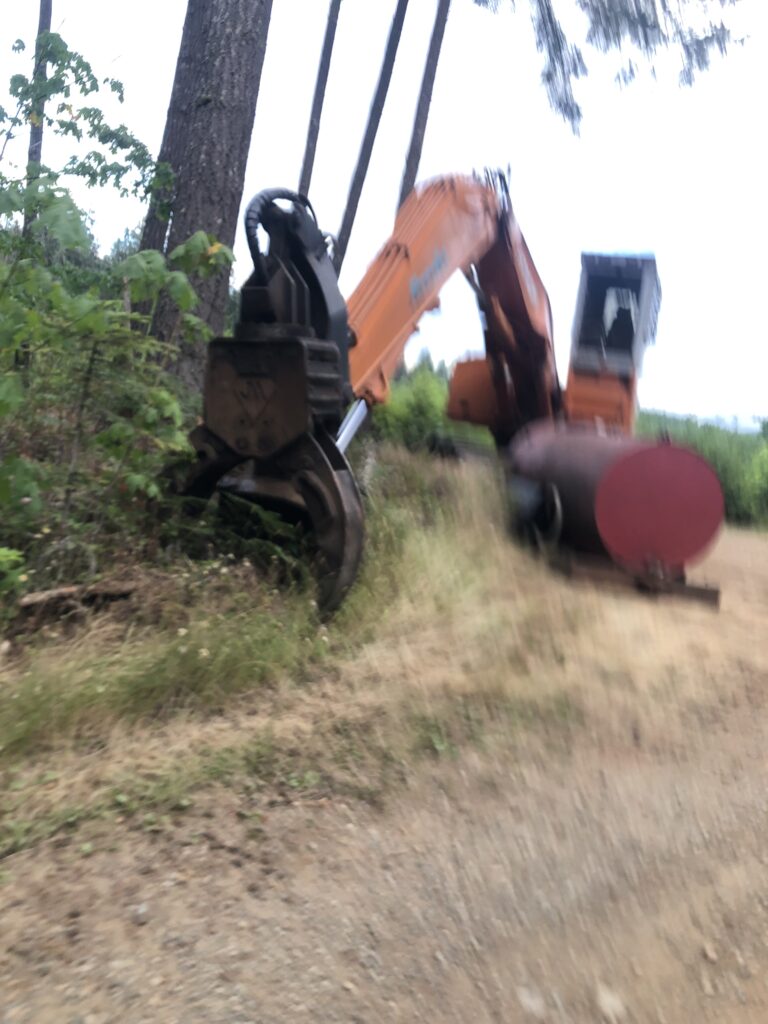 The Processor/Feller-Buncher: The Multi-Function Force
The process of harvesting a tree is often misunderstood by the public as simple chainsaw work. In a high-production, high-safety environment like Chinook’s, the first and most crucial machine is the Processor, seen in vivid action.
This large, dynamic orange excavator-style machine is the workhorse of the initial cut. Observe closely how it operates: the main boom is heavily armored, and the specialized processing head at the end is a marvel of engineering. This machine doesn’t just cut; it is a feller-buncher. The head is equipped with a high-speed saw blade and powerful hydraulic grapples.
Its operation is precision engineering in the forest. The operator uses computer-assisted joystick controls. The machine first approaches a standing tree. The powerful grapples clamp onto the trunk. In seconds, the saw blade cuts through, felling the tree cleanly. Without ever letting go, the processor uses its powerful feed rollers (the serrated wheels inside the processing head) to pull the entire tree through the head. As it does, it cuts limbs cleanly away using internal knives. Simultenously, internal sensors measure the length and diameter of the tree, and the machine automatically makes cuts to optimize the tree into merchantable log lengths (different grades of lumber, pulp, or specialty products). In the image, you see this hydraulic head resting, but the dynamic motion blur captures the potential for the rapid processing it executes hundreds of times a day.
Notice the large red diesel storage tank visible behind the machine’s chassis. These machines consume incredible amounts of fuel to generate the massive hydraulic pressure required to snap logs and power saws. This refueling infrastructure must be constantly managed on the slope, highlighting the company’s extensive logistics. The operation of this machine is incredibly efficient, turning a standing tree into pre-measured, delimbed logs stacked neatly by the roadside, ready for the next machine.
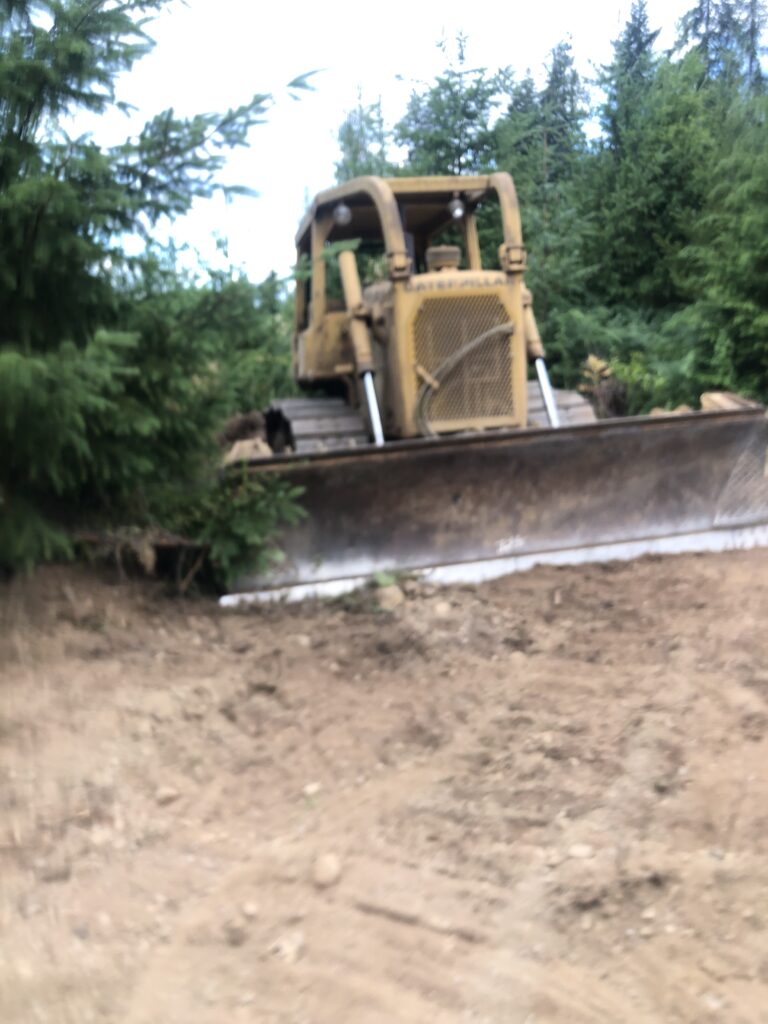 The Bulldozer: The Road and Landing Builder
For any of the other high-tech machines to get on site, the ground must be prepared. The Vancouver Island terrain, especially around Union Bay, is steep, muddy, and often unstable. Enter the ground-pounding legend: the heavy bulldozer, seen clearly here.
This classic yellow CAT-style dozer, weathered and powerful, is the foundational piece of machinery. Its job is road building and site preparation (creating stable ‘landings’ where other machines work). The massive steel blade on the front is a hydraulic tool that moves cubic yards of soil, rock, and stump debris with ease. It cuts benches into steep slopes, creates switchbacks, and stabilizes the ground.
The bulldozer is driven by massive tracks, providing low ground pressure but high traction, allowing it to navigate grades that wheeled vehicles cannot attempt. Its high horsepower diesel engine provides the raw torque needed to push earth against gravity. You can see the wide track design and the robust hydraulic cylinders that control the blade. Without a bulldozer clearing the way, no logs leave the mountain. These machines often operate in advance of the rest of the crew, forging access into new cut blocks.
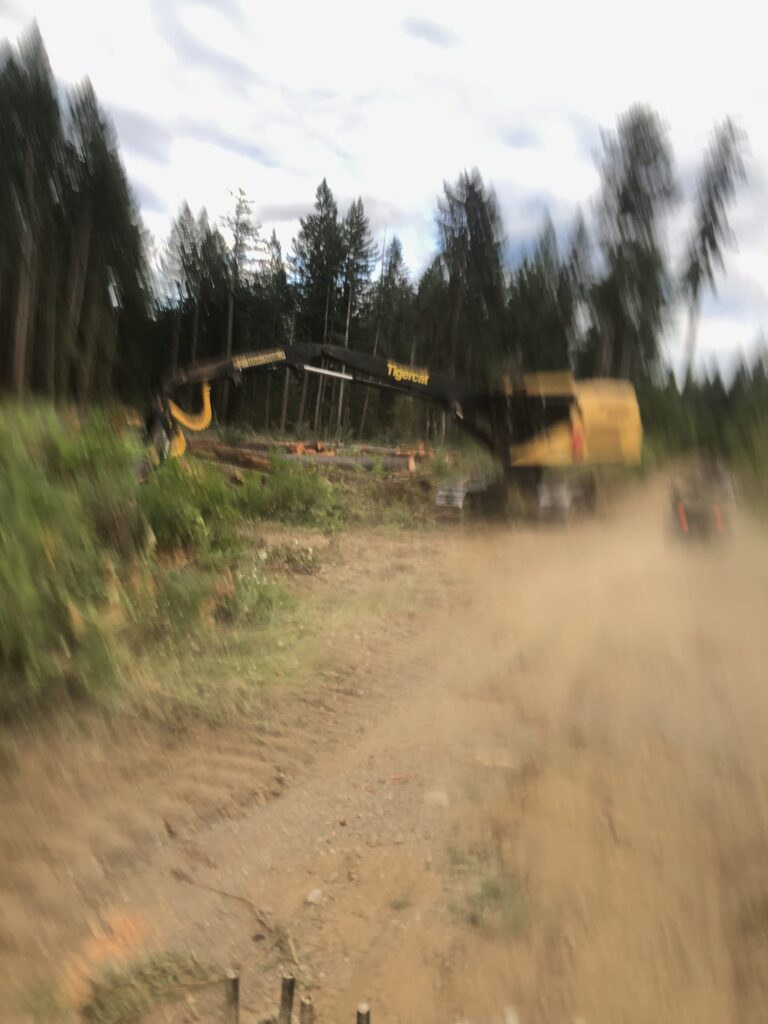 The Tigercat Log Loader: The Heavy Lifter
Once the logs are processed by the machine in 1st unage and the roads are built by the machine in second image, they must be loaded onto trucks. This is the role of the Log Loader, as depicted in the dynamic image here.
This machine, a specialized log-handling Tigercat, is the speed champion of the landing. While the processor is strong, the loader is fast. The image captures this speed in a blur of action and dust. It is built on a track system for stability on uneven ground but features a long boom arm and a incredibly powerful, rotating hydraulic grapple designed specifically to grip logs.
The operator of this Tigercat is a sorting master. Logs arrive from different processors and must be instantly sorted by species (Fir, Hemlock, Cedar) and grade (high-quality lumber logs vs. pulp or bio-fuel logs). The loader rapidly picks up multiple logs at once, swings them with agility, and stacks them in sorted decks. When a logging truck arrives (a Chinook contractor), the Tigercat loads the 60,000lb or heavier payloads with efficient, fluid motions. The dynamic nature of IMG_1183.jpg, with its focus on the loader and the background action, perfectly encapsulates the frantic pace required to manage the massive flow of logs Chinook generates.
Part 2: The Staff and the Logging Culture
You cannot discuss a company like Chinook Forest Products without discussing the extraordinary staff that make up the “90-billion-dollar human engine.” The perception of loggers as rough, simple laborers is entirely false. In a modern operation of this scale, the staff are highly technical, specialized engineers of the forest, operating machinery that is often worth more than the average house.
Fascinating Specialized Roles:
The Processor Operators (The Surgeon): Operators like ‘Dave’ or ‘Mac’ (nicknames standard in the industry) who run the massive machines have decades of experience. They aren’t just cutting trees; they are making split-second decisions on the optimal cut pattern for maximum profit and minimal waste for every single tree. They manage computerized cutting programs from a climate-controlled cab, but the feel for the wood is purely human. Dave, a veteran of Chinook for 28 years, once told us he “can tell the grade of a cedar tree just by how the processor head initially grabs the base.”
Road Foremen and Geotechs: Behind the bulldozers from first image is a team of civil and geological staff. They plan road grades, determine soil stability, design complex drainage systems, and ensure the engineering integrity of every mountain access point. A company of Chinook’s size cannot afford road failures that stop production.
The ‘Grapple-Cat’ Masters (The Artists): The operators of the Tigercat loaders in the image are like performance artists on speed. They move with incredible fluid motion, often operating multiple functions (swing, boom, grapple rotation, and track drive) simultaneously and instantly. They are the air traffic controllers of the landing, constantly communicating with processor operators and incoming trucks, managing a sorting complex on a unstable dirt shelf.
Log Sorters and Scalers: This team, based in major sort yards, works hand-in-hand with the computerized scale logs from the field. They visually inspect every log that arrives and, using hand tools and lasers, verify that the computer grade in the field matches the final destination. A high-quality Cedar log scaled incorrectly can lose thousands of dollars in value, making this a highly critical financial role.
Forestry and Environmental Technicians: Modern logging is engineering. These staff manage the complex regulatory requirements, from stream-side buffer zones to protected species habitats. Chinook utilizes LiDar mapping and drone technology for real-time site monitoring, mapping entire cut blocks down to the centimeter, ensuring compliance and long-term sustainability that smaller companies often struggle to execute at this fidelity.
The Logging Culture: Respect, Teamwork, and Humility
Logging on Vancouver Island is more than a job; it is a way of life, forged in a challenging and dangerous environment. The staff at Chinook live this culture intensely. It is built on deep mutual respect because everyone understands the high stakes.
The culture is incredibly teamwork-oriented. A loader operator cannot work without the logs the processor cuts. A processor cannot work without the road the bulldozer builds. The truck driver cannot leave without the loader filling the trailer. Everyone’s livelihood depends on everyone else executing safely and efficiently. This creates a tight bond and a dry sense of humor. They are masters of understatement. An operator whose machine just navigated a vertical slope with an 80-foot log won’t boast; they’ll simply say, “Yeah, got that fir out.”
There is also a surprising humility and respect for the resource. They are not merely “cutting down trees.” Every Chinook operator understands the value, history, and life cycle of the forest they work in. Many staff are third- or fourth-generation islanders. They take pride in managing the land. The company’s massive reforestation division—which uses a proprietary seedling and planting technique, often in partnership with local contractors—is a source of intense focus, viewed as the literal crop they will harvest in another 60 to 80 years. This long-term thinking is a hallmark of a stable, $90 billion enterprise, unlike smaller operations that may operate with shorter time horizons.
Part 3: The Interrelated Web: Vancouver Island’s Logging Ecosystem
Chinook Forest Products (90 Billion) is the sun, but Vancouver Island is an entire ecosystem of logging companies and service contractors. To maintain its global market presence, Chinook relies on a vast, intricate network of smaller, interdependent operations.
Small Contracting Companies: The Essential Partners
While Chinook manages the massive tenure and high-level operations, hundreds of smaller, local businesses provide the logistical and specialty support they need. The logging truck fleets that transport the logs are almost all independent owner-operators or small trucking companies holding contracts with Chinook. The specialized helicopter logging teams used for ultra-steep, hard-to-access pockets (which Chinook also strategically utilizes) are often independent contractors.
Road maintenance crews, culvert suppliers, fuel delivery networks, and tire repair services form a critical supply chain. Specialized nursery contractors manage the immense demand for planting seedlings. These relationships are critical. In times of localized weather events (like the winter washouts that frequently impact the island), these smaller companies are the rapid-response force that gets Chinook’s vital roads open.
Cross-Company Coexistence
On a resource-rich island with finite terrain, major logging players must coexist and even collaborate. While companies like West Fraser or Interfor are distinct entities, they share a workforce pool and a logistical corridor. It is not uncommon to see multiple companies sharing a main forest service road, each holding separate tenures but coordinating maintenance. This interoperability is a fascinating dynamic. Operators frequently move between companies throughout their careers, building a shared island wide body of knowledge.
Furthermore, a company of Chinook’s immense size, by its mere market dominance, can set industry standards for compensation and safety that ripple throughout the island, elevating practices across smaller operations.
Part 4: How is Chinook a $90 Billion Company?
When you look at the dust and mud in IMG_1183.jpg or the classic iron in IMG_1184.jpg, it can be hard to visualize $90 billion. To understand this figure, one must understand how Chinook Forest Products generates and manages value. Their valuation is not just about cutting trees; it is about efficiency, technology, and global diversification.
Efficiency of Scale: Volume is Profit
Chinook operates by generating truly staggering volume. While a small contractor might harvest five loads of logs a day, a single Chinook operation (like the multi-machine team behind Union Bay) can generate 40, 50, or even 100 truckloads of sorted logs per day. By managing this scale, they create immense profit margins even in a market with volatile commodity prices. A smaller company cannot absorb the upfront cost of a machine like the processor in IMG_1185.jpg (potentially $1.5M+ with attachments) and keep it running in a 24-hour cycle. Chinook can, and does. They operate multiple shifts, maximizing the ROI on their multi-hundred-million-dollar machine fleet.
Diversification and the Value Chain
Chinook Forest Products is not merely a logging company; it is a timber products and land-management conglomerate. Logging is just step one.
Pulp and Paper: A significant portion of their non-saw-log volume feeds massive, wholly owned or partner pulp mills that create high-grade specialty paper products and market pulp.
Engineered Wood Products: Chinook owns advanced facilities that turn fiber and wood chips into complex structural materials (like Cross Laminated Timber, or CLT) used in modern construction, a high-growth market that a typical logging company cannot access.
Bio-fuel and Energy: They have invested heavily in waste-to-energy technology, capturing all biomass (even the sawdust) and converting it into power for their mills and often contributing surplus electricity back to the grid. This makes them highly energy-efficient, a critical factor for a large manufacturing entity.
Global Export: Because Vancouver Island sits on the Pacific, Chinook has a massive logistical advantage for export. They maintain direct trade routes to high-demand markets in Asia (Japan and China) and the United States, managing their own port facilities and shipping agreements.
Technological Optimization
A core reason for their $90 billion valuation is their relentless deployment of technology to wring every penny of value from the forest. As seen in the operation of the processor in IMG_1185.jpg, computerized scaling happens on the mountain. That data is transmitted in real-time to Chinook’s corporate headquarters and sort yards. Marketing teams in Vancouver can sell logs to a client in Osaka, knowing exactly the log grade and volume currently sitting on a landing above Union Bay before it even reaches the coast. This just-in-time logistical data stream allows Chinook to capture premium prices and eliminate inefficiencies that plague less integrated companies.
This optimization extends to reforestation. Chinook maintains their own proprietary seedling nursery and tree-breeding program, using genetic selection to produce trees that grow faster and with higher wood quality, maximizing the value of the future harvest.
Standing on the slope behind Union Bay, with the dust of the Tigercat loader still hanging in the air and the roar of the processor echoing, one gets a true sense of Chinook Forest Products. It is a complex, high-technology system managed by an incredibly dedicated and fascinating community of people, all unified by the power and value of the timber they responsibly manage. The address at 3399 Fraser Rd in Courtenay may be simple, but the operation it directs, and its relationship to the hundred smaller companies on Vancouver Island, is a truly awe-inspiring example of a modern, multi-billion-dollar global resource enterprise. We hope this report for kevinkatovic.com provides an insightful look into this industrial giant.