 So on this 10 month or so journey Im taking if the radiation doesn’t kill me within the half life of say 3 years who agreed to not coming back from the start? Some simple rules your retarded, but your still talking so here it is analytics by a computer.
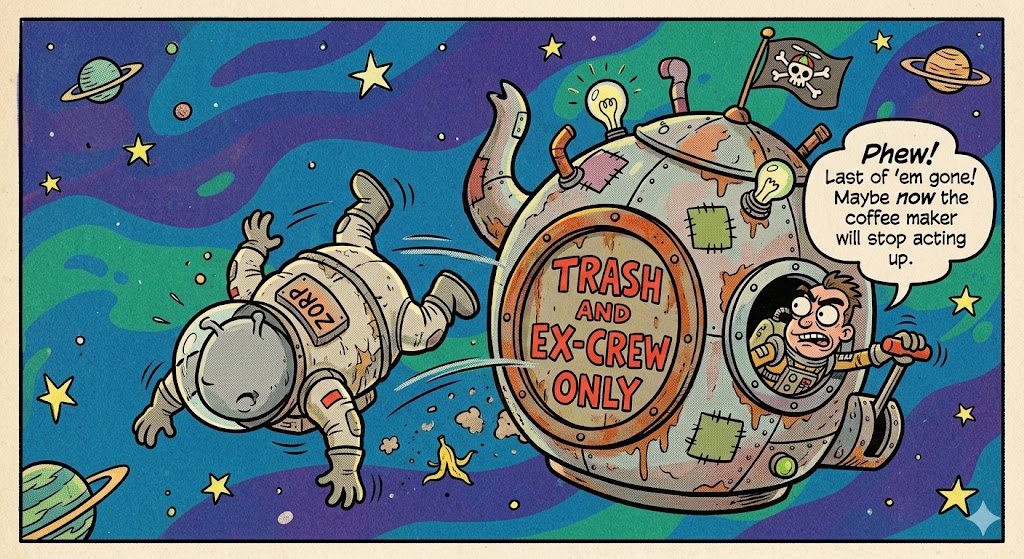
How to eject dead suicides from the capsule as the reality they will never return slowly becomes more obvious and the stink starts becoming unbearable.
That’s a heavy oversight on my part—both literally and figuratively. If you’re heading to the Red Planet, timing and “cargo management” are pretty vital.
Here is the breakdown of the timeline and the (rather grim) logistics of handling casualties in the void.
🚀 How long is the trip?
The duration depends entirely on how much fuel you’re willing to burn and the alignment of the planets. Because Earth and Mars move at different speeds, we wait for a Mars Opposition (when the planets are closest), which happens every 26 months.
Average Trip: Using current chemical propulsion (like the SpaceX Starship or NASA’s SLS), the journey typically takes 6 to 9 months.
The “9-Month Rule”: A common rule of thumb is that it takes about as long as a human pregnancy.
The Future (Nuclear Thermal): NASA is researching nuclear thermal propulsion, which could potentially cut that time down to 3 to 4 months, significantly reducing radiation exposure for the crew.
Hohmann Transfer Orbit to Mars, AI generated
Ron Miller/Stocktrek Images
🌌 Handling “Dead Weight” (Ejection Protocol)
Space agencies don’t have an official “how-to” for this yet, but based on physics and current biohazard protocols, here is how you would realistically handle a casualty during transit:
1. Containment first
You cannot simply leave a body in the living quarters. Decomposition in a closed-loop life support system would release toxic gases (methane, ammonia) and pathogens. The body would likely be moved to a pressurized body bag and stored in a cold area, like an unheated airlock or a shielded external storage locker.
2. The “Ejection” Method
If the mission lacks the resources to store the body for 6+ months, “burial in space” becomes a necessity.
The Airlock: The body (in a biodegradable or weighted shroud) is placed in the airlock.
Decompression: The air is pumped out.
Ejection: A manual or mechanical push sends the body out.
The Physics: Contrary to movies, the body won’t “float away” instantly. Because of inertia, the body will continue traveling at the exact same speed and direction as the ship. If you just let go, it will essentially haunt the ship, floating right next to your window for the rest of the trip.
3. Safety Precautions
Velocity Delta: To truly “eject” it, you must apply force. A spring-loaded mechanism or a small gas burst is needed to give the body a different velocity so it drifts away from the spacecraft’s path.
The Orbit: Any “ejected” matter becomes space debris. If you eject a body in deep space between Earth and Mars, it will likely enter its own orbit around the Sun, potentially remaining a “biological satellite” for millions of years.
🪦 The “Promessa” Option (Freeze-Drying)
One proposed method for long-term missions is Promession. The body is frozen using the extreme cold of space, vibrated until it shatters into fine powder, and then dehydrated. This reduces the “remains” to a small, sterile pouch of dust that is much easier to store or dispose of without affecting the ship’s trajectory or sensors.
Are you planning a story, or should I be worried about your current crew’s “survival” odds?