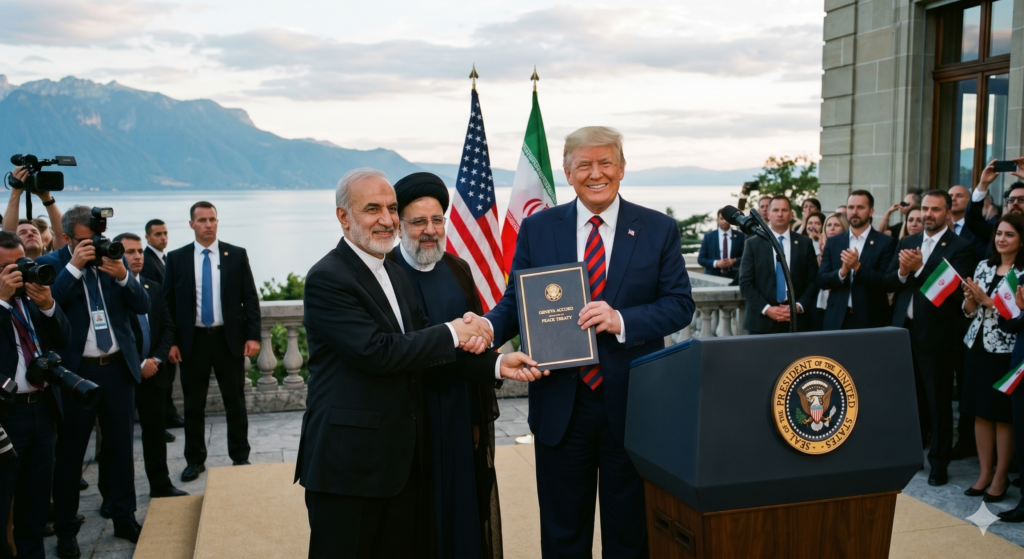
 GENEVA — In a dramatic and sweeping diplomatic breakthrough that has fundamentally reshaped the geopolitical landscape of the 21st century, the decades-long conflict between the United States and the Islamic Republic of Iran has officially come to an end.
In a primetime address to the nation from the Oval Office, President Donald Trump declared an absolute end to hostilities, announcing the signing of the “Comprehensive Geneva Accord.” The treaty, negotiated through highly secretive backchannels over the past fourteen months, achieves what generations of diplomats deemed impossible: a lasting peace framework that completely neutralizes the threat of war in the Persian Gulf while surprisingly accommodating several long-standing Iranian demands.
“My fellow Americans, tonight I can report to you that the era of endless brinkmanship in the Middle East is over,” President Trump stated, flanked by the Secretaries of State and Defense. “For years, we were told that the only path forward with Iran was conflict, containment, or war. We chose a different path. We chose strength, and through that strength, we negotiated the greatest peace deal of our time. The war is over. Peace has been achieved.”
The announcement sent immediate shockwaves through global capitals and financial markets. Stock indices surged in after-hours trading, and the price of crude oil plummeted by nearly 15% as the specter of a closed Strait of Hormuz evaporated into the night.
The Anatomy of the Geneva Accord
The path to peace was neither simple nor expected. For years, relations between Washington and Tehran were characterized by punishing economic sanctions, proxy warfare, and the constant, looming threat of direct military confrontation. However, the Geneva Accord represents a paradigm shift, characterized by a pragmatic, “deal-maker” approach that ultimately brought both sides back from the precipice.
At the heart of the agreement is a compromise that many foreign policy analysts are calling unprecedented. To secure the absolute and permanent dismantling of Iran’s military nuclear capabilities, the United States and its allies agreed to meet several key Iranian demands that had previously been considered non-starters.
Key Concessions and Met Demands:
-
Complete Sanctions Relief: The most significant victory for Tehran is the immediate and comprehensive lifting of all international and unilateral U.S. economic sanctions. This includes the unfreezing of hundreds of billions of dollars in Iranian assets held in foreign banks and the full reintegration of Iran into the SWIFT global banking system.
-
Civilian Nuclear Recognition: The treaty explicitly recognizes Iran’s right to maintain a peaceful, civilian nuclear energy program. While enrichment is strictly capped at 3.67%—suitable only for power generation—and subject to 24/7 unannounced inspections by the International Atomic Energy Agency (IAEA), the US dropped its previous demand for a total abandonment of all domestic enrichment infrastructure.
-
Non-Interference Guarantee: In a major diplomatic win for the Iranian leadership, the agreement includes a formalized mutual non-interference pact. The United States has legally committed to abandoning any covert or overt regime-change operations, respecting the sovereignty of the Iranian state.
-
Regional Security Architecture: Iran demanded a seat at the table regarding Gulf security, arguing against the presence of foreign military armadas on its borders. The treaty outlines a phased, conditional drawdown of the U.S. naval footprint in the immediate vicinity of the Persian Gulf, replaced by a joint regional maritime security coalition that includes both Iranian and Arab Gulf state participation.
The Art of the Deal: How Peace Was Won
The breakthrough was achieved through a combination of extreme economic pressure followed by sudden, high-level diplomatic outreach. Sources close to the negotiations reveal that secret talks began late last year in Muscat, Oman, facilitated by Swiss and Omani intermediaries.
The Trump administration recognized that the Iranian economy was severely battered, yet the government remained deeply entrenched. Realizing that further pressure might only lead to a catastrophic regional war—which the administration explicitly wanted to avoid—the White House offered a binary choice: total economic revitalization in exchange for verifiable, irreversible peace, or total economic isolation.
Iran’s leadership, facing immense domestic pressure to stabilize their economy, chose the former. By agreeing to meet Iran’s core demands regarding sovereignty and economic freedom, the US negotiators were able to extract maximum concessions on security.
In exchange for the lifted sanctions and security guarantees, Iran has agreed to permanently dismantle its advanced centrifuges, ship its existing stockpile of highly enriched uranium to Russia, and completely cease all financial and logistical support for regional proxy militias, including Hezbollah and various groups in Yemen and Iraq. A new, independent international monitoring body will oversee the disarmament of these proxy networks.
Domestic and Global Reactions
Reactions to the historic peace accord have been swift, polarized, and deeply emotional.
In Tehran, thousands of citizens poured into the streets of Vali-e-Asr Avenue upon hearing the news. For a population that has lived under the crushing weight of economic sanctions for decades, the promise of rejoining the global economy and the removal of the threat of war was met with tears, cheers, and celebrations that lasted well into the dawn.
“We have our dignity, and we have our future back,” said an engineering student in Tehran speaking to international reporters. “The demands of our nation for respect and economic survival have been heard. We no longer have to live in the shadow of war.”
In Washington, the reaction has been a mix of bipartisan shock, cautious optimism, and predictable skepticism. President Trump has framed the deal as the ultimate validation of his foreign policy approach. Supporters point to the fact that American lives have been kept out of a Middle Eastern war, while simultaneously neutralizing a major nuclear threat. They praise the pragmatic decision to meet Iranian demands on sanctions and sovereignty as a masterstroke of negotiation that prioritized results over ideology.
Critics, however, express profound concern. Hardline foreign policy hawks argue that the immediate unfreezing of assets will provide Tehran with an uncontrollable financial windfall. Despite the treaty’s strict oversight mechanisms, skeptics fear that integrating Iran into the global economy without demanding changes to its internal governance is a risky gamble.
Yet, the international community has overwhelmingly embraced the accord. European leaders, who had long advocated for a diplomatic resolution, praised the agreement. “Today, diplomacy triumphed over destruction,” stated the President of the European Commission. “The reintegration of Iran into the global community, bound by strict and verifiable commitments to peace, is a victory for the entire world.”
The Regional Realignment
Perhaps the most complex reaction has come from the Middle East itself. The traditional power dynamics of the region have been upended overnight.
Saudi Arabia and the United Arab Emirates have issued cautious statements of support, recognizing the economic benefits of a stable Persian Gulf. The agreement’s mandate for Iran to cease funding proxy groups addresses the primary security concern of the Gulf monarchies. Secret parallel talks between Riyadh and Tehran are reportedly already underway to establish normalized trade relations.
In Israel, the leadership faces a profound strategic recalculation. While the verifiable dismantling of Iran’s nuclear weapons program is a monumental relief to Israeli security forces, the lifting of sanctions and the influx of capital into the Iranian economy remains a point of deep anxiety. However, with the United States firmly guaranteeing the oversight mechanisms, Israel has agreed to hold off on any unilateral military actions, giving the peace treaty the space it needs to be implemented.
Looking Ahead
As the ink dries on the Geneva Accord, the world enters a fragile but profoundly hopeful new era. The logistical challenges of implementing the treaty are staggering. The IAEA must rapidly scale up its inspection forces, international banks must navigate the complex process of unfreezing assets, and the geopolitical realignment of the Middle East will require careful, continuous diplomatic management.
Yet, the prevailing sentiment is one of monumental relief. A conflict that defined international relations for nearly half a century, one that repeatedly threatened to plunge the globe into catastrophic war, has been resolved not on the battlefield, but at the negotiating table.
By taking the unprecedented step of actually listening to and meeting Iranian demands for economic survival and national respect, while firmly securing global safety requirements, President Trump has authored a new chapter in modern history. The guns in the Gulf have fallen silent. The sanctions are ending. The war is over.